

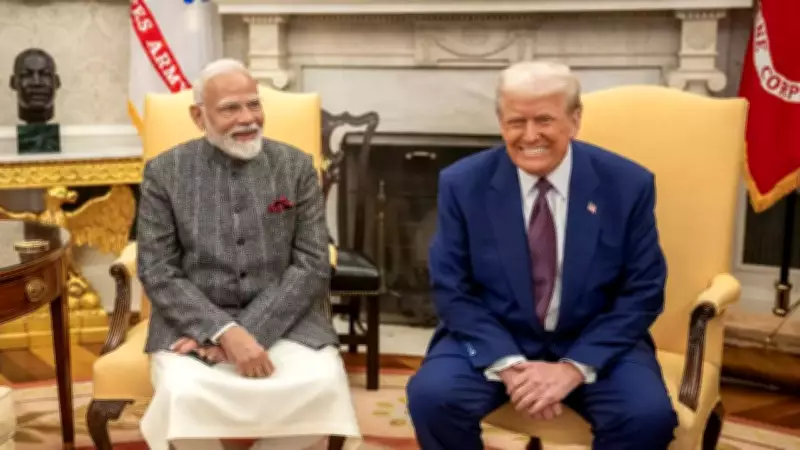
Trump and Modi Announce Surprise US-India Trade Deal with Major Tariff Reductions
In a stunning diplomatic development, US President Donald Trump and Indian Prime Minister Narendra Modi announced a breakthrough trade agreement on February 2 that will significantly reduce tariffs on Indian goods entering the American market to 18%. This announcement marks a dramatic reversal in bilateral relations that had been under severe strain for most of the previous year, surprising observers and officials alike with its timing and substance.
From Tension to Breakthrough: The Rocky Path to Agreement
The relationship between India and the United States had deteriorated sharply after President Trump imposed steep tariffs on Indian goods in August, including a punitive 25% duty linked to India's purchases of Russian crude oil and military equipment. The situation worsened when Trump publicly criticized India as a "dead" economy, accused New Delhi of maintaining high tariffs, and claimed India was funding Russia's war in Ukraine through discounted oil purchases from Moscow.
Relations reached a particularly low point when Trump repeated claims about resolving India-Pakistan conflicts through tariffs—assertions strongly rejected by Indian officials. In a tense June phone call, Prime Minister Modi declined Trump's invitation to visit the White House, where the US president was hosting Pakistan's army chief at the time. Despite these significant challenges, New Delhi chose the path of negotiation rather than confrontation.

Behind the Scenes: Doval's Crucial Washington Mission
In early September, shortly after Prime Minister Modi's notable meeting with Russian President Vladimir Putin and Chinese President Xi Jinping, National Security Adviser Ajit Doval traveled to Washington with a clear diplomatic mission. According to officials familiar with the discussions, Doval met with US Secretary of State Marco Rubio with a dual message: India wanted to move past recent acrimony and return to trade negotiations, but would not respond to pressure tactics.
"India wouldn't be bullied by US President Donald Trump and his top aides," Doval reportedly told Rubio, adding that New Delhi was prepared to wait out Trump's term if necessary, having dealt with hostile US administrations in the past. However, Doval also emphasized that public criticism from US leadership needed to decrease for relations to improve, giving India space to engage constructively without domestic political complications.
The Turning Point and Diplomatic Thaw
Doval's previously unreported meeting marked a significant turning point in the relationship. Shortly after his visit, tensions began to ease, with President Trump calling Prime Minister Modi on his birthday in September and praising him for doing a "tremendous job." By year's end, the two leaders had spoken four more times by phone, gradually rebuilding trust and momentum toward a comprehensive agreement.
A further diplomatic thaw occurred with the arrival of new US Ambassador Sergio Gor in New Delhi in December. A former senior White House official and close associate of both Trump and Rubio, Gor publicly emphasized the importance of India-US ties, describing tensions as disagreements among "real friends" that would be resolved. His recent meeting with External Affairs Minister S. Jaishankar focused on defense, trade, critical minerals, and common interests.
The February 2 Announcement: Details and Implications
On February 2, President Trump announced the trade agreement with Prime Minister Modi, confirming that tariffs on Indian goods would be reduced to 18%—lower than those faced by most Asian trading partners. The punitive 25% duty imposed on India for purchasing Russian oil would be scrapped entirely. In return, India agreed to purchase $500 billion worth of US goods, reduce tariffs and non-tariff barriers on American imports to zero, and shift some oil purchases to Venezuela.
"This development is significantly positive for Indian equities," said Nisha Biswal, partner at The Asia Group and former US Assistant Secretary of State for South and Central Asian Affairs. "The past year has been one where negotiators, both in the US and India worked feverishly to get us to this point. The deal reflects India finally opening up more decisively to global trade."

Strategic Calculations and Long-Term Vision
Indian policymakers remain acutely aware of broader strategic considerations. The prevailing view in New Delhi recognizes that India needs US capital, technology, and military cooperation to counter China and achieve Prime Minister Modi's goal of transforming India into a developed economy by 2047. From this perspective, Trump's presidency was viewed as a temporary disruption rather than a fundamental shift in the relationship.
"New Delhi was never going to sever relations with Washington following last year's downturn in bilateral relations," noted Chietigj Bajpaee, senior research fellow for South Asia at Chatham House. "India-US relations remain 'sticky' given the plethora of institutionalized and people-to-people linkages between both countries."
Diversification and Strategic Autonomy
Despite the renewed engagement with Washington, India continues to pursue strategic autonomy and diversify its partnerships. Prime Minister Modi's highly publicized interactions with Xi and Putin—including images of the three leaders clasping hands—were intended to signal that India maintains multiple options. New Delhi also hosted Putin in December, highlighting a relationship that remains vital for defense supplies and diplomatic support.
In parallel, India has aggressively expanded its trade partnerships, finalizing a free trade agreement with the European Union after nearly two decades of negotiations, following a similar deal with the UK. Later this month, Modi is set to host leaders from Canada and Brazil, further deepening ties with middle-power economies.
Why the United States Remains Indispensable
Despite this diversification, the United States remains crucial to India's economic and strategic interests. India sends approximately one-fifth of its exports to the US, including significant shares of mobile phones and electronic goods. American companies have announced major investment commitments in India, particularly in artificial intelligence and advanced manufacturing sectors.
"The larger geopolitical factors or strategic factors that bind India and the US together are still in place," observed Milan Vaishnav, director of the South Asia Program at the Carnegie Endowment for International Peace. "India requires a great amount of capital, of investment, of technology transfer. So the US is critical."
Conclusion: Engagement Without Submission
The India-US trade breakthrough represents a significant reset after months of tension, achieved not through confrontation but through calibrated diplomacy and quiet negotiation. While challenges remain—including unresolved concerns over Russian oil purchases and agricultural market access—the agreement underscores India's ability to push back diplomatically while keeping long-term strategic priorities intact.
For New Delhi, the message emerging from this episode is clear: engagement without submission, and partnership without pressure. The deal demonstrates that even amid significant disagreements, both nations recognize the fundamental importance of their relationship and are willing to navigate complex diplomatic waters to preserve and strengthen their strategic partnership for mutual benefit.





