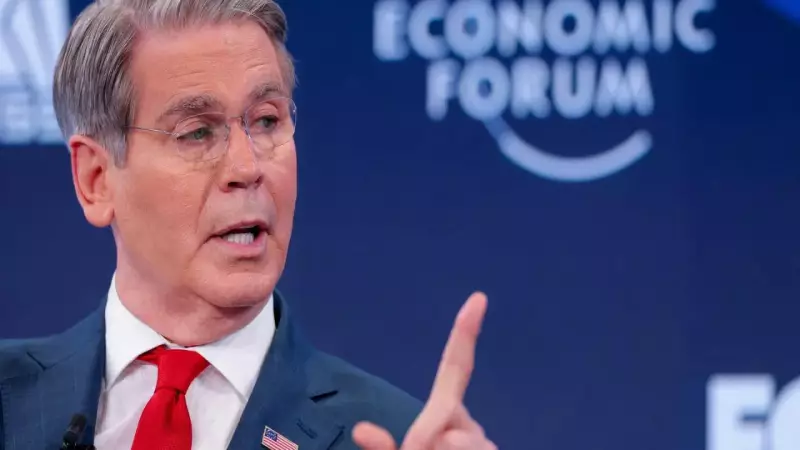
In a significant development that could reshape international trade dynamics, US Treasury Secretary Scott Bessent has signaled a prospective removal of the 25% penalty tariffs imposed on India for its purchase of Russian oil. The announcement came during remarks at the World Economic Forum in Davos, where Bessent highlighted what he termed as a "success" in Washington's pressure tactics while simultaneously expressing disapproval of the European Union's approach to trade with New Delhi.
US Pressure Tactics Yield Results
Bessent revealed that the imposition of tariffs has led to a substantial reduction in India's purchases of Russian oil by its refineries. "We put 25% tariffs on India for buying Russian oil, and the Indian purchases by their refineries of Russian oil have collapsed. So that is a success," Bessent stated. He further explained, "The tariffs are still on. I would imagine there is a path to take them off, so that's a check and a huge success."
Dramatic Reduction in Russian Oil Imports
The Treasury Secretary provided specific data to illustrate the impact of US pressure. Before Russia's invasion of Ukraine, Moscow supplied only 2-3% of India's oil requirements. This percentage rose significantly into the high teens following the conflict but has now declined substantially due to US-imposed tariffs. According to some estimates, India has experienced a 29% month-on-month reduction in Russian crude imports, bringing them down to their lowest levels since 2022, though not reaching zero.

Contrasting Approaches: US vs EU
Bessent sharply contrasted the US approach with that of Europe, criticizing the European Union for not imposing similar tariffs on New Delhi. He pointed out that instead of penalizing India, the EU has been purchasing refined Russian oil products from India, which he characterized as an "ultimate act of irony and stupidity" for indirectly funding Moscow's war effort through these transactions.
Criticism and Context
Some critics have noted that the United States itself continued purchasing Russian uranium until very recently. Additionally, the Trump administration's perceived deference toward Russia regarding the Ukraine conflict has been highlighted as not contributing to ending the war. These factors add complexity to the US position on trade sanctions and energy policies.
EU-India Free Trade Agreement Looms
Bessent's remarks come at a crucial time when the European Union and India are on the verge of concluding a free trade agreement that has been in negotiation for nearly two decades. This development appears to have irked Washington, which has been vocal about what it perceives as unfair trade practices globally, claiming the US has been "ripped off" in international trade arrangements.
Broader Trade Tensions
In a separate but related development, President Trump has lashed out at Canada for its recent trade deals with China, threatening to impose 100% tariffs against Ottawa. The President accused Canada of transforming itself into a "drop-off port" for channeling Chinese goods into the United States, highlighting the broader context of global trade tensions.
US-India Trade Deal Complications
While Bessent held out the possibility of removing Russian oil tariffs on India, his colleague Commerce Secretary Howard Lutnick suggested last week that the US-India trade deal negotiations have been stalled because Prime Minister Narendra Modi has not personally called President Trump to discuss the matter.
Indian Government's Response
New Delhi has firmly rejected this claim, stating that Prime Minister Modi has spoken with President Trump at least three or four times since taking office to discuss a wide range of bilateral issues. The Indian side acknowledged that the Prime Minister did not delve into the specific details of the trade deal, explaining that under the Indian governmental system, such negotiations fall within the remit of officials rather than the Prime Minister personally.
Indian officials clarified that Prime Minister Modi would be happy to call President Trump once the trade deal is successfully concluded. However, they refrained from providing any specific timeline for when such a conclusion might occur, indicating that negotiations continue to address remaining gaps between the two nations.

The evolving situation reflects the complex interplay of energy security, trade diplomacy, and geopolitical considerations that characterize contemporary international relations. As India navigates its relationships with major global powers, the potential removal of US tariffs could signal a new phase in bilateral cooperation while highlighting ongoing tensions in the global trade landscape.