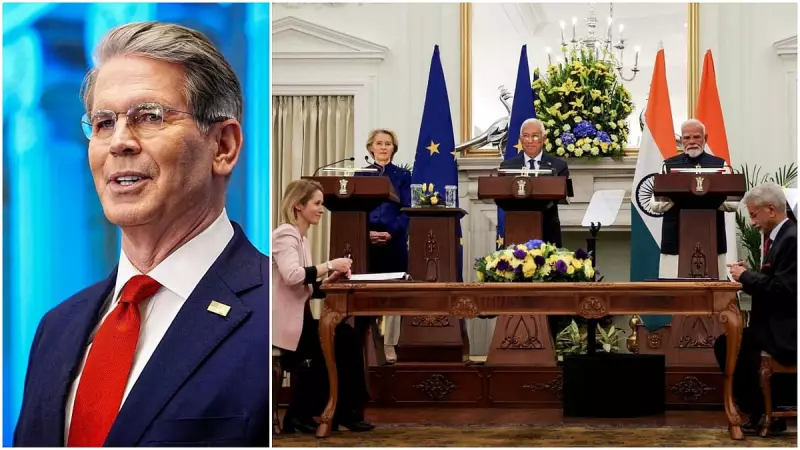
US Treasury Secretary Voices Disappointment Over EU-India Trade Agreement
In a significant development in international trade relations, US Treasury Secretary Scott Bessent has expressed his disappointment regarding the recent trade deal between the European Union and India. This statement comes amid ongoing global economic tensions and strategic realignments.
Concerns Over European Stance on Tariffs
Secretary Bessent pointed out that the EU-India agreement clearly illustrates why Brussels hesitated to join Washington's decision last year to impose substantial 25% tariffs on India. This move was part of a broader US initiative aimed at reducing India's purchases of Russian oil, a key geopolitical objective in the current global landscape.
The US had implemented these tariffs as a strategic push to curb India's reliance on Russian energy sources, reflecting ongoing efforts to isolate Russia economically following recent conflicts. Bessent's remarks underscore the divergence in approaches between the United States and the European Union on how to address trade and energy security issues with India.

Call for South Korea to Ratify Trade Deal
In addition to his criticism of the EU-India pact, Secretary Bessent emphasized the importance of South Korea ratifying its own trade deal. This call to action highlights the US administration's focus on strengthening trade partnerships in the Asia-Pacific region, particularly with key allies like South Korea.
The urgency for South Korea to move forward with ratification is seen as crucial for enhancing economic cooperation and aligning trade policies amidst growing global competition. Bessent's dual focus on both the EU-India deal and the South Korean ratification underscores the interconnected nature of international trade agreements and their impact on US foreign policy objectives.
Implications for Global Trade Dynamics
The Treasury Secretary's comments reveal deeper layers of complexity in global trade negotiations:
- The EU's reluctance to impose tariffs on India may signal a more cautious or independent trade strategy compared to the US.
- India's continued purchases of Russian oil remain a point of contention, affecting its trade relations with Western nations.
- South Korea's pending trade deal ratification is now under increased scrutiny, with potential implications for US-Korea economic ties.
These developments occur against a backdrop of shifting alliances and economic pressures, where trade deals are increasingly used as tools of diplomatic and strategic influence. Bessent's disappointment reflects broader US concerns about maintaining cohesive international efforts on trade and energy policies.
As global economies navigate these challenges, the responses from the European Union, India, and South Korea will be closely watched. The outcome could shape future trade negotiations and the balance of power in international economic forums.