West Asia Conflict Triggers LPG Crisis in Bihar's Food Sector
The escalating conflict in West Asia is now directly impacting the food economy of Bihar, with hotels, restaurants, and street vendors across the state facing a severe shortage of commercial LPG cylinders. This disruption in supply chains, linked to geopolitical tensions, has led to immediate economic consequences for local businesses and consumers alike.
Sharp Price Increases and Menu Revisions
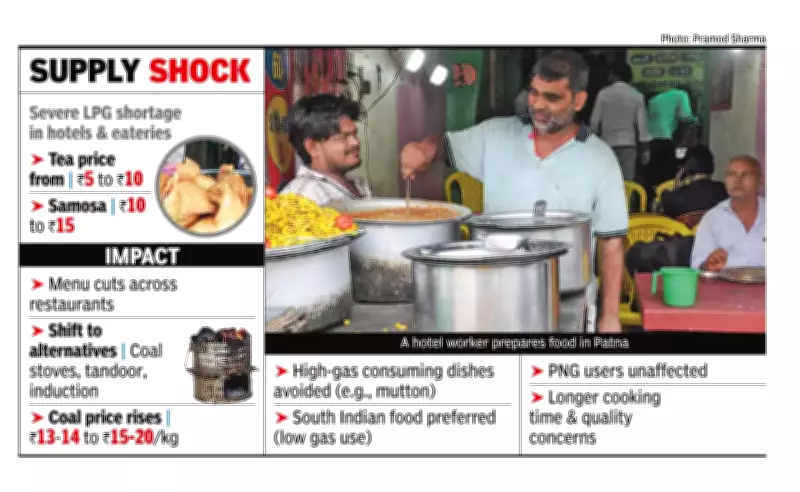
The acute shortage has triggered a dramatic rise in prices for everyday food items. A cup of tea that previously cost Rs 5 is now being sold at Rs 10, while samosas have increased from Rs 10 to Rs 15. Across Patna, eateries are being forced to revise their menus and adopt alternative cooking methods to cope with the crisis.
Establishments are increasingly turning to tandoors, induction stoves, and coal-based cooking as substitutes for LPG. Some have completely switched to coal-fired stoves, though this raises significant concerns about food quality and longer preparation times. The shift is not merely operational but is reshaping how food is prepared and served in the region.

Hotel Industry Adapts Under Pressure
A manager of a prominent hotel near Gandhi Maidan, who requested anonymity, confirmed that LPG supply remains constrained. However, he noted that menu prices have not yet been revised, stating, "The government and district administration are handling the situation and ensuring supply." This suggests official efforts are underway to mitigate the impact.
Allen Christopher, vice-president of a hotel at Ramghulam Chowk, provided more detail on the adaptations. He explained that the district administration, led by DM Thiyagarajan S M, is extending support to tackle the crisis. "We are cutting down the menu and preparing dishes that require less gas. Earlier, our kitchen ran round the clock; now it operates only till midnight. We are increasingly using tandoor and induction to save LPG," he said.
Christopher added that fuel-intensive dishes like mutton are currently being avoided. "Earlier, we used to get around 12 cylinders a day; now it has dropped to four to five. We are preparing food strictly as per demand," he emphasized, highlighting the severe reduction in supply.
Widespread Shift to Alternative Cooking Methods
Several restaurants have shifted to coal-based cooking, which is cheaper but slower and more labour-intensive, according to Ranveer, a restaurant owner near Patna Junction. This transition is not without its challenges, as it affects efficiency and customer service.
Sameer Ranjan, manager of a popular sweets and vegetarian outlet on Boring Road, offered a contrasting perspective. He noted that establishments with PNG (Piped Natural Gas) connections are relatively unaffected. "Our pipeline gas supply is stable, so prices remain unchanged," he said, indicating a divide in how different businesses are experiencing the crisis.
Forced Innovations and Customer Impact
The crisis has forced many food operators to innovate and adapt rapidly. Some are preparing biryani and snacks on coal and wood-fired stoves, while others are switching to South Indian dishes that consume less gas. Ravi Sharma, a restaurant manager in Patliputra, stated, "For now, we are serving only South Indian food. We will resume the full menu once the situation improves."
Rajesh Kumar, who runs a snacks outlet in Ashiana Nagar, reported that commercial cylinders are completely unavailable. "We are making samosas and sweets on coal stoves. Even coal prices have risen from Rs 13-14 per kg to Rs 15-20 per kg," he said, illustrating how the shortage is driving up costs across alternative fuel sources as well.
Pushpendra Kumar, a restaurant owner in Raja Bazar, highlighted the operational challenges. He said the increased use of induction and coal has extended service times, negatively affecting customer experience. This underscores the broader implications of the LPG shortage on business viability and consumer satisfaction.
The situation in Bihar reflects how global conflicts can have localized economic impacts, disrupting daily life and business operations. As the West Asia conflict continues, the food economy in Patna and beyond remains under strain, with businesses navigating uncertainty through adaptation and resilience.