

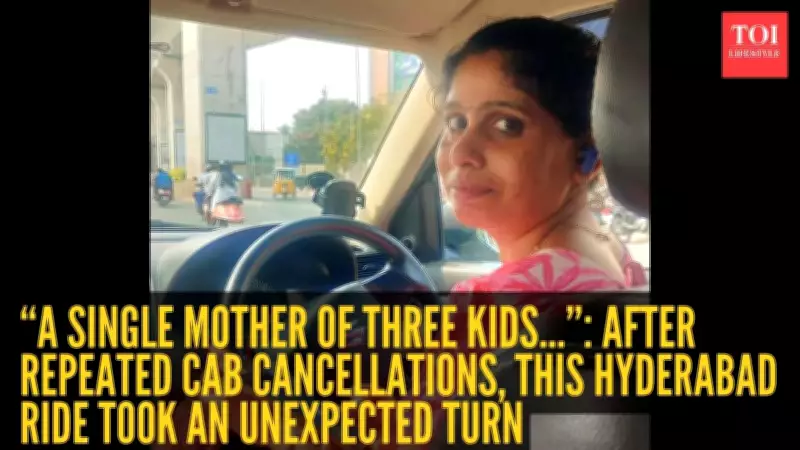
If you have ever attempted to book a cab in a bustling city like Hyderabad, you are likely familiar with the routine. You wait patiently, only to have one driver cancel, followed by another. Just as you are on the verge of giving up, a driver finally accepts your request. However, in a recent instance, the screen displayed something out of the ordinary—the driver was a woman.
The Viral Moment That Captured Attention
Suresh Kochattil later shared this experience online, detailing his encounter with Nandini, an Uber driver who has been working on the platform for approximately a year. Originally from Vijayawada, she relocated to Hyderabad and is independently raising three children. According to Kochattil, Nandini explained that driving helps her cover their educational expenses.
The post quickly gained traction, with many users labeling it as inspiring. Some applauded her determination and resilience, while others framed it as a heartwarming narrative of women breaking through traditional barriers. Yet, as the story spread across social media platforms, it prompted a more subdued inquiry: why does something so commonplace feel so astonishing?

When Ordinary Still Seems Exceptional
In urban centers across India, women are employed in various sectors such as offices, hospitals, schools, and retail stores. However, in occupations that involve extended hours on the road, like cab driving or delivery services, their presence remains limited. Consequently, when a woman does appear in such a role, it often feels remarkable. The ride itself was uneventful—no dramatic incidents or viral altercations, just a woman performing her job. Nonetheless, this simplicity was sufficient to propel the story into the viral spotlight.
This phenomenon underscores how certain types of work continue to be subtly perceived as men's jobs, highlighting persistent societal norms and biases.
Insights from Statistical Trends
Women are gradually entering the workforce, with much of this growth occurring through flexible and informal employment avenues, including small enterprises, self-employment, and app-based gigs. The gig economy has experienced a significant surge in recent years, offering many women an accessible entry point when traditional office positions are not readily available. The ability to adjust working hours and lower entry barriers makes these platforms appealing.
For numerous women, this is not necessarily a dream career but a pragmatic decision driven by necessity and circumstance.
Flexibility Comes with Its Own Challenges
While flexibility is a key advantage, it is accompanied by considerable drawbacks. Most gig workers lack fixed salaries, paid leave, or long-term job security. Their earnings fluctuate based on factors like ride availability, customer ratings, and evolving app policies. This type of work sustains them but seldom provides relaxation or stability.
Women, in particular, face additional hurdles, including safety concerns, lengthy shifts, family responsibilities, and financial pressures, all of which compound the difficulties of gig employment.
The Unseen Labor Behind the Scenes
A substantial amount of labor remains invisible, as women disproportionately shoulder unpaid care work such as cooking, cleaning, and caring for children or elderly relatives. This unpaid burden significantly influences the types of jobs they can undertake and the duration they can commit to external employment.
Thus, when women opt for flexible work arrangements, it is often not due to ideal conditions but because these jobs accommodate responsibilities that are frequently overlooked in employment statistics and media coverage.
Why This Particular Ride Resonated Widely
Millions of women across India are engaged in informal and app-based jobs daily, yet most of their stories do not achieve viral status. When one does, it typically aligns with a familiar narrative arc—highlighting struggle, courage, and solitary perseverance. While these stories are important, they risk simplifying complex, messy realities into tidy inspirational snippets that are quickly scrolled past and forgotten.

Progress Amid Persistent Disparities
There is undeniable progress, with increased government schemes, more digital platforms, and greater discourse on skill development and employment opportunities. However, access to fundamental resources like childcare, safe transportation, healthcare, and affordable loans continues to determine who can participate in the workforce and who cannot.
Therefore, while advancements are being made, they are uneven and gradual, leaving many behind in the process.
Looking Beyond a Single Uber Ride
Nandini's story, encapsulated in a brief online post, mirrors broader societal shifts: individuals migrating to cities for work, families grappling with escalating living costs, and workers prioritizing flexibility over security due to limited alternatives. These dynamics unfold quietly every day, often escaping public notice.
The buzz surrounding this Uber ride serves as a poignant reminder of how infrequently we pause to acknowledge these everyday realities. Perhaps genuine change will be realized when the sight of a woman behind the wheel no longer elicits surprise.
Disclaimer: The details regarding Nandini are derived from a social media post and have not been independently verified by The Times of India.





