CBSE Implements On-Screen Marking for Class 12 Board Exams
The Central Board of Secondary Education (CBSE) has issued a crucial circular ahead of the upcoming board examinations, announcing a significant shift in the evaluation methodology for Class 12. According to the directive, the assessment for Class 12 will now be conducted through the on-screen marking (OSM) system, while Class 10 evaluation will continue to follow the traditional manual system.
Examination Schedule and Infrastructure Requirements
The CBSE Class 10 and 12 board exams are scheduled to commence on February 17. The Class 10 examinations will conclude on March 11, whereas the Class 12 exams are set to end on April 10. In preparation for the new on-screen marking system, affiliated schools have received detailed guidelines mandating specific infrastructure upgrades.
Schools are required to ensure the availability of a fully equipped computer lab, the latest internet browser, and a dedicated reader. Additionally, institutions must guarantee robust internet connectivity and an uninterrupted power supply to facilitate the seamless operation of the online evaluation process.

Mixed Reactions from School Principals
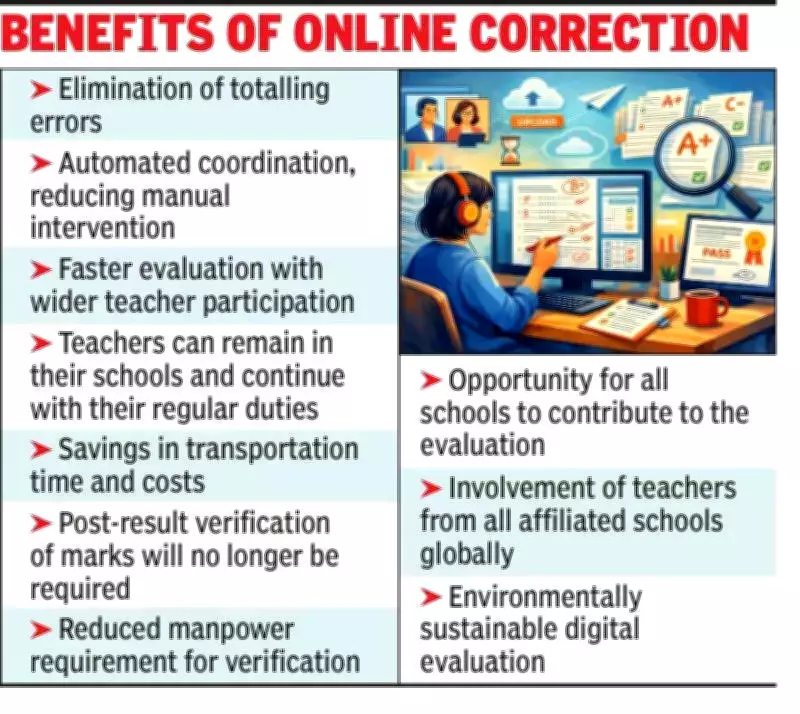
The introduction of the on-screen marking system has elicited varied responses from school principals across the country. While the CBSE asserts that this method will accelerate the evaluation process and minimize errors, several educational leaders have voiced concerns regarding the limited preparation time.
Vijaylaxmi Kumar, Principal of G D Goenka Public School in Dakshineswar, expressed a positive outlook, stating, "We are collaborating with an ever-evolving and dynamic Board, and it is imperative that we upgrade ourselves with time. If a school possesses the necessary infrastructure and a team ready to embrace new changes, adaptation is feasible. Our school is well-equipped, and we view this as a matter of training, approaching it with a very positive spirit."
Arun Dasgupta, Principal of Bhavan's GKV School, highlighted the potential benefits of the system, noting, "Implementing this system will conserve time, financial resources, and manpower. The automated system will handle addition and verification of question checking, thereby reducing errors and optimizing efficiency. However, there will be challenges as the system is novel and requires learning and adaptation. Despite initial hurdles, online correction is not unprecedented, as numerous colleges and universities nationwide already employ similar methods."
Operational Changes in Evaluation Process
Previously, answer sheets were physically transported from examination centers to regional offices and subsequently dispatched to correction centers for manual evaluation. Under the new framework, instead of sending physical copies, scanned versions of the answer sheets will be uploaded to an online platform. Teachers will then assess and mark these digital copies remotely, streamlining the entire evaluation workflow.
Concerns Over Infrastructure and Training
Despite the anticipated advantages, some educators have raised apprehensions regarding the practical implementation of the on-screen marking system. Satabdi Bhattacharjee, Principal of The Newtown School, remarked, "Had the Board notified us earlier, teachers would have had ample time to practice and familiarize themselves with the system. However, with examinations imminent, educators have minimal time to acquaint themselves, even though meticulous evaluation is paramount."
Furthermore, numerous principals have pointed out that many schools currently lack the requisite infrastructure, necessitating urgent upgrades to comply with the online system requirements. This has prompted institutions to undertake rapid development efforts to meet the stipulated standards before the evaluation period begins.
The transition to on-screen marking represents a pivotal step in modernizing the CBSE evaluation process, aiming to enhance accuracy and efficiency. However, the success of this initiative hinges on effective infrastructure deployment, comprehensive teacher training, and timely adaptation by all stakeholders involved.