The Intricate Journey of Exam Papers: From Secrecy to Suspected Leaks in Nagpur
When a Board question paper finally reaches a student inside the examination hall, it marks the culmination of a long, meticulously planned journey designed to preserve its utmost secrecy. However, incidents of alleged paper leaks are not uncommon, with the latest case emerging from Nagpur during the HSC physics and chemistry examinations.
The Secured Pathway of Question Papers
Determining at which precise point in this secured journey a paper gets leaked is currently a matter of police investigation. Past incidents, though, consistently indicate that the crime typically occurs after the paper arrives at the examination centre itself.
The question paper is always packed in sets, usually of 25 each, within a sealed envelope. It remains under 24x7 vigilant security at the board office before being transported to an undisclosed custody centre on the night prior to the exam. On average, one custody centre stores question papers for four to five examination centres, although this number can vary. Even at this stage, the papers are secured in a trunk under constant guard.

The Final Dispatch and Handover Protocol
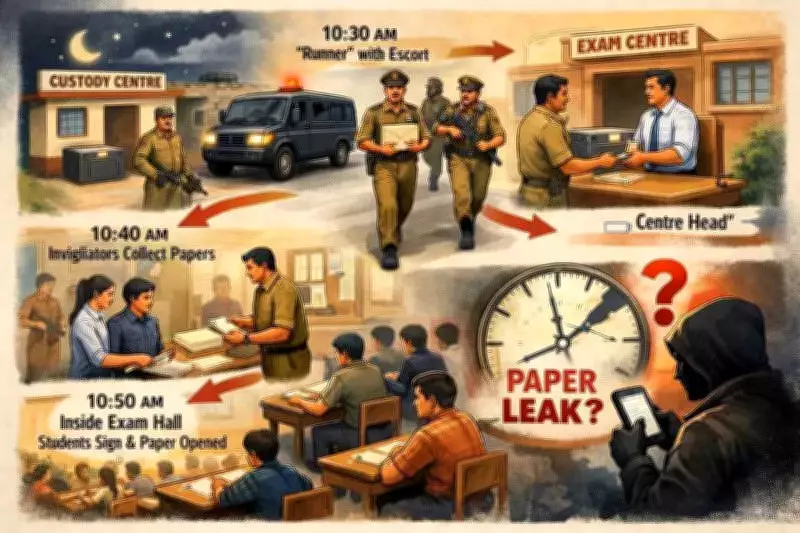
On the day of the examination, the papers are dispatched to the centres, which are typically schools or junior colleges. They arrive approximately 30 to 40 minutes before the exam commences. For instance, if the exam starts at 11:00 AM, the trunk containing the question paper is escorted to the centre by 10:30 AM.
This escort is led by an individual commonly referred to as a "runner," who hands over the trunk or sealed parcel to the head of the examination centre. All necessary checks are conducted during this handover to ensure there has been no tampering whatsoever.
Inside the Examination Hall: The Final Steps
The exam centre head then assumes responsibility, calling upon invigilators to collect the papers for distribution. This occurs around 10:40 AM, when each invigilator receives sealed envelopes one by one. For example, if there are 40 students in a particular room, two envelopes of 25 papers each are provided. At this juncture, the invigilator also verifies that they have received a completely sealed packet.
The invigilator subsequently enters the examination hall and summons any two students to the front. These students act as witnesses, confirming that the question paper is indeed in a sealed packet and signing documents to attest to this fact. Following this verification, the invigilator opens the envelope and distributes the question papers to the students.
This entire meticulous process typically brings the clock to around 10:50 AM or just a few minutes later. Over decades, the board has refined this system to function with clockwork precision, aiming to eliminate vulnerabilities.
Pinpointing the Breach: A Critical Investigation
Now, the pressing question arises: at which exact point did the paper get leaked? A former board official emphasized, "The timing of the leak is absolutely key. This narrows down the window of when the leak actually happened. If the paper was leaked a day before, then we know precisely where the paper was on its journey. I am confident the police will probe into these specific aspects and ultimately crack the case."
In response to the recent incident, board officials have initiated stricter implementation of envelope checks, ensuring there are no signs of tampering at any stage. This heightened vigilance underscores the ongoing challenge of maintaining paper security amidst evolving threats.