Aarav's Triumph: Battling Illness to Excel in Board Exams with Resilience
When Aarav first received his medical diagnosis, the full weight of the situation did not immediately sink in. This delay in comprehension, perhaps, is one of the peculiar mercies of childhood, where the mind does not rush to catastrophize with the urgency that adults often exhibit. "When I first learnt about my condition, I didn't think about it too much because at that time I didn't realise how serious it was," Aarav recalls. "After about two months of chemotherapy, I read about it and told myself it wasn't something I should be scared of. I even told my parents that I understood my condition."
A Mindset of Resilience and Hope
This resilient mindset consistently emerges throughout Aarav's narrative: absorb what is happening, refuse to collapse under pressure, and move forward one day at a time. "I kept a 'never lose hope, never give up' attitude," Aarav emphasizes. "I followed what my doctors and my parents told me, and that helped me in my recovery." He now reflects that the experience has fundamentally altered his outlook on both life and achievement. "Now, I look at life a little differently. I feel health is more important. Studies are important too, but for me, being healthy matters more." This statement, while seemingly simple, carries profound weight, born from the trials endured by his own body.
A Routine Built Around Treatment and Recovery
For many students, board exam preparation entails longer study hours, stricter schedules, and fewer distractions. For Aarav, it meant learning how to integrate academics into days largely dominated by medical treatment. "In the morning, I used to go for chemotherapy and physiotherapy," he explains. "By the time I came home, I would be quite tired, so I would take a nap. After that, there was often another physiotherapy session." This is not the typical timetable from which one expects a high board score to emerge, yet that is precisely what Aarav achieved.

Key to his success were flexibility, accommodation, and a school that understood that discipline is sometimes best preserved not through rigidity, but through compassion. "My teachers were very flexible with their timings," Aarav notes. "They would take classes whenever I was available—sometimes in the morning, sometimes in the afternoon, and even late at night. They cleared my doubts whenever I needed, even around 11 pm." The emotional impact of such unwavering support on a child striving to keep up with schoolwork while enduring intense physical challenges cannot be overstated.
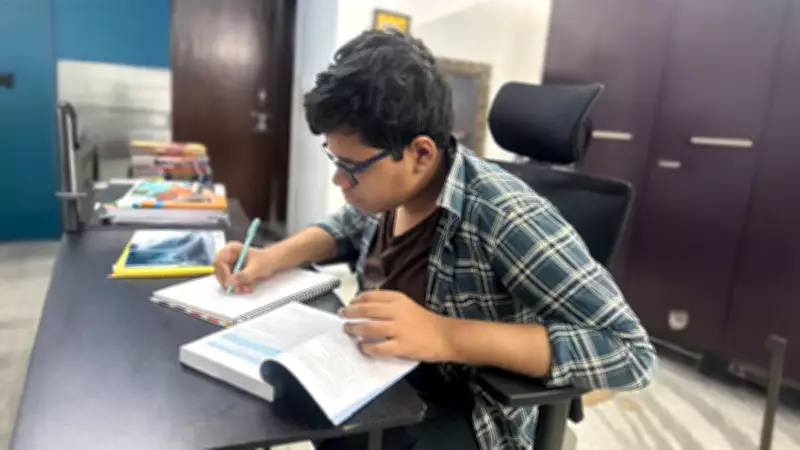
Aarav typically studied for around five to six hours daily—three to four hours through personalized classes with his teachers, and another two to three hours spent learning from textbooks, writing, and practicing questions. While this number might not seem extraordinary in India's competitive exam culture, the context transforms its significance. These were hours reclaimed from fatigue, recovery periods, travel for treatment, and the emotional toll of serious illness.
Adapting Study Strategies Amid Time Constraints
Illness not only reduced the quantity of time available to Aarav but also shaped the quality of his preparation. "In terms of studies, the biggest challenge was that I couldn't give as much time as I wanted because of chemotherapy and physiotherapy," Aarav admits. "I had to cover a large portion in a much shorter time and understand concepts quickly."
This emphasis on conceptual understanding became crucial as time grew scarce. "Since I didn't have enough time to memorise everything, I focused more on understanding the concepts. I also practised sample papers and the questions given by my teachers." Sample papers played a decisive role in addressing a practical difficulty: speed. "During my pre-boards and mid-term exams, my speed was quite slow, and I even had to leave some questions," he recalls. "My teachers advised me to focus on more sample papers, and that made a big difference. It helped improve my speed a lot. By the time I reached the board exams, I was able to attempt all the questions, and my speed was back to normal."

Notably, Aarav accomplished this without relying on conventional coaching systems. "I didn't really take any coaching or tuitions," he states. "My school supported me a lot, so I didn't feel the need for it." He utilized some YouTube videos and artificial intelligence to create practice tests and identify likely question types, but when discussing support, his focus consistently returns to people rather than tools. "AI may transform education, but it cannot replace teachers and their experience," Aarav asserts. Beyond the flexibility of teachers and the aid of technology, the true strength of his preparation lay in his approach to difficulty.
"Whenever I find a concept, subject, or chapter difficult, I try not to stress about it," he shares. "I take it line by line and understand it slowly. Instead of memorising definitions, I prefer to write things in my own words."
The People Who Provided Unwavering Support
In narratives of individual achievement, there is often a tendency to isolate the individual, making resilience appear self-generated. Aarav's account resists this myth, repeatedly highlighting the crucial role of others. "As a student, I would say I'm most influenced by my parents—my mother, my father—and also my brother and grandparents," he says. "My class teachers and the principal supported me a lot, so they've all had a strong influence on me." Behind his board exam success stands a family that avoided turning marks into an additional burden and a school that offered practical, sustained support rather than mere token sympathy.
One memory from school encapsulates this support vividly. After a prolonged absence due to chemotherapy, Aarav returned to class to find that his teachers and classmates had surprised him with letters. "I did not feel insecure or different from others," Aarav remembers. "In fact, they made me feel very comfortable and I realised that friends are very important in life." In a story filled with medical terms, schedules, and performance metrics, it is striking that a child, post-illness, was made to feel included in his everyday world.
Support extended beyond the classroom as well. "Whenever I was physically or mentally exhausted, I would talk to my friends," Aarav explains. "They always encouraged me and reassured me that everything would be all right. My class teachers also spoke to me during those difficult times." His parents, too, understood that recovery encompasses more than just medical treatment. "They made sure I stayed positive. They got me games, movies, and my mom gifted me an electric guitar. These helped me stay engaged and distracted in a positive way," Aarav says.
Their support went beyond maintaining cheerfulness during treatment or filling difficult days with distractions; it also involved alleviating academic pressure. In a country where board exams can transform homes into pressure chambers, Aarav's parents adopted a different approach. "They told me that I just needed to pass. In fact, my father even said that 33 per cent was enough," he recalls with a smile. Sometimes, it is the absence of excessive ambition that provides a child with the space to breathe and perform at their best.
Courage Derived from Personal Inspirations
Courage in Aarav's case does not stem solely from the people around him or the ordeal he endured. Some of it originates from the private worlds teenagers inhabit and the fictional figures who subtly teach perseverance. "As a person, I think I'm also influenced by the games I play and the characters in them," Aarav reveals. "For example, Leon Kennedy—he has this never-give-up attitude, and I really admire that. Characters from movies and games have influenced and have also kept me positive during this journey."
A Mind Inclined Toward the Stars
What prevents Aarav's story from becoming a single-note narrative of courage is that he does not emerge merely as 'the boy who battled cancer and topped exams.' He also appears distinctly as a student with evolving interests and a mind already leaning toward questions larger than the next exam. Before Class 8, biology was his favorite subject, but then physics took precedence. "This is a subject where you need to do a lot more than just memorizing," he observes. "You need to understand so many concepts."
He began reading about astronomy and space, physicists and their theories, and even research papers. In this transition from textbook learning to genuine curiosity, one can glimpse the ambition that now drives him: a future in astrophysics, potentially with organizations like ISRO or DRDO. "I enjoy learning about the universe," Aarav says. "So astrophysics feels like the right path for me."
A Redefined Perspective on Success
Aarav now articulates a definition of success that feels both earned and remarkably clear-eyed for someone his age. "I don't think success is ever just about marks," he states. "Skills matter a lot in life, and marks or degrees alone don't guarantee a successful career." He then adds the line that perhaps best encapsulates all he has experienced. "At the same time, health is a big part of life. If you're not healthy, nothing else really works."
For a boy who has learned, far earlier than most, the fragility of ordinary life, this is not merely the wisdom of a topper reflecting on success. It is the steadier, hard-won clarity of someone who has discovered that achievement holds little meaning if health, hope, and the determination to persevere are not intact. Aarav's journey exemplifies patience, discipline, and quiet strength, offering inspiration to all who face adversity.