Union Budget 2026: Essential Highlights for UPSC and Competitive Exams
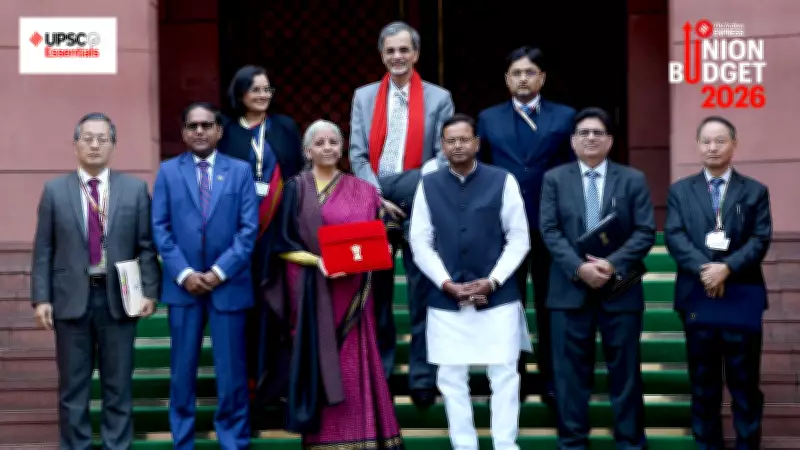
Union Finance Minister Nirmala Sitharaman presented the Union Budget 2026-27 on Sunday, February 1, 2026, in the Lok Sabha, New Delhi. This budget, delivered on Magha Purnima and the birth anniversary of Guru Ravidas, marks Sitharaman's record ninth budget presentation. Notably, this is only the second time a budget has been presented on a Sunday, with the first being by Yashwant Sinha in 1999. The budget has been termed a 'Yuva Shakti Driven Budget,' emphasizing the government's commitment to focusing on the poor, underprivileged, and disadvantaged sections of society.
Overview of the Budget Structure
The Union Budget is a critical component of the syllabus for various competitive exams, including the UPSC Civil Services Examination. It is divided into two main parts: Part A provides an overview of the economy, government priorities, and major programs, while Part B deals with tax proposals and fiscal details. Understanding these sections is vital for aspirants aiming to excel in their exams.
Three Kartavyas: Core Duties of the Government
In her budget speech, Finance Minister Nirmala Sitharaman outlined three Kartavyas or duties that guided the budget preparation. These duties are designed to steer India towards sustainable growth and inclusive development.

- Accelerate and Sustain Economic Growth: This involves enhancing competitiveness and building resilience against global economic volatility.
- Fulfill Aspirations and Build Capacity: Aimed at empowering citizens to become strong partners in India's prosperity journey.
- Ensure Sab Ka Saath, Sab Ka Vikas: Focuses on equitable access to resources and opportunities for all families, communities, and regions.
First Kartavya: Accelerating Economic Growth
To boost economic growth, the budget proposes interventions in six key sectors. These include scaling up manufacturing in seven strategic sectors, rejuvenating legacy industrial clusters, creating champion MSMEs, enhancing infrastructure, ensuring long-term security, and developing city economic regions.
- Biopharma SHAKTI: A Rs 10,000 crore initiative over five years to establish India as a global bio-pharma manufacturing hub.
- India Semiconductor Mission 2.0: A renewed focus on semiconductor manufacturing to achieve technological self-reliance.
- Rare Earth Mineral Corridors: Dedicated corridors to be established in Odisha, Kerala, Andhra Pradesh, and Tamil Nadu for rare earth minerals.
- Infrastructure Development: Public capital expenditure increased to ₹12.2 lakh crore, with new initiatives like the Infrastructure Risk Guarantee Fund and dedicated freight corridors.
- Carbon Capture Utilization and Storage (CCUS): An outlay of Rs 20,000 crore over five years to combat climate change.
Second Kartavya: Fulfilling Aspirations and Building Capacity
This section focuses on leveraging the services sector to meet the aspirations of India's youth. Key announcements include:
- Education to Employment and Enterprise Committee: A high-powered committee to enhance the services sector, aiming for a 10% global share by 2047.
- Orange Economy: Content creator labs to be set up in 15,000 secondary schools and 500 colleges to boost the Animation, Visual effects, Gaming, and Comic (AVGC) sector.
- Ayurveda and Medical Tourism: Establishment of new All India Institutes of Ayurveda and regional medical hubs to promote medical tourism.
- Tourism and Sports: Initiatives like the National Institute of Hospitality and Khelo India Mission to enhance tourism and sports development.
Third Kartavya: Ensuring Inclusive Development
Aligned with the vision of Sabka Sath, Sabka Vikas, this Kartavya emphasizes inclusive growth through various schemes.

- Fisheries and Animal Husbandry: Integrated development of 500 reservoirs and Amrit Sarovars, along with support for high-value agriculture.
- Bharat-VISTAAR: A multilingual AI tool to integrate AgriStack portals and provide customized advisory support to farmers.
- Empowerment Initiatives: Schemes like Self-Help Entrepreneur (SHE) Marts and Divyangjan Kaushal Yojana to support women and persons with disabilities.
- Mental Health and Trauma Care: Establishment of NIMHANS-2 and upgrades to regional mental health institutes to improve healthcare access.
Part B: Fiscal Proposals and Economic Indicators
The budget outlines key fiscal targets and proposals for the financial year 2026-27.
- GDP Estimate: Projected at ₹393,00,393 crore, a 10% increase over the previous year.
- Fiscal Deficit: Estimated at 4.3% of GDP, with a debt-to-GDP ratio target of 55.6%.
- 16th Finance Commission Recommendations: Accepted, retaining the vertical devolution share at 41% and allocating Rs 1.4 lakh crore as grants to states.
- New Income Tax Act: Income Tax Act, 2025 to come into effect from April 1, 2026, with simplified rules and forms.
Brush Up the Basics: Understanding the Union Budget
For exam preparation, it is crucial to grasp fundamental concepts related to the Union Budget.
- Definition: The Union Budget, under Article 112 of the Constitution, is an annual financial statement detailing government revenues, expenditures, and borrowing.
- Key Documents: Includes the Annual Financial Statement, Demands for Grants, and Finance Bill, mandated by the Constitution and fiscal laws.
- Important Terms: Revenue Budget, Capital Budget, Fiscal Deficit, and Money Bill are essential for understanding budget mechanics.
- Finance Commission: A constitutional body that recommends tax devolution and grants to states, crucial for fiscal federalism.
This comprehensive overview of Union Budget 2026 highlights key points for UPSC and competitive exam aspirants, ensuring a thorough understanding of its implications for India's economic and social landscape.