AI Revolution Sparks Urgent Need for Linguists, But Gujarat Universities Face Enrollment Crisis
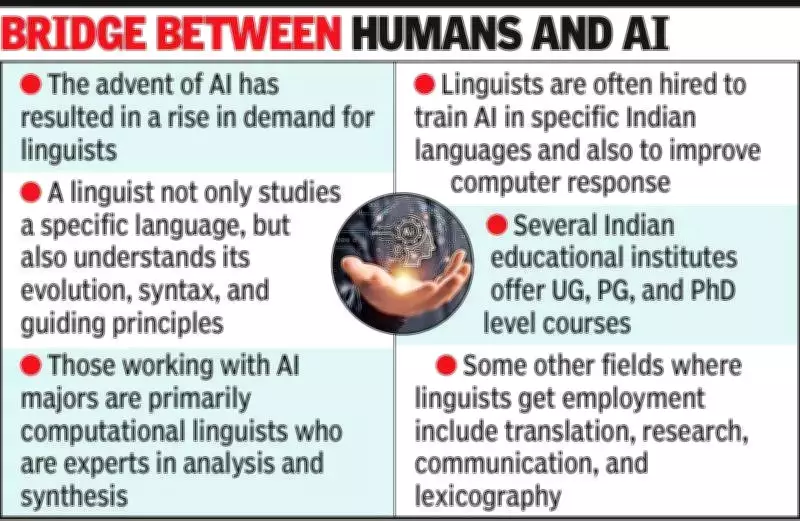
In the rapidly evolving world of artificial intelligence, the infinite power of technology risks being wasted on simple pronunciation errors, such as confusing "REF-yoos" (rubbish) with "re-FYOOZ" (to decline). This underscores a critical challenge: the AI revolution is creating an unprecedented demand for linguists to refine language models, yet the discipline of linguistics has long been dismissed as a career of the past with limited future prospects.
Current Crisis in Gujarat's Linguistics Departments
The urgency of this issue is starkly evident in Gujarat, where linguistics departments are struggling to attract students. At Gujarat University, the MA program in linguistics has 75 seats, but only four students are enrolled in the first year and one in the second year. The last permanent faculty member retired approximately five years ago, leaving two contract-based instructors to manage the course. Similarly, at MS University of Baroda, only 11 students opted for the undergraduate linguistics program against 30 available seats, and merely four chose the postgraduate course, which has a capacity of 40 seats.
Dr. Mona Parakh, an assistant professor in the linguistics department at MS University, emphasized the awareness gap. "Students are not aware of the immense potential that this discipline holds," she said. "There is a huge demand for linguistics, with inquiries coming annually from institutes in Bengaluru, Hyderabad, and other metros seeking experts." She added that the demand for Gujarati linguists is particularly on the rise, but a shortage of trained professionals persists.

Root Causes of the Shortage
Academics point to several factors contributing to this crisis. Linguistics is often not recognized for government teaching jobs at school or college levels, where qualifications like an MA in English, Hindi, or Gujarati are preferred. An educationist in Vadodara noted, "Most vacancies every year are for English teachers. But a candidate with a BA, MA, or PhD in linguistics is not considered eligible for those posts." This lack of job recognition discourages students from pursuing the subject, seeing little incentive in their career prospects.
Professor Jagdish Joshi, the in-charge head of the linguistics department at Gujarat University, attributed the situation to the law of demand and supply that existed before the AI era. However, the landscape is shifting rapidly with the tech wave.
AI's Dependence on Indian Languages and Linguists
At the recent AI Impact Summit in New Delhi, Indian innovators showcased products tailored for local users, with Large Language Models (LLMs) relying heavily on Hindi, Gujarati, Telugu, and other official Indian languages. As these languages gain prominence at the intersection of technology and culture, a new class of jobs for linguists has emerged. Some linguists are now collaborating closely with computer scientists to train LLMs in Indian languages, but the shortage of experts hampers progress.
Dr. Purvi Mehta, an English expert with the state government's higher education department and a Gujarati linguist at the International Institute of Information Technology, Hyderabad, has worked with international tech giants. She explained, "We have to explain the difference between language and linguistics not only to students but also to recruiters. If language is a body, linguistics can be compared to the skeleton, forming the basis for a language to function."
Glimmers of Hope and Future Prospects
Despite the challenges, there are signs of hope. Individuals passionate about language and computational science are finding opportunities at major tech companies. Shachi Sejpal, a linguistics graduate from Deccan College now working as a Gujarati linguist with Sarvam AI, highlighted the potential. "The field of AI is developing swiftly, and I believe there will be high demand for linguists—especially those who understand computational linguistics," she said. "Language is about patterns, and computers are adept at it. Humans, however, excel in grasping the cultural nuances that drive these patterns."

This synergy between human expertise and technological advancement is crucial for refining AI systems. The call to revitalize linguistics in universities is more urgent than ever, as the discipline holds the key to unlocking AI's full potential in a multilingual India.