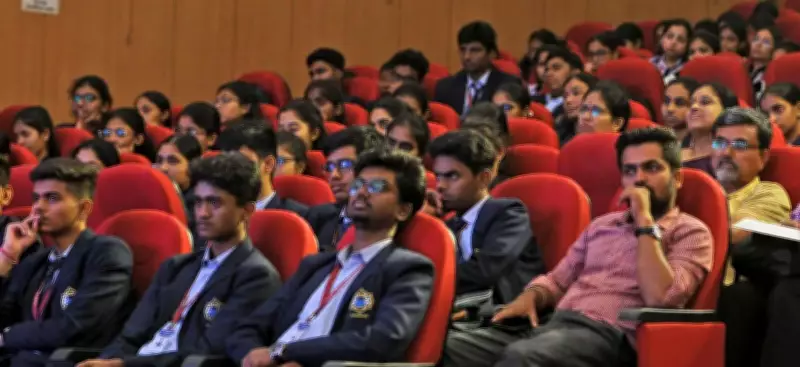
Hundreds of students on the verge of higher education participated in The Times of India's Mission Admission 2026, held at Jnana Jyoti Auditorium in central Bengaluru on Saturday. The event aimed to provide valuable insights before students make critical career-shaping decisions. Educationists, academicians, and industry experts engaged with students, parents, and teachers through panel discussions and presentations on key topics in higher education.
Inaugural Address and Advice
Mohammed Mohsin, additional chief secretary to the department of medical education, inaugurated the event. He urged students to utilize available resources and guidance. Mohsin advised students to conduct a SWOT analysis—assessing strengths, weaknesses, opportunities, and threats—before choosing career paths. "Do not go behind fancy titles. Choose a career path according to your natural talents and understanding the schedules and style of functioning that the job demands," he added. He also highlighted that a single notification on a mobile phone can disrupt three minutes of focus, advising students to limit gadget use. He recommended reading newspapers for at least 30 minutes daily, regardless of the field chosen.
Becoming AI Creators, Not Just Users
A panel discussion on 'How industry-ready is engineering education in Karnataka' featured Prof S Sadagopan, former director of the International Institute of Information Technology-Bangalore, moderating four senior academicians. Sadagopan advised students not to outsource decision-making to parents but to ask questions, explore, and engage in peer learning. He also urged parents to give children space and avoid living their dreams through them. With Artificial Intelligence (AI) dominating all fields, experts analyzed AI integration in education, particularly engineering. Students were encouraged to view AI as a collaborator rather than a threat.

Udayakumar Reddy, dean of the school of engineering at Dayananda Sagar University, stated: "Students need to move from being AI users to becoming builders of AI systems. Every student should learn to work with AI, know where it fails, and learn to evaluate it." He emphasized that AI is not the final decision-maker, so engineers must challenge it.
KN Subramanya, principal of RV College of Engineering, addressed curriculum changes due to AI and industry needs. "Though we have new branches like AI and ML, core branches also need attention. By providing minors and other courses, we have enabled students across branches to be AI-educated. There is also an AI component in every course," he said, adding that problem statements from companies are introduced to make students industry-ready.
Kiran Kumari Patil, director of innovations and deputy director at CMR School of Engineering and Technology, noted that the AI framework is being integrated into all streams. "Conventional streams are in for transformation. In future, we may use terms like intelligent structures for civil engineering or intelligent systems for electrical and electronic branches," she said.
Seshachalam D, professor and vice-principal (admin) at BMS College of Engineering, termed AI a big disruption. "We must gear up for AI as it has penetrated every branch of engineering and even fields like medicine. IT has reached every field. Since AI has disrupted IT itself, it has also reached every field," he said.
Combined Entry Option Not Happening: KEA
Following the recent cancellation of the National Eligibility-cum-Entrance Test (NEET), the Karnataka Examinations Authority (KEA) will not proceed with the combined option entry as in previous years, said Manjunatha R, joint controller of examinations and PRO at KEA, during Mission Admission. "As we cannot wait for NEET results, we will start option entry for engineering and take up medical option entry later," he said. However, he assured students that several rounds would still be available by the time NEET results are out. "Students who have opted for engineering but wish to switch to medical might still be able to do so as the rounds will still be in progress," he added.

Interdisciplinary Learning Should Complement Core Expertise
Experts at Mission Admission 2026 emphasized that while interdisciplinary learning is trending, strengthening one's core discipline remains crucial. They noted that a trans-disciplinary approach should not replace core disciplines, and the ideal approach is when learners are well-versed in their own discipline and can collaborate naturally with others.
A panel on 'Smart degree choices: How to match your degree with the current industry demand' featured five experts from diverse fields. The session, moderated by Nilisha Mohapatra, head of growth and partnerships at Teamlease, explored how latest trends in education, especially in non-engineering fields, require different professional personalities.
Chanakya University professor Nisshanth Kumar M discussed the type of worker needed in the current industrial setup. "The techno-humanist, who has the ability to interpret, contextualize, form judgments, and is culturally rooted, can manage to ride the tsunami of AI," he said. Kumar also highlighted opportunities in Indian languages. "If data is the new gold, Indian language data is diamond. There is a huge opportunity in this space," he said.
Harold Fernandes, product management expert at BITS Pilani Digital, stressed the importance of AI education. "AI is not just technology, it is like literacy. It is now ubiquitous. Everyone needs to be educated to use AI at least as a tool," he said, pointing out AI's role in blurring borders between disciplines.
Dinesh Nilkant, provost of Presidency University, revealed that syllabus revisions in universities are slower than industry changes. "We must develop our capabilities of teaching AI and ML, and managements must invest in this," he said.
AV Arun Kumar, professor and director at IFIM Institutions, noted that the banking, financial services, and insurance (BFSI) sector is a top employer. He stressed continuous skill acquisition throughout one's career. "A simple degree is insufficient. What determines one's career today are the skills acquired and demonstrated continually," he said.
Harold Andrew Patrick, professor and director at Alliance University, said career path choice is about future-relevant fields, not just degree demand. "As AI becomes more powerful, human-centric skills are becoming more crucial. Graduates in disciplines like psychology, economics, political science, public policy, and communication are being employed on a greater scale," he said. Regarding interdisciplinary approaches, Patrick noted that more successful careers will belong to people who can connect disciplines.
Key ComedK Aspects Highlighted
Gururaj Bhat, joint secretary of ComedK, explained features of the ComedK route to engineering and medical admissions. He stated that 43,071 applications to ComedK 2026 were received from Karnataka-based students, and 87,549 from outside the state. "Unlike K-CET, ComedK will not consider 12th or PU exam scores in calculating ranks," he said. However, the NEET exam will be the sole basis for merit determination for medical and dental admissions, he added.