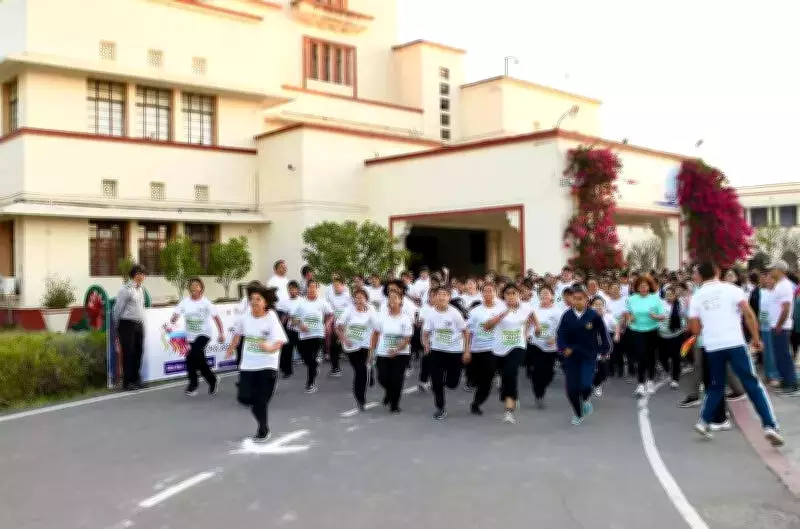
Bengaluru Students Turn Classroom Theory into Social Impact with Rs 65 Lakh Marathon
In a powerful demonstration of applied learning, students from three management institutions in Bengaluru have successfully raised approximately Rs 65 lakh through Kanyathon, a student-driven marathon held last week. This initiative is dedicated to supporting the education of nearly 1,000 government school students, primarily girls, by providing essential resources and supplementary learning programs.
Kanyathon: A Curriculum-Integrated Social Enterprise
Kanyathon is a robust social impact initiative spearheaded by students from the Jagdish Sheth School of Management, IFIM College, IFIM College of Law, and Vijaybhoomi University. The marathon, which attracted nearly 10,000 running enthusiasts, was meticulously organized in Electronics City. Funding was strategically sourced by students from leading corporates including Wipro, HP, Biocon, Deutsche Bank, Infosys, and Siemens, showcasing their prowess in corporate engagement and fundraising.
Over the past six years, Kanyathon has cumulatively raised about Rs 3.1 crore, establishing itself as a sustainable model for student-led philanthropy. The funds have enabled the creation of nine Kanyathon Shiksha Kendras, which supplement the education of 1,000 government school-going girls. These centers focus on building a solid foundation in English, enhancing digital literacy, and promoting health and hygiene awareness. A critical component of the program is menstrual health education, providing girls with knowledge and access to feminine hygiene products, addressing a vital yet often overlooked aspect of their well-being.

Academic Credits and Real-World Business Experience
This fundraising event serves as a practical application of management lessons learned on campus. "It is fully integrated into the university curriculum," explained Kalpana Padode, governing board member of Vijaybhoomi University and the visionary behind Kanyathon. "Students earn academic credits and develop practical skills as they manage the event, applying classroom theories in areas such as organisational leadership, project management, human resources, and finance."
Structured to mirror a corporate entity, Kanyathon features designated roles including president, vice president, marketing head, operations manager, and finance head. This setup provides students with hands-on experience in real-world business settings, preparing them for future professional challenges. Planning for the event begins in November, involving around 2,000 students. By January, participants transition from classrooms to full-time project work, immersing themselves in the operational aspects of the marathon.
Student Insights: Lessons in People Management and Creativity
Naomi Bhowmick, a PG diploma in management student from JAGSoM, highlighted the interpersonal skills gained: "One of the most prominent lessons is in people management. We meet a wide range of people — from common participants to senior corporates — everyone comes with different sets of expectations and temperaments."
She elaborated on the corporate pitching process: "We strongly believe in the cause. We pitch to the corporates and try to convince them with the impact and the scale at which it is happening. We engage them with stories of how it changed lives. Once they are convinced, we change the conversation to how they want to invest."
Ruchika Goel, another student, shared an anecdote about creative problem-solving: "We once went to Church Street for a sales drive. Some students stood on the pavement, frozen. People got curious, came up to us, and asked about the event. So it was a class for us to get our creativity out too." This experience underscores how Kanyathon fosters not only managerial acumen but also innovative thinking and adaptability in dynamic environments.
The success of Kanyathon exemplifies how academic institutions can bridge the gap between theoretical education and tangible social impact, empowering students to drive meaningful change while honing essential career skills.