Union Budget 2026-27: Healthcare Education Takes Center Stage with Major Expansions
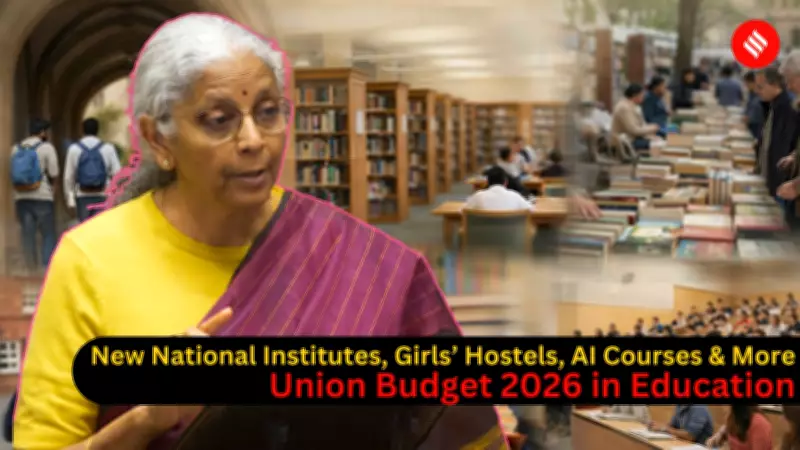
The Union Finance Minister presented the Budget for 2026-27 on Tuesday, placing a strong emphasis on medical and health education as a cornerstone of India's services-led growth strategy. This comprehensive plan includes significant investments in new institutes, upgraded facilities, and large-scale skilling initiatives to address critical gaps in the healthcare sector.
Pharmaceutical and Clinical Training Boost
At the core of the announcements is a ₹10,000-crore bio-pharma sectoral development outlay, designed to strengthen pharmaceutical education, clinical training, and research ecosystems. The government has proposed establishing three new National Institutes of Pharmaceutical Education and Research (NIPERs), increasing the total to ten. Additionally, seven existing NIPERs will undergo upgrades to enhance advanced training, research capacity, and industry linkages.
A nationwide network of accredited clinical facilities is also planned to address long-standing gaps in hands-on clinical exposure and translational research within medical and pharma education. This initiative aims to create a robust pipeline of skilled professionals ready to meet evolving healthcare demands.

Focus on Traditional Medicine and Mental Health
Traditional systems of medicine and mental health education have received substantial attention in this budget. The government will set up three new All India Institutes of Ayurveda, aimed at producing a larger pool of skilled personnel in Ayurvedic practices. In mental healthcare, a second NIMHANS-like national institute will be established in north India, while the existing mental health institute in Ranchi will be upgraded to improve services and training capabilities.
Expanding Allied Health Professional Education
The budget outlines a structured expansion of Allied Health Professional (AHP) education across ten selected disciplines, including optometry, anaesthesia technology, applied psychology, and behavioural health. Over the next five years, the government plans to train one-lakh AHPs to address critical shortages in hospitals and community health systems. Complementing this is a proposal to build a strong geriatric and long-term care ecosystem, with a target of training 1.5 lakh multi-skilled caregivers, including wellness and yoga practitioners.
Skilling Initiatives for Smaller Cities and Corporate Support
Beyond healthcare, the budget emphasizes short-cycle, practical skilling, particularly for smaller cities. Professional bodies such as ICAI, ICSI, and ICMAI will design short-term modular courses and practical toolkits to develop a new cadre of "corporate mitras". These programmes aim to support small businesses and enterprises in tier-2 and tier-3 cities by providing locally available professional support in accounting, compliance, and corporate governance.
Research, Employment, and Infrastructure Developments
Research and employment linkages feature prominently, with the Finance Minister referring to the Anusandhan Research Fund and announcing a high-powered education-to-employment standing committee. This committee will focus on employment generation, export of services and technologies, and the integration of AI-linked skills to align higher education with labour market demands.
In higher education infrastructure, a challenge-based model will support states in establishing five university townships in industrial and logistics hubs. These integrated clusters will host multiple universities, residential facilities, and shared research infrastructure to improve regional access to quality education.
Equity and Specialized Sector Initiatives
Equity-linked interventions include setting up one girls' hostel in every district, targeting regions with low female participation in STEM education. In creative and design sectors, the budget proposes upgrading the Indian Institute of Creative Technology in Mumbai and creating content-creator laboratories in 15,000 schools and 500 colleges. A new National Institute of Design (NID) will be established in the Northeast to address the shortage of trained designers.

Science outreach will be strengthened through four major telescope facilities, including a large solar telescope and the COSMOS-2 planetarium, to boost research and public engagement in space sciences. Tourism, hospitality, and sports education are also integrated into the skilling narrative, with a National Institute of Hospitality and extended Khelo India Mission pathways.
Overall, the Union Budget 2026-27 presents a holistic approach to education, with healthcare at its forefront, aiming to build a skilled workforce and drive India's growth in the coming years.