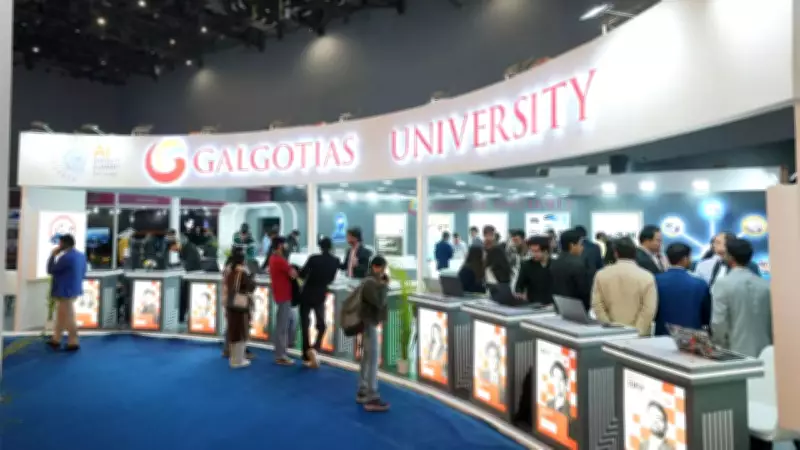
Galgotias University Stall Removed from AI Summit Over Chinese Robot Controversy
In a significant development at the India AI Impact Summit 2026, Galgotias University was directed to vacate its exhibition stall at the Bharat Mandapam on Wednesday. This action followed the identification of a robotic dog displayed at the university's booth as a commercially available Chinese product, rather than an in-house innovation as initially presented. Government sources confirmed the incident, which quickly escalated into a major controversy at the flagship AI event inaugurated by Prime Minister Narendra Modi.
Details of the Robotic Dog Incident
The robot, showcased by the university under the name "Orion," was recognized by observers as the Unitree Go2, a quadruped robot manufactured by the Chinese robotics firm Unitree. This model is sold in India for approximately Rs 2–3 lakh. Critics argued that the robot was presented at the summit as a product developed by Galgotias University, raising serious questions about the showcasing of imported technology at a national AI event designed to highlight domestic innovation and advancements.
The episode triggered a broader debate over the authenticity of indigenous AI development claims versus the utilization of globally available tools in educational and research settings. It underscored concerns about transparency and the representation of technological achievements at high-profile national forums.

Initial Presentation and University Statements
Professor Neha Singh, while presenting the robot earlier to DD News, stated, "We are the first private university investing more than 350 crore rupees in artificial intelligence, and we have a dedicated data science and artificial intelligence block on the campus. So Orion has been developed by the Center of Excellences, and as you can see, it can take all shapes and sizes." She added, "It's quite naughty also, and it can perform small tasks of surveillance and monitoring."
In response to the controversy, Galgotias University issued a clarification, emphasizing that it had not built or claimed to have built the robotic dog. The university highlighted its focus on student learning through exposure to advanced global technologies. "Let us be clear - Galgotias has not built this robodog, neither have we claimed. But what we are building are minds that will soon design, engineer, and manufacture such technologies right here in Bharat. Innovation knows no borders. Learning should not either. We will continue to source the best technologies from across the world so our students can study them, challenge them, improve upon them—and ultimately create world-class solutions from India for the world," the university stated.
In a later statement, the university expressed distress over what it termed a "propaganda campaign" and reiterated its commitment to developing AI talent. "We at Galgotias, faculty and students, are deeply pained by the propaganda campaign against our university. We would like to clearly state that the robotic programming is part of our endeavour to make students learn AI programming and develop & deploy real-world skills using globally available tools and resources, given developing AI talent is need of an hour," the statement read.
Professor Neha Singh acknowledged that unclear communication may have contributed to the controversy. "The controversy happened because things may not have been expressed clearly. I take accountability that perhaps I did not communicate it properly, as it was done with a lot of energy and enthusiasm and very quickly, so I may not have come across as eloquently as I usually do. Also, the intent may not have been properly understood. One important point is regarding the robot dog—we cannot claim that we manufactured it. I have told everyone that we introduced it to our students to inspire them to create something better on their own. Our university contributes to building future leaders by providing cutting-edge technologies in the field of AI, and it will continue to do so," she explained.

Political Reactions and Broader Implications
The controversy drew sharp reactions from opposition parties, adding a political dimension to the incident. The Congress party criticized the government on social media platform X, stating, "The Modi government has made a laughing stock of India globally, with regard to AI. In the ongoing AI summit, Chinese robots are being displayed as our own. The Chinese media has mocked us. This is truly embarrassing for India. What is even more shameful is the fact that Modi’s minister Ashwini Vaishnaw is indulging in the same falsehood, promoting China's robots at the Indian summit." The party further added, "The Modi Government has caused irreparable damage to the image of the country - they have reduced AI to a joke - a field in which we could be world leaders given our data power."
Leader of Opposition in Lok Sabha, Rahul Gandhi, also weighed in, calling the summit a "disorganised PR spectacle." In a post on X, he remarked, "Instead of leveraging India's talent and data, the AI summit is a disorganised PR spectacle - Indian data up for sale, Chinese products showcased."
Impact on the AI Summit and Future Considerations
The focus of the India AI Impact Summit 2026, which aimed to showcase India's ambitions in artificial intelligence, was significantly overshadowed by this controversy. The identification of the robot as the Unitree Go2 highlighted challenges in ensuring the authenticity of innovations presented at such high-stakes events. This incident may prompt stricter verification processes for exhibitors and a renewed emphasis on promoting genuinely indigenous technologies to bolster India's global standing in the AI sector.
As the debate continues, it raises important questions about the balance between leveraging global technologies for educational purposes and maintaining transparency in public representations of innovation. The episode serves as a cautionary tale for institutions and policymakers alike in the rapidly evolving field of artificial intelligence.