Gujarat DST Launches Pioneering 'Science Within Dot' Periodical for Visually Impaired Children
In a landmark move for inclusive education, the Gujarat Department of Science and Technology (DST) officially launched 'Science Within Dot' on Friday. This first-of-its-kind periodical is specifically designed to make science accessible and engaging for children with visual impairment.
A Multi-Sensory Approach to STEM Learning
The innovative publication employs a comprehensive, multi-sensory approach to learning. It features:
- A dedicated Braille section for tactile reading.
- Tactile graphics to help illustrate scientific concepts through touch.
- A large print insert for children with low vision.
- An audio edition for auditory learning.
The core mission of 'Science Within Dot' is to actively promote concepts of Science, Technology, Engineering, and Mathematics (STEM) among young learners with visual challenges.

Beyond the Page: Interactive and Practical Elements
Narottam Sahoo, Adviser to the Gujarat Council on Science & Technology (GUJCOST), elaborated on the periodical's interactive components. "The idea of the initiative is to make science inclusive," he stated. The publication goes beyond traditional reading material by including:
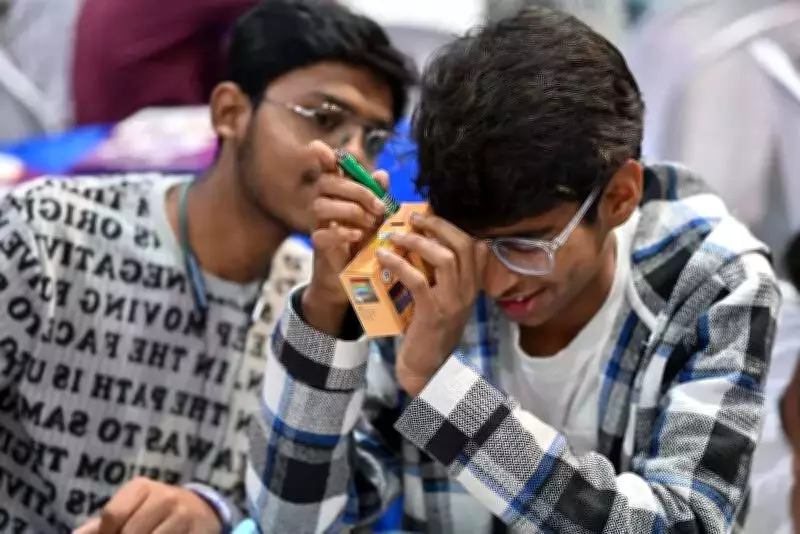
- Try-at-home experiment kits that allow hands-on learning.
- Current affairs explainers to connect science with real-world events.
- A dedicated tech corner focused on the latest assistive devices and technologies.
Launch Timed with National Science Day Celebrations
The launch was strategically timed to coincide with National Science Day, observed annually on February 28th to commemorate Dr. C.V. Raman's Nobel Prize-winning discovery of the Raman Effect. This alignment underscores the state's commitment to fostering a scientific temperament across all sections of society.
Statewide Push for Hands-On STEM Education
The launch of 'Science Within Dot' is part of a broader, statewide initiative to promote practical, hands-on STEM learning. Several premier institutions are actively contributing to this educational transformation.
At the Indian Institute of Technology Gandhinagar (IITGN), the Centre for Creative Learning (CCL) unveiled new projects and curriculum modules designed for both teachers and students. Director Prof. Rajat Moona explained that the centre's work focuses on making abstract scientific and engineering concepts tangible, encouraging students to explore and innovate beyond the confines of conventional classrooms.
Prof. Manish Jain, Principal Investigator at CCL, detailed their efforts in embedding semiconductor education into Industrial Training Institutes (ITIs) and engineering colleges. "Students can start with calculators and digital clocks, and can progress towards designing their own hardware systems," he said. The curriculum guides students from basic breadboard circuits and logic gates through to advanced topics like PCB design, FPGAs, and processor architecture.
Furthermore, the Vikram A. Sarabhai Community Science Centre (VASCSC) presented newly developed, textbook-linked experiment kits. These kits are specifically crafted to facilitate hands-on, experiential learning directly in the classroom, bridging the gap between theory and practice.
The collective efforts of GUJCOST, IITGN's CCL, and VASCSC represent a significant and coordinated push by Gujarat to democratize science education, ensuring it reaches and benefits every child, including those with visual impairments.