Karnataka Faces Call to Transform Dharwad Institute into Pioneering Water Resources University
With water scarcity projected to escalate into one of the most critical challenges in the coming decades, water experts and academicians across Karnataka are intensifying their appeal to the state government. They are urging officials to upgrade the Water and Land Management Institute (WALMI) in Dharwad into a comprehensive, full-fledged water resources university. This strategic move is deemed essential to confront the growing complexities of water management and to ensure the sustainable utilization of water resources for future generations.
Growing Demand from Experts and Former Directors
The demand for this transformation has been strongly voiced by experts affiliated with WALMI, former directors of the institute, and authorities from the University of Agricultural Sciences (UAS) in Dharwad. Collectively, they argue that Karnataka is uniquely positioned to take a leadership role in specialized education and advanced research within the field of water resource management. By establishing such an institution, the state could set a national benchmark for addressing water-related issues.
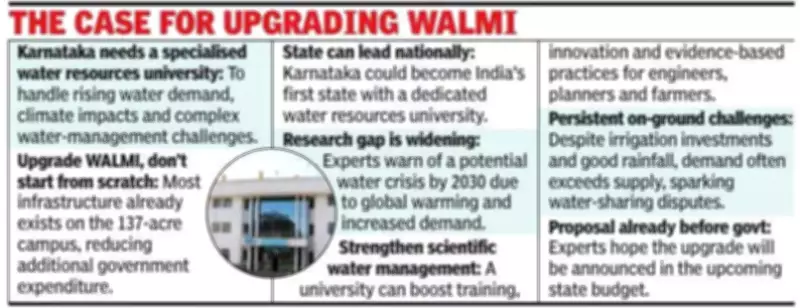
Former WALMI director and managing trustee of the Vishva Manava Foundation, Rajendra Poddar, has formally written to Chief Minister Siddaramaiah, pressing the state government to establish a water resources university through the enhancement of WALMI. Poddar emphasized that despite Karnataka receiving considerable annual rainfall and making substantial investments in irrigation and water resource development projects, the statewide demand for water continues to surge at an alarming rate.

He issued a stark warning, noting that water management is becoming increasingly intricate, with experts predicting a severe water crisis by 2030. This impending crisis is largely driven by the dual pressures of global warming and escalating demand from various sectors, including agriculture, industry, and domestic use.
Poddar stressed that a specialized university dedicated exclusively to water resources could be instrumental in developing sustainable solutions, strengthening cutting-edge research, and improving scientific water management practices across the state.
Substantial Infrastructure Already in Place
Established in 1986, WALMI in Dharwad has played a pivotal role in training engineers, planners, and farmers in modern water management techniques. The institute's significance was recently underscored when the Karnataka government declared it a Centre of Excellence in Water Management, highlighting its critical contributions to the sector.
Spread across an expansive 137 acres, WALMI boasts substantial infrastructure that includes:
- 75 acres of dedicated agricultural land for practical training and research
- Comprehensive administrative and academic buildings
- Modern classrooms and state-of-the-art laboratories
- A fully equipped guest house and hostel facilities for students and researchers
Experts point out that since the majority of this infrastructure is already operational, the government would not face major additional expenditures to upgrade the institute into a fully functional university. This existing foundation provides a cost-effective pathway to establishing a premier educational institution.
Opportunity for Karnataka to Lead Nationally
If this proposal materializes, Karnataka could achieve a historic milestone by becoming the first state in India to establish a dedicated water resources university. This institution would focus exclusively on critical areas such as water management, irrigation systems, watershed development, climate change impacts, and the sustainable utilization of water resources.
A formal proposal has already been submitted to the state government, and Poddar expressed optimism that the initiative could be announced in the upcoming state budget, signaling a strong commitment to water security.

Supporting the proposal, Bharat Ekta Andolan president Mahadev Horatti highlighted that despite significant investments in irrigation and water resource development, numerous challenges persist at the ground level. He pointed out that even in regions receiving ample rainfall, rising demand has made it increasingly difficult to meet water needs, leading to shortages and conflicts.
Officials from UAS further noted that water demand frequently exceeds supply, resulting in disputes over water sharing among different regions and sectors. They believe that a water resources university could emerge as a vital center for research, innovation, and training. Such an institution would empower policymakers, engineers, and farmers to adopt more effective water management practices and better prepare for future environmental and demographic challenges.
In summary, the push to elevate WALMI into a water resources university represents a proactive step toward securing Karnataka's water future, fostering innovation, and positioning the state as a national leader in sustainable resource management.