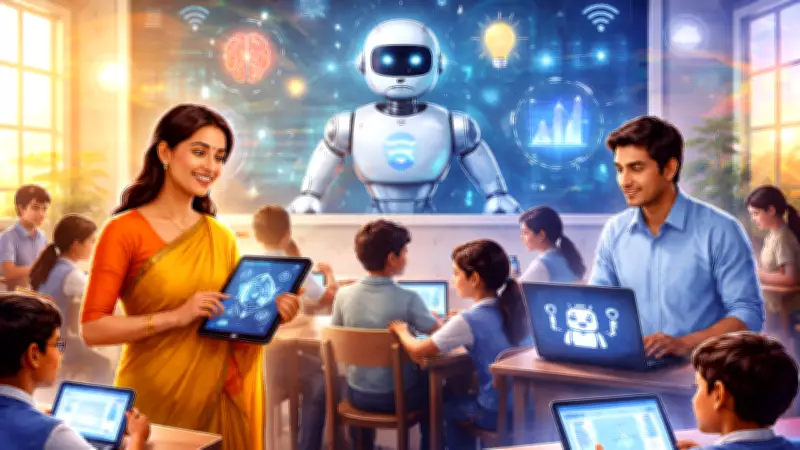
Microsoft's Ambitious AI Teacher Training Programme Launches in India
In recent years, technology has transitioned from a peripheral element to a central component in Indian education. The National Education Policy (NEP) 2020 has been instrumental in driving this transformation, emphasizing digital literacy and computational thinking as long-term educational goals. This policy shift moves technology beyond isolated computer classes or ICT labs, integrating it into the core of subject teaching and student practice.
Curriculum Evolution: From Senior to Primary Levels
The initial curriculum changes were evident in senior classes, with the Central Board of Secondary Education (CBSE) introducing Artificial Intelligence as a Skill subject for Classes IX and X. This allowed students to formally opt for AI, learn foundational concepts, develop projects, and navigate the AI project cycle. Now, the government aims to introduce AI and Computational Thinking from Grade 3, fundamentally altering the starting point from teenagers to primary-level learners.
The Teacher Readiness Challenge
However, curriculum reforms cannot succeed through circulars or frameworks alone; teachers are the backbone of any pedagogical shift. A critical question arises: Are Indian teachers prepared for this AI-driven transformation? According to a 2025 nationwide survey by the Centre for Teacher Accreditation (CENTA), approximately 75% of teachers actively use AI resources, primarily for lesson planning, with 26% employing AI to generate classroom activity ideas.

Despite this adoption, the survey revealed a significant gap between confidence and clarity. While 67% of respondents rated their AI expertise at 6 or higher on a 10-point scale, with an average self-rating of 7 out of 10, only 57% could correctly answer a basic misconception question on AI posed by CENTA. This disparity underscores the need for comprehensive teacher training.
Microsoft's 'Elevate for Educators' Initiative
In response to this backdrop, Microsoft has launched its 'Elevate for Educators' programme in India, marking the first Asian country for this initiative. The tech giant plans to train two million teachers in Artificial Intelligence skills by 2030, beginning with all 75 CM SHRI schools in Delhi, making it the first full implementation site. With nearly 10 million teachers in Indian school education, achieving this target would involve roughly one in five educators over the next five years, extending to up to 200,000 schools and institutions.
Programme Structure: Credentials, Community, and Capacity
Microsoft's framework is built on three core pillars: Credentials, Community, and Capacity. This teacher training programme prioritizes the use of AI tools in education, focusing on professional development rather than curriculum changes.
- Credentials: Microsoft will introduce AI-related certifications aligned with national education standards and AI literacy guidelines. These certifications aim to enhance teachers' understanding of AI tools, improve lesson planning, and boost student engagement. However, operational details such as training hours and assessment methods remain unspecified.
- Community: The initiative provides a shared platform for two million teachers, fostering a peer-learning network for collaboration, practice exchange, and mutual support in adopting AI tools, ensuring long-term engagement beyond one-time training.
- Capacity: Microsoft will establish AI Ambassadors, Educator Academies, AI Productivity Labs, and Centres of Excellence across 25,000 institutions to build "AI readiness" before large-scale classroom implementation.
Real-World Applications in Delhi Schools
In Delhi's CM SHRI schools, AI is already enhancing classroom preparation. Fatima, a teacher in Rohini's Sector 11, used Microsoft Copilot to develop a Class XI biology lesson, creating posters, infographics, and structured presentations with clear learning goals. She noted that complex concepts can now be broken into smaller, more digestible steps for students.

Madhubala, a teacher in Dwarka, utilized Copilot to support a student with autism by creating customized motivational stickers and feedback tools, improving the child's comfort in class. Preeti Sharma from Rohini highlighted AI's benefits in language learning, simplifying abstract English ideas and encouraging skills like inference and prediction beyond straightforward answers.
Scale vs. Substance: Addressing Historical Challenges
While Microsoft's plan to train two million teachers is ambitious, teacher training in India has historically faced issues with depth and continuity. Workshops and certificates often lack sustained handholding for improved efficiency. Critical questions remain unaddressed in policy notes: defining responsible AI use in classrooms, setting guardrails against misinformation, and navigating ethical, pedagogical, and practical nuances.
Moreover, unequal access poses a significant challenge. Urban schools with advanced infrastructure may quickly adapt, but rural schools, where basic facilities are lacking, will struggle with AI adoption and teacher training. If teacher readiness is uneven, AI risks exacerbating the learning gaps it aims to reduce. The success of this initiative hinges on whether its promised scale translates into meaningful depth, particularly for teachers in resource-constrained environments.