Last September, Mahesh Gangurde was sifting through insurance papers in his office in Nashik when his phone beeped. The alert said four cows on his farm, 80 km away in Chandwad, were showing reduced rumination. He had lost three cows in 2024 due to delayed detection of diseases, so Gangurde wasted no time and called his veterinarian. The cows were diagnosed with the onset of a protozoan disease—the same one that had killed his earlier livestock. They were put on medication, and within six days, they were back to normal without much loss of milk.
Dr Pravin Gavade had a similar experience. While attending to patients in his clinic, he received an alert that four of his cows were in silent heat, along with the best time window for insemination. Today, three of those cows are six months pregnant. For Zuhaib Pasha, a farmer in Chikkaballapur, Karnataka, timely alerts helped reduce veterinary expenses for his 15 cows from Rs 11,000 a month to Rs 2,500. His milk production has also stabilised.
What connects all these farmers is a sensor-equipped collar that monitors cattle health, sends alerts in case of abnormalities, and identifies the optimal time for insemination. Developed by Pune-based Areete Business Solutions (ABS) and incubated at BAIF Development Research Foundation, the collar has drawn interest from major dairy players, including Amul and Chitale Dairy.

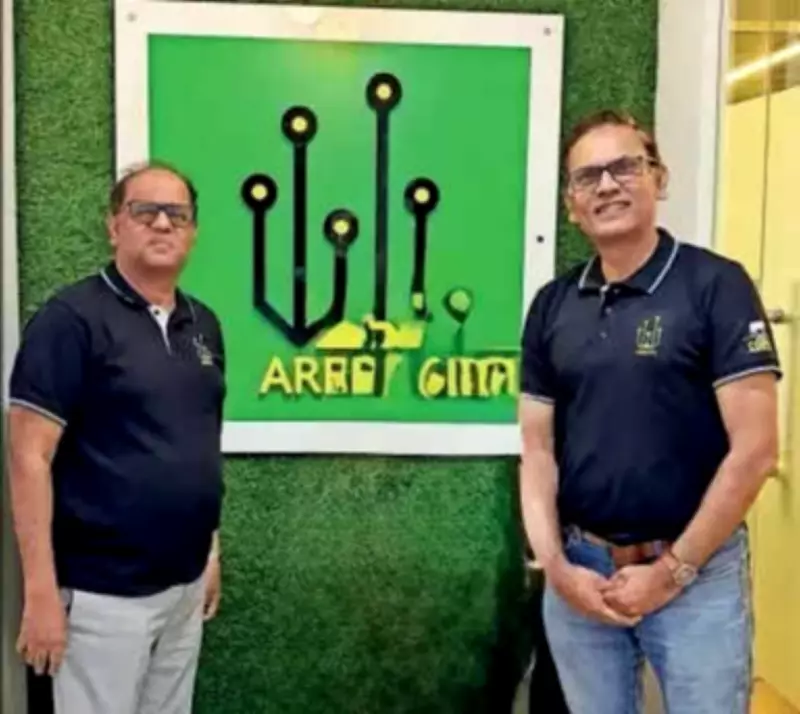
ABS is an agritech firm founded by Srinivas Subramanian and V. S. Shridhar. Subramanian has previously worked with Aditya Birla Group, Bajaj Auto, and Crompton Greaves, while Shridhar has been associated with IBM and the Tata Group. According to Shridhar, the idea took shape in 2016 when they began exploring solutions for farmers. They focused on cattle because, unlike weather-dependent agriculture, dairy provides a steady source of income.
“Automation exists for almost everything after milking, but not for the animal itself,” Shridhar says. “India may be the largest producer of milk, but there’s a severe shortage of veterinary doctors. Farmers have to identify issues themselves or risk losing their cattle to illness.”
Mahesh Gangurde began using the collars in 2024 after losing three cows. “Doctors told me that if we had brought the cows earlier, they could have been saved,” he recalls. He visited large dairies to understand how they detect diseases and found sensor-based collars, but suppliers typically catered only to farms with more than 100–150 cows. That’s when he discovered ABS. He first tested the collars on his best milk-producing cows. Satisfied with the results, he expanded their use to all 25 cows on his farm.
The collar uses four types of sensors—gyroscopes, accelerometers, magnetometers, and temperature sensors—to collect about 550 data points per cow. These include movement, rumination, health indicators, and behavioural patterns. The data is transmitted to a central system, where AI and machine learning analyse it. If anomalies are detected, alerts are sent to the farmer’s phone via an app, available in nine Indian languages. For farmers who might miss notifications, ABS also deploys care managers who call them, especially for heat alerts.
Gavade, who has been using the collars for eight months on his 40 cows—both Holstein Friesian and indigenous breeds—says the detection of silent heat is the most valuable feature. “If a cow doesn’t conceive within a certain time after calving, we have to wait a long period before milking again, since lactation happens only after calving,” he explains.
Chitale Dairy, one of the country’s oldest organised private dairies, collects around 10 lakh litres of milk daily through a network of more than 100 collection centres across Sangli, Satara, and Kolhapur. Vishwas Chitale, CEO and CTO of the dairy, says that since adopting Areete’s collars, they have seen a 10% increase in conception rates. “The system has consistently delivered nearly 93% accuracy in heat prediction, setting a new benchmark in precision and reliability,” he says.

ABS collars are significantly more affordable than imported alternatives and are compatible with both cows and buffaloes. Once fitted, the system takes about two weeks to learn and establish a baseline for each animal’s normal behaviour and health patterns. “Our technology predicts heat in cows with 95% accuracy and health issues with about 90% accuracy,” Shridhar says.