Maharashtra's NRI Quota Reforms Lead to Drastic Decline in Professional Course Applications
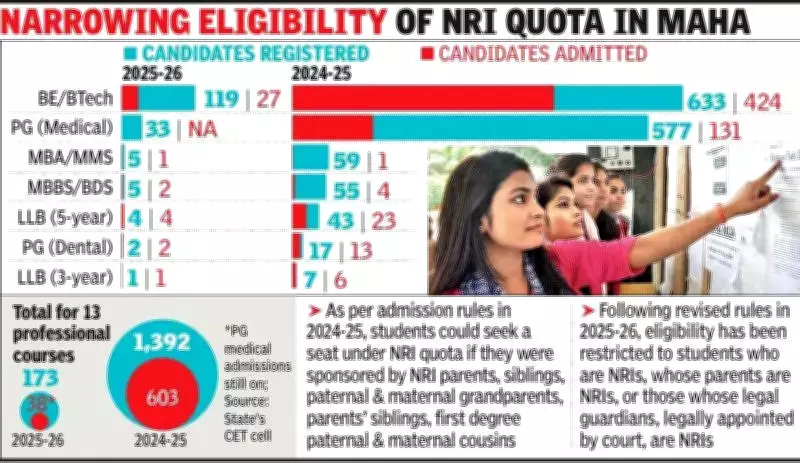
In a significant development affecting professional education admissions, applications for courses under the Non-Resident Indian (NRI) quota in private colleges across Maharashtra have witnessed a staggering decline. Data from the state's Common Entrance Test (CET) cell reveals that applications plunged from 1,392 in the 2024-25 academic year to just 173 in the current session—representing a dramatic drop of nearly 90%.
Stricter Eligibility Norms Implemented to Curb Misuse
This sharp reduction follows the Maharashtra government's decision to tighten eligibility criteria for the NRI quota, specifically aimed at curbing what authorities described as widespread misuse of the category. The revised policy, implemented in June 2025 under the guidance of Higher and Technical Education Minister Chandrakant Patil, has fundamentally altered who can qualify for these seats.
Maharashtra has emerged as potentially the first state in India to significantly narrow NRI quota eligibility, now restricting it exclusively to students who are themselves NRIs, whose parents are NRIs, or whose legal guardians appointed under the Guardians and Wards Act of 1890 are NRIs. This marks a substantial departure from the previous framework, which allowed students to seek admission under the quota if sponsored by NRI relatives including siblings, grandparents, uncles, and aunts.

Immediate Impact on Admissions and Seat Allocation
The policy change has produced immediate consequences for the current admission cycle. During the previous academic session, 603 of the 1,392 applicants secured admission through the NRI quota. This year, that number has plummeted to just 38 admissions thus far, with only a marginal increase anticipated after postgraduate medical admissions conclude.
Vacant seats under the NRI category are being converted into management seats, where fee structures are comparatively lower. This reallocation represents a significant shift in how private colleges fill their professional course vacancies.
Course-Specific Trends and Historical Patterns
CET cell data indicates that NRI quota applications have historically concentrated in specific professional programs. Engineering courses, particularly BE/BTech programs, traditionally received the highest number of applications under this category, followed closely by postgraduate medical programs which feature limited seats and intense competition.
Last year's breakdown showed 633 engineering aspirants and 577 postgraduate medical candidates among the 1,392 total NRI quota applicants. Despite the overall decline in numbers this year, this course distribution pattern remains consistent.
Contrasting Approaches: State vs. Central Policies
While Maharashtra has implemented stricter eligibility criteria, the central government's Medical Counselling Committee continues to follow a broader framework for medical admissions under the all-India quota and in central and deemed universities. This central policy still permits extended family members to sponsor candidates for NRI seats.
This discrepancy highlights the varying approaches to NRI quota regulations across different educational jurisdictions within India.
Official Perspective and Legal Challenges
Dileep Sardesai, Commissioner of the CET cell, explained that authorities had observed most students benefiting from the NRI quota were being sponsored by relatives and distant relatives rather than immediate family. "The revised rules bring in transparency and will benefit students in the long run," Sardesai stated, noting that private medical colleges under the NRI quota can charge up to five times the fees fixed by the Fee Regulatory Authority.
The policy amendment faced legal challenges in four separate cases. While two matters have been dismissed by the Bombay High Court and its Aurangabad bench, two remain pending. Special Counsel for the state and CET Cell, Pralhad Paranjape, confirmed that the Aurangabad bench upheld the state policy, aligning it with the Supreme Court judgment in the PA Inamdar versus State of Maharashtra case.

Diverse Stakeholder Perspectives
Parent representative Sudha Shenoy expressed concern that genuine students with higher merit scores, whose first-degree blood relatives were NRIs, benefited from the earlier policy but now face exclusion. She emphasized the particularly intense competition surrounding postgraduate medical admissions.
However, Tamil Nadu-based activist Meeran offered a contrasting viewpoint, suggesting that with the central government lowering NEET-PG eligibility criteria to zero percentile, merit considerations have diminished in importance. "The fact that students can benefit economically is important now," he added, highlighting the financial dimensions of the admissions process.
Shenoy also noted that engineering colleges not only reserve seats for foreign nationals but also for children of Indians working in Gulf countries, which may contribute to the historically higher application numbers in engineering programs.
The transformation of Maharashtra's NRI quota policy represents a significant shift in professional education admissions, balancing concerns about transparency and misuse against questions of accessibility and opportunity for students with genuine NRI connections.