

Research Scholar's Symbolic Gesture at Annamalai University Convocation Creates Stir
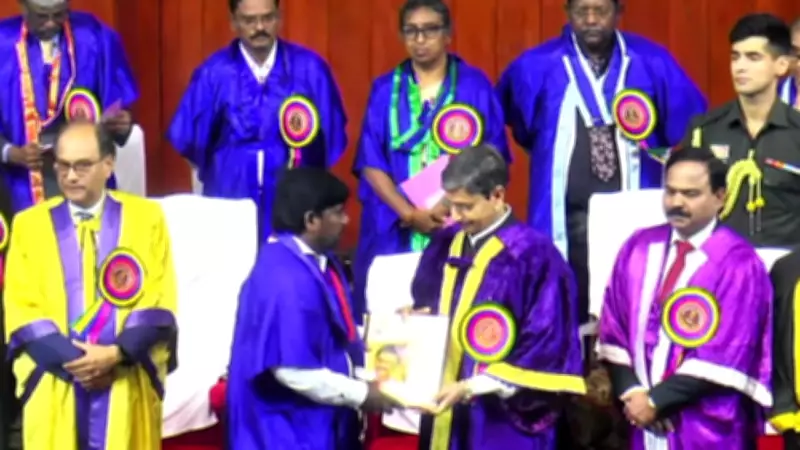
In a remarkable incident that has captured public attention, a research scholar at Annamalai University's 87th convocation ceremony made a powerful statement about Tamil Nadu's ongoing political dynamics. J Pushparaj, a history scholar, received his PhD degree from Tamil Nadu Governor R N Ravi while prominently holding a photograph of Chief Minister M K Stalin, creating an unexpected moment on stage during the Monday ceremony in Chidambaram, Cuddalore district.
The Convocation Ceremony and Scholar's Explanation
The convocation event saw Governor Ravi presenting degrees to 1,014 students at the prestigious Annamalai University. However, it was Pushparaj's deliberate gesture that became the focal point of the proceedings. The research scholar later clarified his actions to reporters, explaining that his display of Stalin's photograph was intended to highlight recent Supreme Court rulings that favor elected chief ministers as university chancellors over appointed governors.
"I felt awkward receiving my degree from a nominated governor when the chief minister has enacted student welfare schemes that I personally benefited from," Pushparaj stated, emphasizing his intention to affirm the chief minister's legitimate role in higher education governance while avoiding direct discourtesy toward the governor.

Visible Tensions and Political Context
Observers noted visible discomfort from Governor Ravi during the exchange, underscoring the ongoing conflict between the governor's office and the Tamil Nadu state government regarding university control. Pushparaj praised the DMK regime's higher education initiatives and expressed regret that he could not receive his degree directly from Chief Minister Stalin, whose administration has implemented numerous student-focused programs.
This incident represents the latest chapter in the continuing tension between appointed governors and elected state governments in India, particularly concerning educational institution governance. The symbolic protest highlights how academic ceremonies have become arenas for political expression in contemporary Tamil Nadu.
Governor's Address on Artificial Intelligence and Ethics
Earlier in the convocation program, Governor Ravi addressed the gathering with remarks focusing on technological advancement and ethical responsibility. He noted that the world is currently experiencing a fourth industrial revolution driven by artificial intelligence.
"Artificial intelligence is not just a tool for computer scientists. It is transforming healthcare, precision agriculture, space science and even the humanities," Ravi told the graduates. "However, I urge you to embrace AI as an augmentative force. Use it to analyse the vast datasets of climate change or to optimise chemical conversion processes, but never let it replace human ethics and creative intuition."
The governor emphasized that expertise without ethics represents an incomplete approach to knowledge. "As we integrate responsible AI into our laboratories and fields, use it to augment human empathy, not replace it. Be the generation that ensures a data-driven world remains a human-centric one," he concluded, offering guidance to the new graduates as they embark on their professional journeys.
Broader Implications for Higher Education Governance
The convocation incident has reignited discussions about:
- The appropriate role of governors versus chief ministers in university administration
- How academic ceremonies reflect broader political tensions
- The intersection of education policy and state politics in Tamil Nadu
- Student and scholar perspectives on governance structures
Pushparaj's carefully calculated gesture serves as a microcosm of larger debates about democratic representation, educational autonomy, and the balance of power between appointed and elected officials in India's federal system. As graduates move forward with their degrees, this incident reminds observers that education remains deeply connected to questions of governance and political representation in contemporary India.

