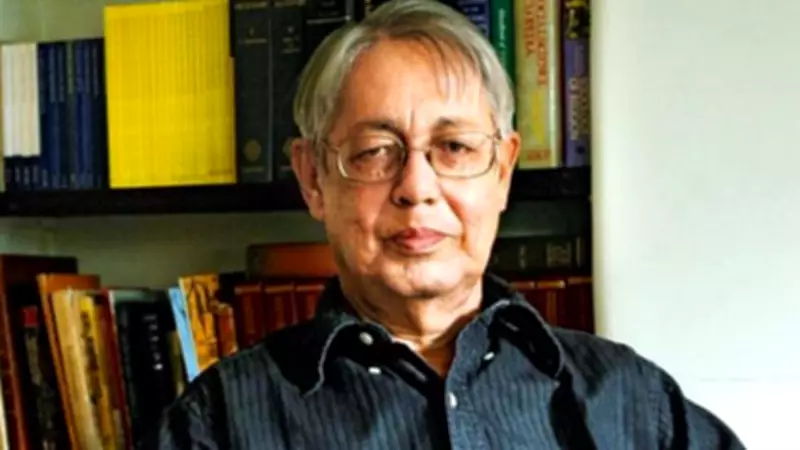
André Béteille (1934-2026): Teacher, Thinker and Scholar, a Founding Father of Sociology in India
André Béteille, one of India's most influential sociologists and a scholar whose work fundamentally reshaped the study of caste, class, and inequality in the subcontinent, died on Tuesday night in New Delhi after a prolonged, age-related illness. He was 91 years old. The news of his passing has left the academic community in mourning, remembering a towering intellectual whose contributions spanned decades.
A Life Dedicated to Academia and Teaching
Born in West Bengal to a French father and an Indian mother, Béteille grew up navigating multiple cultures, languages, and traditions, an experience that profoundly shaped his interdisciplinary approach to sociology. After completing his MA at Calcutta University, he moved to Delhi in 1959, a time when sociology was still an emerging discipline in India. The department at Delhi School of Economics had just one other professor, its founder M.N. Srinivas. Over the next several decades, Srinivas and Béteille would collaboratively transform the department into a national and international centre of sociological thought.
Béteille taught at Delhi School of Economics until his retirement in 1999, becoming synonymous with the institution. His daily routine was legendary among colleagues and students. "He was one of those institution people who was there every day in his office from 8.30 in the morning to at least 5 o'clock," recalled Janaki Abraham, professor of Sociology at DSE and one of Béteille's former students. "Sometimes, if he had work, he would stay longer. He would be walking up and down, or talking to students. He loved talking to students."

Scholarly Contributions and Accessible Writing
Béteille's scholarly output was both prolific and accessible. He wrote extensively on caste, landholding structures, political institutions, education, and social justice, always using language that students could understand and engage with. Among his most celebrated works are:
- Caste, Class and Power (1965)
- Society and Politics in India (1991)
- Equality and Universality: Essays in Social and Political Theory (2002)
His ability to bridge complex theoretical concepts with real-world social issues earned him the Padma Bhushan in 2005 for his contributions to literature and education. Béteille taught various subjects including kinship, sociological theory, and political sociology, drawing significant influence from British social anthropologists Evans-Pritchard and Meyer Fortes.
The Teacher Who Prioritized Students
Those who knew him consistently emphasize that teaching was the central pillar of his life. "He wrote several books and received many awards, but teaching mattered most to him," said Abhijit Dasgupta, former head of the sociology department at Delhi School of Economics. From 1959 to 1999, Béteille "never missed any classes" except for a handful of visiting fellowships abroad, demonstrating remarkable dedication to his students.
His accessibility and genuine interest in student perspectives set him apart. "Whether you were a student or older, he treated you as an equal. He genuinely wanted to hear what you were saying," Abraham noted. He would read students' work closely and provide feedback within days, inviting them for discussions. This reciprocal openness extended to sharing his own writing with students, creating an environment of collaborative learning.
Commitment to Social Justice and Affirmative Action
Béteille's commitment to social justice was not merely theoretical. Dasgupta recalled an incident where a scholarship selection committee faced a tie between two equally meritorious candidates, one from an economically weaker background. Béteille strongly advocated for supporting the disadvantaged student, firmly believing in affirmative action principles. "He strongly believed in affirmative action. If all other things are equal, preference should be given to students from disadvantaged backgrounds," Dasgupta explained, highlighting Béteille's practical application of his egalitarian ideals.

Personal Dimensions: Literature, Music, and Family
Beyond academia, Béteille was a man of diverse interests and deep personal connections. His elder daughter, Radha Béteille, remembered "his love for literature and poetry" and "his ability to hold a tune – he could whistle a whole Tagore song effortlessly." His younger daughter, Tara Béteille, cherished memories of long walks through the Ridge and university gardens. "My father loved the company of children. He had infinite patience with them, and treated them like mini adults," she said. "We had so much to chat about – from the solar system to poetry to soccer. He was also an excellent singer, which many people may not know."
Post-Retirement Contributions and Legacy
After retiring from the University of Delhi, Béteille remained active in academic circles through associations with the Indian Council of Social Science Research and later Ashoka University, where he served as Chancellor from 2014 to 2017. Historian Ramachandra Guha, in a tribute posted on social media, described Béteille as "a moral and intellectual anchor" and "the Indian scholar I most admired."
André Béteille's passing marks the end of an era in Indian sociology. His legacy lives on through his groundbreaking research, his countless students who now teach and research across the globe, and his unwavering commitment to making sociological knowledge both rigorous and relevant to understanding India's complex social fabric. His work continues to inspire new generations of scholars examining the intersections of caste, class, and power in contemporary society.