Student Organizations Nationwide Express Divergent Views on Supreme Court's Stay of UGC Anti-Discrimination Regulations
The Supreme Court of India's decision to stay the University Grants Commission's newly notified anti-discrimination regulations has created a sharp divide among student bodies across the country. While some organizations have welcomed the judicial intervention, others have condemned it as a setback for social justice on campuses.
Court's Rationale and Regulatory Background
On Thursday, the apex court stayed the University Grants Commission (Promotion of Equity in Higher Education Institutions) Regulations, 2026, stating that the provisions appeared "completely vague" and were "capable of misuse." The court directed that the 2012 regulations would remain in force until further notice.
These 2026 regulations, notified on January 13, were intended to update equity guidelines first issued by the UGC in 2012. The new rules mandated the establishment of anti-discrimination committees and formal complaint mechanisms in universities, coming in the aftermath of two tragic deaths that reshaped the national conversation on caste and higher education.

The regulations were developed following the suicides of Rohith Vemula at the University of Hyderabad in 2016 and Payal Tadvi at a Mumbai medical college in 2019, both allegedly due to caste-based discrimination. Since their notification, the rules have generated intense political debate, with concerns about potential misuse dominating public discourse.
Contrasting Reactions from Student Organizations
The Supreme Court's stay order has elicited dramatically different responses from various student unions:
- ABVP's Welcome: The RSS-affiliated Akhil Bharatiya Vidyarthi Parishad issued an official statement welcoming the Supreme Court's decision. "This order is significant as it helps dispel the widespread ambiguity surrounding the UGC equity regulations across the country, while reaffirming the constitutional principles of equality and fairness," the statement declared.
- JNUSU's Criticism: Jawaharlal Nehru University Students' Union president Aditi Mishra expressed strong disapproval, calling the stay "deeply shameful and unfortunate." Mishra argued that "the Supreme Court has now stayed the regulations following upper-caste outrage" and emphasized the need for a comprehensive Rohith Vemula Act rather than ambiguous regulations.
- Mixed Response from DUSU: Delhi University Students' Union office-bearers presented nuanced perspectives. ABVP member and DUSU secretary Deepika Jha acknowledged that the regulations came "after many student movements and repeated struggles against caste oppression in universities," but cautioned against mistaking legislation for transformation. NSUI-affiliated vice-president Rahul Jhansla emphasized the need for social equality in educational institutions.
Regional Perspectives and Political Alignments
The debate has taken distinct forms across different states, reflecting regional political dynamics:
West Bengal's Unified Opposition to Stay
In West Bengal, both the Trinamool Congress-affiliated Trinamool Chhatra Parishad and the CPI(M)-affiliated Students Federation of India criticized the Supreme Court's decision. TMCP general secretary Abhirup Chakraborty suggested that "the new rules should be imposed in BJP-ruled states," while SFI's Calcutta University president Priyanka Ghosh offered sharper criticism, arguing that the stay preserves "the status quo where the powerful stay comfortable and the marginalised keep suffering in silence."
Uttar Pradesh's Complex Response
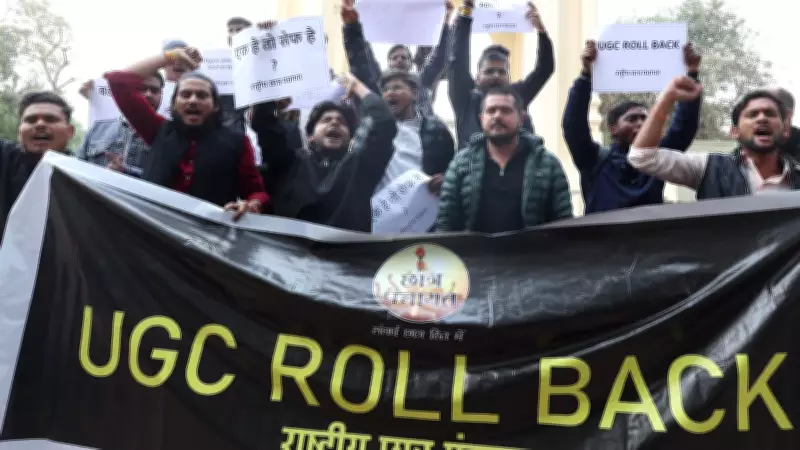
The new UGC rules had previously sparked protests across Uttar Pradesh, leading to the resignation of Bareilly city magistrate and at least 11 Lucknow BJP office-bearers over fears of potential misuse. NSUI functionary Satyam Kushwaha from Prayagraj noted the clear campus divide, with "Dalits, STs and OBCs in favour of it, while the remaining stand on the other side." Despite supporting the regulations, he welcomed the court's directions while adopting a wait-and-watch approach.

Telangana's Cautious Silence
At the University of Hyderabad, where Rohith Vemula's death sparked massive protests in 2016, there has been surprisingly little debate about either the new UGC rules or the Supreme Court's stay order. Student organizations including ABVP, SFI, NSUI, and the Ambedkar Students Association had initially welcomed the regulations with various caveats, but local leaders declined to comment on the court's decision, deferring to their central leadership for official positions.
Academic Perspectives and Implementation Concerns
The JNU Teachers' Association expressed skepticism about the regulations' fundamental premise, stating they were based on the "entirely false premise" that administrations could be "blindly trusted" to prevent discrimination. This reflects broader concerns about implementation that have surfaced across various stakeholders.
Deepika Jha of DUSU highlighted this implementation challenge, noting that "even after strict laws like the SC/ST (Prevention of Atrocities) Act, there has been no reduction in suicides of Dalit students due to discrimination." She emphasized that implementation would be the real test of any regulatory framework.
The Road Ahead and Legislative Alternatives
As the legal process unfolds, student leaders are already looking beyond the stayed regulations. JNUSU president Aditi Mishra's call for a comprehensive Rohith Vemula Act represents one potential direction for future advocacy. The Ambedkar Students Association at UoH had previously criticized the UGC rules for "watering down" provisions dealing with social justice on campus, suggesting that more robust legislation might be necessary.
The Supreme Court's intervention has temporarily halted the implementation of the 2026 regulations, but it has also intensified the national conversation about caste discrimination in higher education institutions. As student organizations across the political spectrum articulate their positions, the debate continues to evolve, reflecting deep-seated societal divisions and the ongoing struggle for equity in India's educational spaces.