UPSC Essentials Daily Quiz: Science and Technology MCQs for Prelims 2026 Preparation
Are you actively preparing for the UPSC Civil Services Examination (CSE) Prelims 2026? This comprehensive subject-wise quiz on Science and Technology is designed to help you assess your progress and revise crucial static syllabus topics effectively. Written by Nitendra Pal Singh, this quiz covers diverse areas from space technology to environmental science, providing valuable practice for aspirants.
Question 1: Carbon Capture Techniques and Technologies
With reference to the different techniques of capturing carbon, consider the following statements:
- In post-combustion, using a chemical solvent, CO2 is separated from the exhaust or 'flue' gases and then captured.
- Pre-combustion generates hydrogen, which is separated and can be used as fuel.
- In oxyfuel combustion, the fossil fuel is burnt in the absence of oxygen, which produces CO2 and water vapour.
Which of the statements given above is/are correct?

(a) 1 and 2 only
Relevance and Explanation:
Carbon capture techniques have become increasingly significant in global climate discussions and national policies. In her recent Budget speech, Finance Minister Nirmala Sitharaman proposed an outlay of Rs 20,000 crore over the next five years for Carbon Capture Utilisation and Storage (CCUS) technologies, highlighting India's commitment to climate goals.
Carbon capture involves three primary techniques: post-combustion, pre-combustion, and oxyfuel combustion. In post-combustion, CO2 is removed after fossil fuel combustion using chemical solvents to separate it from flue gases, making statement 1 correct. Pre-combustion involves removing CO2 before burning through gasification, which generates hydrogen as a byproduct that can serve as fuel, validating statement 2. However, oxyfuel combustion involves burning fossil fuel with nearly pure oxygen, not in its absence, producing CO2 and water vapor that can be separated through cooling. This makes statement 3 incorrect. Therefore, the correct answer is option (a).
Question 2: NASA's Supercomputer Athena Specifications
With reference to the supercomputer – Athena, consider the following statements:
- It consists of 512 computing nodes.
- It is capable of delivering over 20 petaflops.
- It has been launched by C-DAC and the Department of Science and Technology.
How many of the statements given above are correct?
(a) Only one
Relevance and Explanation:
As NASA prepares for its Artemis II mission, the agency has unveiled Athena, its most powerful supercomputer to date. This development represents significant progress in high-performance computing capabilities essential for complex scientific and engineering calculations.
Athena was released for operational use on January 14, 2026, through NASA's Advanced Supercomputing facility, not by C-DAC or India's Department of Science and Technology, making statement 3 incorrect. The supercomputer consists of 1,024 computing nodes (not 512), each equipped with two 128-core AMD EPYC processors, totaling over 264,000 cores. Statement 1 is therefore incorrect. At peak performance, Athena delivers over 20 petaflops, meaning it can perform more than 20 quadrillion calculations per second, making statement 2 correct. Thus, only one statement is accurate.
Question 3: High-Altitude Acclimatization Fundamentals
Acclimatisation is essential at high altitudes primarily because:
(a) air pressure and oxygen availability decrease
Relevance and Explanation:
This question tests fundamental understanding of physiological adaptations required at high altitudes, a topic relevant for disaster management and understanding human limitations in extreme environments.

As demonstrated by mountaineers like Aritra Roy attempting peaks such as Mt. Aconcagua (22,841 feet), high altitudes present severe challenges including temperature drops and wind speeds exceeding 100 kmph. The primary reason acclimatization is crucial is the significant decrease in both air pressure and oxygen levels at higher elevations. While temperature decreases and UV radiation increases are factors, the most critical physiological challenge remains reduced oxygen availability due to lower atmospheric pressure.
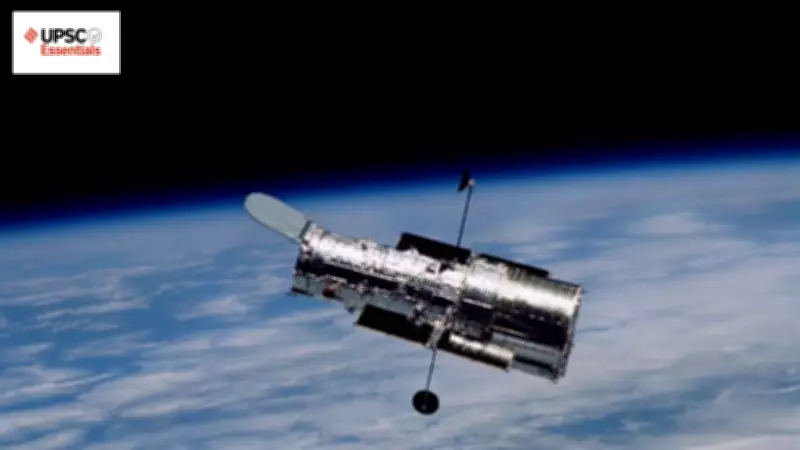
Question 4: Hubble Space Telescope Facts and Discoveries
With reference to the Hubble Space Telescope, consider the following statements:
- It is a project of international cooperation between NASA and ESA.
- The telescope captured some colourful patterns of gases in a black hole powered galaxy known as the 'Circinus Galaxy'.
- It is the second major optical telescope after the James Webb Telescope.
How many of the statements given above are correct?
(b) Only two
Relevance and Explanation:
Space telescopes remain high-yield topics for UPSC due to their continuous discoveries and international collaboration aspects. Hubble's ongoing contributions to astronomy make it particularly relevant for current affairs preparation.
The Hubble Space Telescope represents a successful international collaboration between NASA and the European Space Agency (ESA), making statement 1 correct. In 1999, Hubble captured vibrant gas patterns in the Circinus Galaxy, a black hole-powered galaxy, confirming statement 2. However, Hubble was launched in 1990 as the first major optical telescope in space, while the James Webb Space Telescope followed in 2021, making statement 3 incorrect. Hubble's discoveries, including comet disintegration observations and galaxy collision documentation, continue to shape astronomical understanding decades after its deployment.
Question 5: Vitamin D and Calcium Nutritional Interaction
Consider the following statements:
Statement 1: Vitamin D works best when paired with another crucial nutrient: calcium.
Statement 2: Without enough calcium, vitamin D alone cannot improve bone strength or prevent bone loss.
Which one of the following is correct in respect of the above statements?
(a) Both Statement 1 and Statement 2 are correct and Statement 2 is the correct explanation for Statement 1.
Relevance and Explanation:
Nutritional science questions frequently appear in UPSC examinations due to their public health implications, particularly regarding micronutrient deficiencies prevalent in India.
Vitamin D functions optimally when combined with calcium, as it facilitates calcium absorption in the body, making Statement 1 accurate. Statement 2 correctly explains that vitamin D alone cannot enhance bone strength or prevent bone loss without sufficient calcium availability. Essentially, vitamin D acts as a facilitator for calcium absorption, but requires calcium presence to be effective. This synergistic relationship explains why these nutrients are often prescribed together in clinical settings for bone health management.
This Science and Technology quiz provides essential practice for UPSC aspirants, covering current developments and fundamental concepts across multiple domains. Regular engagement with such quizzes helps build conceptual clarity and improves answer accuracy for the Prelims examination.