Bombay High Court Directs Maharashtra Government to Reconsider RTE Admission Distance Criteria
The Nagpur bench of the Bombay High Court issued a significant directive on Thursday, ordering the Maharashtra government to reconsider and modify the distance criteria applied for admissions under the Right to Education (RTE) Act, 2009. The court emphasized that imposing rigid territorial limits could severely undermine children's fundamental right to education.
Court Observations on Constitutional Mandate
A division bench comprising Justices Anil Pansare and Nivedita Mehta made these observations while hearing a Public Interest Litigation (PIL) filed by Ashish Fulzele and others. The petitioners challenged provisions of a government resolution issued on February 12, 2024, relating to admissions under the RTE Act. The matter has been scheduled for compliance review on March 16.
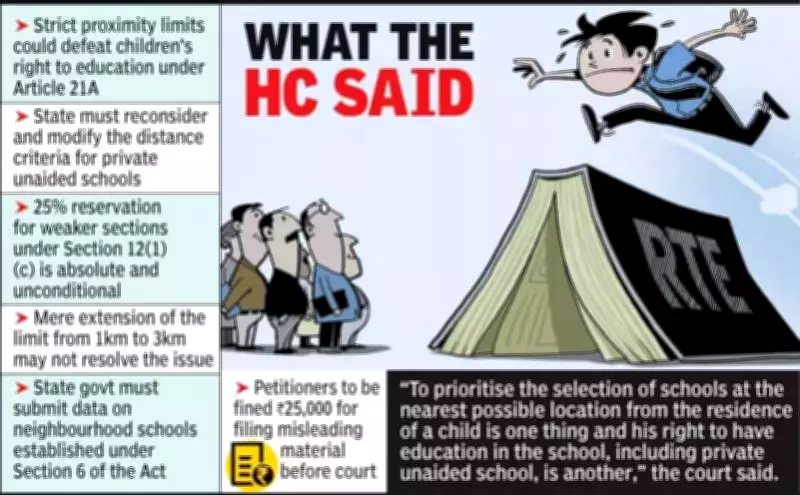
The bench specifically addressed clauses in the resolution that imposed a strict 1-kilometer territorial limit while implementing the provision requiring private unaided schools to reserve 25% of their seats for children from weaker sections and disadvantaged groups. The court firmly stated that Article 21A of the Constitution guarantees free and compulsory education to children aged between 6 and 14 years, and the RTE Act was enacted precisely to operationalize this constitutional mandate.

Absolute Obligation Under RTE Act
Referring to the statutory framework, the bench noted that Section 12(1)(c) of the RTE Act places an absolute obligation on specified category schools and private unaided schools to admit at least 25% of students from weaker sections in Class I and provide free elementary education until completion. The judges declared this obligation to be "absolute and unconditional" and emphasized that it cannot be diluted through subordinate legislation or administrative orders imposing restrictive territorial conditions.
The court also referenced an earlier ruling in Akhil Bharatiya Samajwadi Adhyapak Sabha versus State of Maharashtra, where the High Court had previously held that proximity conditions restricting admissions in private unaided schools were inconsistent with both the RTE Act and Article 21A of the Constitution.
Practical Challenges and Government Response
The bench observed that the February 12 government resolution appeared to reintroduce similar restrictions despite this earlier judgment. "To prioritize the selection of schools at the nearest possible location from the residence of a child is one thing and his right to have education in the school, including private unaided school, is another," the court stated unequivocally.
The judges highlighted practical realities, noting that in several localities, private unaided schools might not exist within a 1-kilometer radius even though government or aided schools might be present. In such situations, the court asserted that children must have the option to travel beyond that limit to secure admission in a private unaided school under the RTE quota.
During the hearing, the state government informed the High Court that it had decided to extend the distance criteria from 1 kilometer to 3 kilometers and had also extended the deadline for submission of admission applications until March 18. However, the bench observed that merely extending the limit might still fail to address the underlying issue comprehensively.
Court's Directive for Substantive Change
"If purpose of provision under Section 12(1)(c) of the RTE Act is to be achieved, the respondents should ensure that the distance of the school from the residence of the child should be such as to accommodate at least one private unaided school," the court stated. The bench added that in practice, it would be difficult to impose any rigid distance limit that could potentially exclude eligible children from accessing their right to education.
The court also directed the state government to place on record data regarding the establishment of neighborhood schools under Section 6 of the RTE Act. The bench noted that the government was obligated to establish such schools within three years of the law coming into force, and the absence of schools within a 1-kilometer radius in some areas suggested a possible failure to meet this statutory obligation.

This landmark directive from the Bombay High Court reinforces the primacy of children's educational rights over administrative convenience and sets an important precedent for RTE Act implementation across Maharashtra and potentially other states facing similar challenges.