The Transformative Power of Creative Education in Indian Schools
For many decades, the Indian education system has placed overwhelming emphasis on quantifiable academic achievements—marks, rankings, and entrance examination results. While this approach has successfully cultivated strong technical expertise and analytical capabilities, it has simultaneously created significant developmental gaps that are becoming increasingly apparent and problematic. Educators, employers, and parents across the nation are now identifying the same critical missing elements: emotional awareness, original thinking, social confidence, and the ability to adapt to changing circumstances.
Creative Disciplines as Practical Solutions
This discussion moves beyond philosophical arguments about 'art for art's sake' to present a practical perspective grounded in how children actually think, learn, and engage with their world. Creative disciplines including visual arts, music, drama, movement, debate, and design are emerging as vital components that address these educational shortcomings directly and effectively.
Developing Emotional Intelligence Through Creative Expression
Emotional intelligence has rarely been prioritized within traditional Indian classroom settings, despite its proven connection to long-term outcomes such as resilience, collaborative ability, and mental well-being. According to UNICEF India's 2023 data, approximately one in seven adolescents in the country experiences some form of mental health challenge, with school environments often serving as the primary setting where stress becomes visible and problematic.

Creative activities provide students with non-verbal pathways to understand and process emotions—both their own and those of others. When a child performs a dramatic scene, interprets musical compositions, or works through a visual art project, they naturally learn to recognize and manage complex emotional states including frustration, patience, empathy, and self-regulation. These skills develop organically without direct instruction, gradually forming a foundation for unique personal identity and emotional maturity.
Imagination as a Foundation for Problem-Solving
Imagination is frequently misunderstood as being antithetical to academic discipline, when in reality it serves as a powerful support system for sophisticated problem-solving capabilities. The World Economic Forum's Future of Jobs Report consistently ranks creativity and cognitive flexibility among the top skills that global employers seek. Indian industry leaders echo this perspective, with NASSCOM's FutureSkills reports identifying adaptability and original thinking as critical gaps within the current talent pipeline.
Creative subjects train young minds to explore multiple possibilities rather than searching for single correct answers. In classrooms where drawing, storytelling, theatre, or design thinking receive serious attention, students become increasingly comfortable with ambiguity and uncertainty. This comfort later translates into enhanced performance in scientific projects, entrepreneurial ventures, and leadership positions across various fields.
Cultivating Empathy Through Shared Creative Experiences
Empathy cannot be memorized or taught through textbooks alone—it develops through genuine interaction and perspective-taking exercises. Group-based creative work such as choir performances, theatre productions, collaborative art projects, or dance ensembles requires students to actively listen, adjust their approaches, and respond thoughtfully to others.
The NCERT National Curriculum Framework (2023) explicitly recognizes this dynamic, recommending experiential and arts-integrated learning as effective methods for building social and emotional competencies. This represents a significant departure from earlier educational frameworks that treated creative subjects as optional or peripheral components. When students step into roles different from their own identities or engage with stories from unfamiliar cultural contexts, empathy transforms from theoretical concept to practiced reality.

Building Adaptability Through Unpredictable Creative Processes
Creative disciplines naturally foster adaptability because their outcomes are rarely predictable or fixed. While a science experiment might fail in specific, anticipated ways, a drama rehearsal could encounter dozens of unexpected challenges requiring immediate creative solutions and quick thinking for recovery.
A British Council study on arts education in India reports that students exposed to regular creative learning environments demonstrate significantly greater comfort with change and constructive feedback. These students are less likely to shut down emotionally or intellectually when plans shift unexpectedly or instructions evolve—an ability that proves invaluable in higher education settings and modern workplace environments alike.
Developing Confidence Beyond Academic Metrics
Academic confidence within the Indian context is often fragile and closely tied to examination scores, creating vulnerability for many students. Creative disciplines offer an alternative pathway to self-assurance. A student who struggles with written examinations may nevertheless excel on stage, in an art studio, or during a presentation. Over time, these positive experiences build a robust sense of personal capability that extends into other academic subjects and life domains.
This development is particularly crucial during middle school years, when dropout risks and student disengagement typically begin to increase. UDISE+ data indicates that student retention becomes a significant concern from upper primary levels onward, especially in learning environments that feel rigid, impersonal, or exclusively focused on academic metrics.
Progressive School Models Leading the Change
Some forward-thinking private school networks are beginning to treat creative education as a core element rather than an occasional add-on. Orchids The International School, for instance, systematically integrates arts, performance, and activity-based learning into regular school days instead of isolating them as occasional special periods.
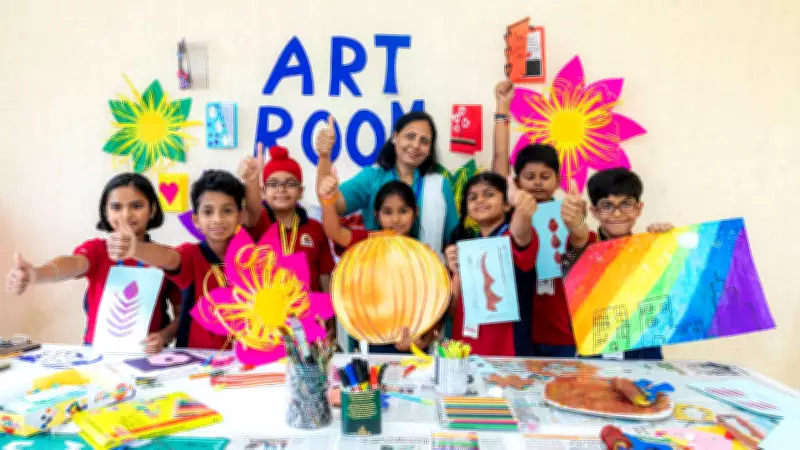
Parents frequently observe that students become more articulate, socially aware, and confident over time—changes that may not appear on traditional report cards but become evident in daily behavior and interactions. At Orchids International School, the visual arts program provides sustained exposure to multiple artistic forms rather than limiting students to single mediums.
Students develop observation and representation skills through drawing and sketching before progressing to painting with watercolors, acrylics, and oil-based techniques. The curriculum also includes sculpture and clay modeling, allowing learners to explore form and texture through hands-on, three-dimensional work. Alongside traditional methods, students receive introduction to digital art and graphic design, where technology transforms into a creative tool rather than a distraction.
Printmaking and mixed-media projects further encourage experimentation by combining diverse materials and techniques. Collectively, these experiences help students think visually, approach problems creatively, and develop well-rounded understanding of how ideas can be expressed through artistic mediums.
By linking creative exposure with structured reflection and age-appropriate guidance, such educational models attempt to balance academic expectations with emotional and social growth. For families concerned that creativity might dilute academic focus, this integrated approach offers reassurance rather than presenting trade-offs between different types of learning.
The Evolving Educational Conversation
The national conversation around Indian education is gradually shifting in important ways. Board examination results and entrance tests will continue to hold significance, but they are increasingly recognized as insufficient on their own. Schools are being asked to prepare students not merely for standardized tests, but for uncertainty, collaboration, and self-direction in an unpredictable world.
Creative disciplines do not represent shortcuts to these outcomes, nor should they be considered educational luxuries. They stand among the few proven methodologies that help children understand themselves more deeply, relate meaningfully to others, and adapt effectively when the world refuses to follow a predetermined syllabus.
As Indian schools reassess what genuine educational success truly looks like, creativity may ultimately prove to be less about specialized talent and more about fundamental readiness for life beyond classroom walls—equipping students with the emotional, social, and cognitive tools needed to navigate an increasingly complex global landscape.