The Economic Survey 2025-26, presented in Parliament by Union Finance Minister Nirmala Sitharaman, has identified critical challenges facing India's education system, with a particular focus on learning outcomes and higher education quality. While acknowledging significant progress in school enrolment through infrastructure development and teacher capacity building, the survey cautions that these gains have not uniformly translated into improved educational results.
Retention Beyond Class 8 Remains a Critical Issue
According to the survey, India has achieved near-universal enrolment at the school level, but the net enrolment rate (NER) for secondary education remains concerningly low at 52.2 per cent. This statistic underscores the urgent need to retain students beyond Class 8, as many drop out during the transition to higher classes. The survey emphasizes that policy interventions must shift focus from mere enrolment to ensuring meaningful learning outcomes and sustained student engagement throughout their educational journey.
Rural-Urban Disparity in School Infrastructure
A significant structural imbalance highlighted in the survey is the uneven distribution of schools across rural and urban areas. In rural regions, only 17.1 per cent of schools offer secondary education, while 54 per cent provide only foundational or preparatory level classes. In stark contrast, urban areas have a much higher share of secondary schools at 38.1 per cent.

This disparity creates substantial barriers for rural students seeking access to higher-level classes, resulting in what the survey terms "transition losses, increased travel time, and higher dropout rates." These challenges are reflected in enrolment patterns, with noticeable declines from foundational to middle and secondary levels in rural areas, while urban areas show rising enrolment from middle to secondary stages.
Policy Recommendations for Educational Improvement
The Economic Survey outlines several strategic recommendations to address these challenges:
- Expanding composite and integrated schools to provide continuous education pathways
- Upgrading existing schools up to Class 7 to improve accessibility
- Strengthening open schooling systems to reach underserved populations
- Enhancing teacher skills through robust training programs at District Institutes of Education and Training (DIET) and State Councils of Educational Research and Training (SCERT)
- Increasing community and parental involvement in school governance
The survey also emphasizes the importance of aligning curriculum and assessment reforms with the National Education Policy (NEP) 2020, while leveraging digital platforms like PM e-Vidya to deliver high-quality education even in remote areas.
Higher Education Quality Concerns
While acknowledging the rapid expansion of higher education institutions and student enrolment over the past decade, the survey flags serious concerns regarding quality standards, faculty shortages, and uneven research capacity across universities. It calls for greater institutional autonomy, stronger academic leadership, and deeper integration of research and innovation to enhance the global competitiveness of Indian universities.
The document also stresses the need for experience-based and skill-oriented learning approaches, noting that traditional classroom models often fail to connect theoretical knowledge with practical application. Greater emphasis on vocational education, internships, and industry collaboration is seen as essential for improving graduate employability and aligning education with labor market requirements.
Digital Education as an Enabler with Caveats
Digital education initiatives are recognized as crucial tools for scaling access, particularly in remote and underserved regions. However, the survey cautions that technology cannot substitute for strong pedagogy and effective teacher training. Digital tools must be complemented by substantial investments in human capacity development to ensure they enhance rather than replace quality teaching practices.

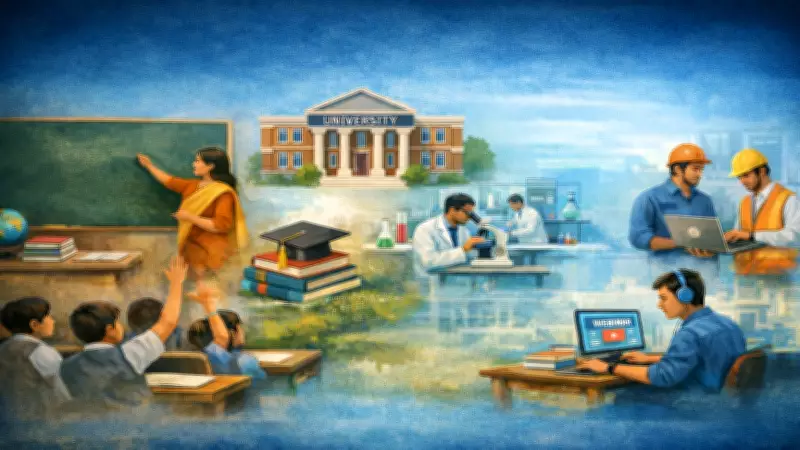
The Economic Survey 2025-26 ultimately presents a comprehensive roadmap for transforming India's education system, balancing infrastructure development with quality enhancement, and addressing both access disparities and learning outcome challenges across all educational levels.