Gujarat's First Maths Park in Panchmahal Transforms Learning Amid Declining Student Interest
For countless students across India, mathematics represents a subject where numbers cease to be logical and instead become a source of significant anxiety and confusion. Recent educational data from Gujarat vividly illustrates this growing discomfort among learners. The number of students choosing Standard Mathematics has experienced a dramatic decline, plummeting to 61,314 in the 2024–25 academic year. This figure marks a sharp drop from the 1.10 lakh students who opted for the subject when the Gujarat Secondary and Higher Secondary Education Board first introduced the Basic and Standard mathematics options four years earlier.
A Quiet Revolution in Panchmahal District
However, in a serene corner of Gujarat's Panchmahal district, numbers are discovering an entirely new language—one that students genuinely enjoy and engage with enthusiastically. At a government primary school located in Navanadisar village, mathematics has boldly stepped out of traditional textbooks and into a sprawling, vibrant garden. Here, learning unfolds dynamically through playful activities and hands-on exploration, transforming abstract concepts into tangible experiences.
The timing of this groundbreaking initiative is particularly telling and relevant. Panchmahal district's Secondary School Certificate (SSC) pass percentage recently slipped to 73.60% in 2025, down from 81.75% in the previous year. This decline positioned Panchmahal as the second lowest performing district academically in the state, underscoring an urgent need for fresh, innovative approaches to teaching and learning methodologies.

The Vibrant Maths Park: Where Concepts Come Alive
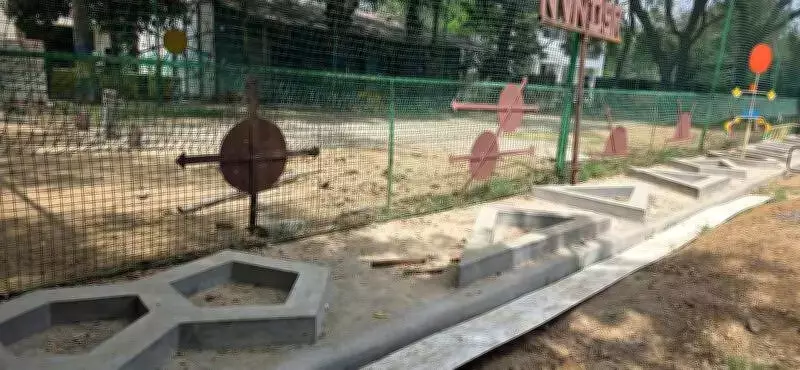
Amid lush greenery, the school's maths park features a giant abacus, metal number lines, and life-sized geometric shapes and angles that form a vibrant outdoor classroom. Children do not merely solve mathematical problems on paper; they physically walk along number lines, touch and manipulate geometric forms, and experience core concepts firsthand through interactive play. This first-of-its-kind initiative in Gujarat is successfully turning abstract arithmetic and geometry into something tangible, intuitive, and genuinely enjoyable for young learners.
The entire idea, design, and execution were driven entirely by the school's dedicated teachers, who collaborated with local artisans instead of hiring expensive external contractors. For mathematics teacher Shantilal Maliwad, the primary goal was straightforward: make an inherently abstract subject tangible and accessible. "Mathematics is often intangible and theoretical, but the park makes it tangible for students. We have developed activities suitable for both younger children and older students," he explained, emphasizing that without such practical engagement, the subject can frequently appear dull, intimidating, and disconnected from real life.
Addressing a Larger Educational Trend
Maliwad's concern reflects a significant larger trend across Gujarat's educational landscape. Since the state board introduced the standard and basic mathematics options for Class 10 students, progressively fewer learners have been selecting the standard, more challenging level. Education experts warn that if this trend continues unchecked, it could substantially shrink the pipeline of students pursuing technical fields and pure science streams in higher education—making early interest and proficiency in mathematics absolutely crucial for future academic and career pathways.
From Modest Beginning to Comprehensive Learning Zone
The innovative idea for the maths park began quite modestly. "We initially considered installing a simple weighing scale to help children understand weight and measurement concepts. However, the idea expanded organically, and we eventually conceptualized the entire maths park," recounted teacher Gopal Patel, who worked diligently on the project alongside principal Rakesh Patel and Shantilal Maliwad.

Today, the park features dedicated, well-organized zones for shapes, angles, area, volume, and numerous other mathematical concepts, comprehensively covering eight key areas of the curriculum. Students can physically measure dimensions, compare different shapes, and understand unit conversions using metal strips marked clearly in metres, inches, and centimetres. Concepts like positive and negative integers are taught interactively through a metal number line and even a customized ‘snakes and ladders' game that incorporates both positive and negative values.
Another clever interactive tool enables students to practise inequality signs by filling in numbers on either side of ‘<' and ‘>' symbols, making abstract comparisons concrete. "The park is a direct result of our constant, collective effort to bring innovative ideas into everyday learning. We discuss concepts collaboratively and implement them together as a team," Patel affirmed proudly.
Recognition Under National Education Scheme
The school has been selected as a model institution under the Pradhan Mantri Schools for Rising India (PM SHRI) scheme, a national initiative aimed at developing exemplary schools. It is now drawing considerable attention for successfully turning mathematics from a feared and avoided subject into an interactive, engaging outdoor experience—one number, one concept, and one joyful discovery at a time.