Kerala Government Higher Secondary Schools Grapple with Severe Non-Teaching Staff Shortage
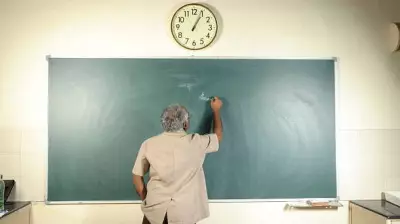
Principals and teachers across government higher secondary schools in Kerala have raised urgent concerns about an acute shortage of non-teaching staff, describing a crisis that has crippled routine school operations and forced educational professionals to perform clerical and even menial duties. The situation has become so dire that principals find themselves cleaning toilets and filling water tanks, tasks far removed from their educational leadership responsibilities.
Budgetary Disappointment and Escalating Protests
Higher secondary teachers had placed their hopes on fresh fund allocation in the recent state budget to address these long-pending issues. However, with no specific budgetary provision announced, disappointment has spread throughout the teaching community. Teachers have now decided to intensify their protests, seeking urgent government intervention to resolve their grievances and restore normal school functioning.
Deteriorating Working Conditions Despite Educational Achievements
Despite Kerala being widely hailed for its achievements in school-level education, principals and teachers in higher secondary sections (classes XI and XII) report that their working conditions are deteriorating rapidly due to the absence of dedicated support staff. Currently, no clerks, office assistants, peons, or sweepers are directly attached to higher secondary sections in government schools.

This staffing vacuum forces principals and teachers to shoulder administrative, clerical, and maintenance work in addition to their teaching and leadership responsibilities, severely affecting both academic and administrative efficiency. Under the existing arrangement, higher secondary sections are expected to depend on non-teaching staff from secondary schools, but principals point out that these staff members are already overburdened and rarely available to assist higher secondary sections.
Voices from the Ground: Principals Share Their Struggles
A principal of a government school in Edappally described the situation as increasingly unmanageable. "Neither a clerk nor a peon is provided. The principal has to do the job of both. Every day I reach school around 7:30am and make sure the water tanks are filled because there is no one else to do it and students cannot be denied drinking water," said the principal, who wished to remain anonymous.
"At times, some of us are even forced to clean washrooms," he added, highlighting the extent of the crisis.
Echoing similar concerns, a principal from a government school in Ezhikkara noted that the crisis is widespread and has been ignored by successive governments, irrespective of political affiliations. "In aided schools, the management appoints sufficient staff to handle clerical and office work. In government schools, principals or teachers are forced to open and close school gates, visit treasuries to process bills, and even ring the school bell before classes," he explained.
Systemic Issues and Growing Administrative Workload
A principal from a school based in Alappuzha district provided context to the scale of the problem: "There are more than 800 government higher secondary schools in Kerala with over eight lakh students. But staffing patterns have not kept pace with the growing administrative workload."
The Kerala Higher Secondary School Principals' Association (KHSSPA), the only major principals' organization not aligned to any political party, reported that repeated pleas to the government have failed to yield results. KHSSPA president Sakkeer Sainuddeen stated, "We demanded separate non-teaching staff for years, but the government is reluctant to commit. There is no permanent solution in sight."
Government Response and Continuing Challenges
Following earlier protests, the government allowed principals to appoint guest faculty to take classes and limit their teaching hours. However, teachers emphasized that this measure did little to address the core problem of non-teaching staff shortage.

S Satheesh, regional deputy director overseeing higher secondary schools in Ernakulam and Thrissur, admitted that the issue persists across districts. "We have reported the plight of principals and teachers to higher authorities. Even with court interventions, it has not had lasting change. It is for the government to formulate a clear policy with adequate budgetary support," he said.
Historical Context and Structural Problems
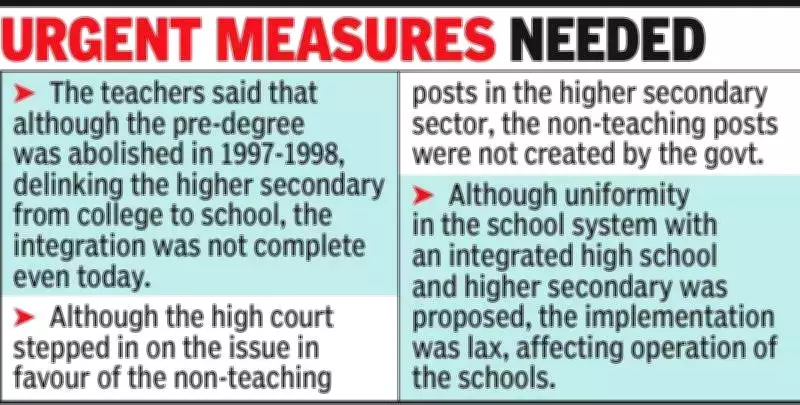
Teachers highlighted that although the pre-degree system was abolished in 1997-1998, delinking higher secondary education from colleges to schools, the integration remains incomplete even today. Although the high court intervened on the issue in favor of creating non-teaching posts in the higher secondary sector, the government has not established these positions.
Despite proposals for uniformity in the school system with integrated high school and higher secondary sections, implementation has been lax, significantly affecting school operations. This structural gap continues to undermine the quality of education and working conditions in Kerala's government higher secondary schools.