Lucknow University Campus Erupts in Tension Over Sealed Mosque Access
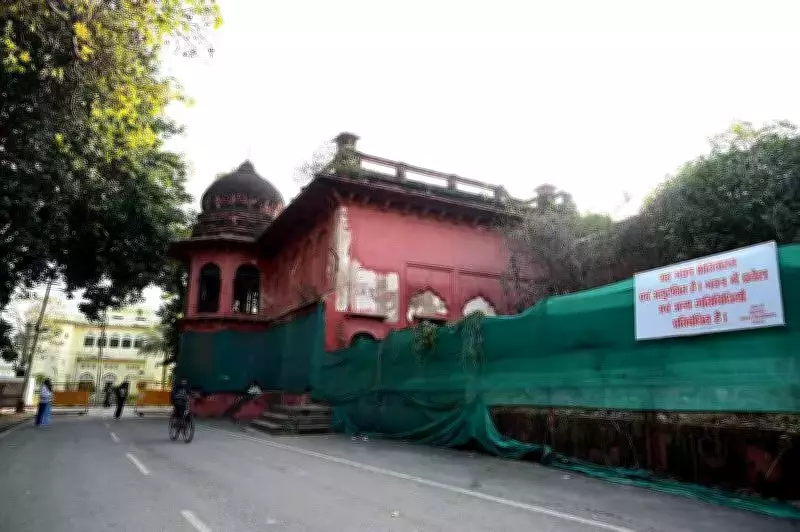
Lucknow: A significant confrontation unfolded at Lucknow University on Monday, creating a tense atmosphere as student organizations and right-wing activists faced off. The dispute centered on the offering of 'namaz' outside the historic Lal Baradari building, which houses a mosque that had its entry gates sealed by university authorities.
Protests and Counter-Protests Escalate on Campus
Members of the Samajwadi Chhatra Sabha (SCS), National Students' Union of India (NSUI), and the All India Students' Association (AISA) were actively protesting the university's decision to seal the Lal Baradari gates. Their demonstration took a dramatic turn when right-wing organization members arrived at the scene and began chanting religious slogans.
In response, the student bodies reciprocated with their own religious chants and the powerful slogan: "Vishwavidyalaya hamara, aapka—na kisi ke baap ka" (The university belongs to all of us, not to any individual). The situation required immediate intervention from police and proctorial board members to prevent it from escalating into violence.

University's Safety Concerns and Student Demands
Lucknow University officials explained that the decision to seal the building stemmed from genuine safety concerns. A bank and canteen that previously operated from Lal Baradari had been shut down years earlier. The recent collapse of a wall from the dilapidated structure prompted the administration to declare it a restricted zone and seal the entrances.
Following the initial confrontation, students affiliated with the protesting organizations marched to the vice-chancellor's office. They submitted a formal memorandum to the proctor, demanding either the reopening of the mosque entrance or the allocation of an alternative space where Muslim students could freely offer namaz.
Police Intervention and Legal Actions
Right-wing activists also presented their own memorandum to police authorities, requesting action against those who had offered namaz outside the sealed Lal Baradari. The police responded by summoning thirteen students—including members of NSUI, SCS, and AISA—to appear before the Joint Commissioner of Police for law and order.
These students have been formally challaned for creating law and order issues through their protests and religious activities outside the restricted building. The entire incident traces back to Sunday when university authorities first sealed the mosque entrance, citing the structure's dangerous condition as potentially life-threatening to anyone using it.
Historical Context and Conflicting Perspectives
Muslim students and supporting organizations countered the safety argument, asserting that unlike other sections of Lal Baradari, the mosque had undergone multiple renovations and presented no significant risk. On Sunday evening, a poignant scene unfolded as Muslim students performed namaz and broke their fasts while Hindu students from SCS, NSUI, and AISA formed a protective human chain around them.
This moment, captured on video and widely shared across social media platforms, was celebrated by many as a beautiful representation of Lucknow's renowned Ganga-Jamuni tehzeeb—the city's traditional composite culture of Hindu-Muslim harmony.
Student Leaders Voice Their Concerns
SCS representative Navneet Kumar emphasized the historical continuity, stating: "LU's Muslim students have been offering namaz in this mosque since the university's very inception."
NSUI national coordinator Vishal Singh posed a rhetorical question that resonated with many: "How would you feel if you visit a place daily for worship and suddenly you find its doors sealed?"
Akhil Bharatiya Vidyarthi Parishad state zonal convener Aman Dubey clarified that his organization was not involved in the confrontation but supported the university's safety-based decision to seal the building.

Administrative Stance and Historical Significance
LU spokesperson Mukul Srivastava reiterated the administration's position: "The historic building is in a genuinely dilapidated condition. After a wall collapsed recently, we declared it a restricted zone, but some students continued entering the building. Hence, the sealing decision became necessary. The university is currently corresponding with the Archaeological Survey of India regarding the building's restoration."
Lal Baradari once accommodated multiple facilities including the teachers' association office, a bank, a cafeteria, and a staff club. All these operations were evacuated approximately a decade ago due to the structure's increasingly fragile condition.
Congress MP Imran Pratapgarhi publicly supported the students' right to offer namaz, urging the LU administration to immediately reopen Lal Baradari for student use.
Architectural and Historical Importance
According to historical records, Lal Baradari holds unique distinction as the only red-stone building in Lucknow dating back to the Nawabi era. Originally known as Badshah Bagh in the 18th century, its foundation stone was laid by Nawab Ghaziuddin Haider Shah in 1814. The magnificent structure was completed by his son, Naseeruddin Haider Shah, in 1820, making it an important architectural and cultural landmark within the university campus.