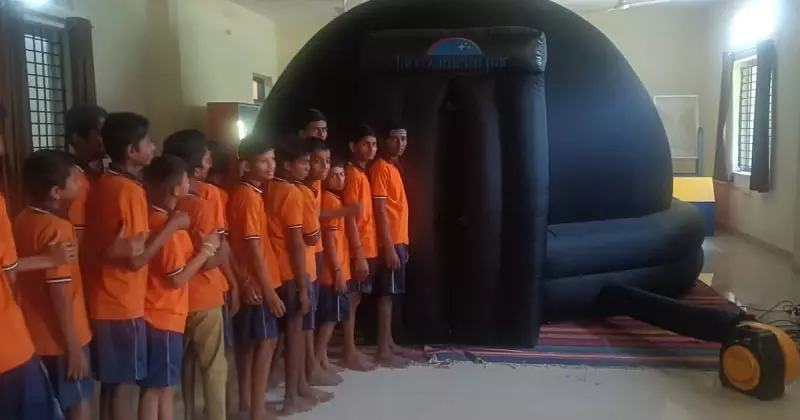
A revolutionary educational initiative is taking the wonders of the universe directly to the doorsteps of young learners in Karnataka. A state-of-the-art mobile digital planetarium is currently touring rural areas, fundamentally changing how children experience and comprehend scientific concepts, particularly astronomy.
Cosmos on Wheels: A Classroom Under the Digital Dome
This innovative project, reported by Athul Damale, employs cutting-edge projection technology to create an immersive celestial experience inside a portable dome. Unlike traditional textbook learning, the planetarium offers interactive sessions that allow students to visually explore planets, stars, and galaxies. The program is specifically designed to bridge the educational resource gap between urban and rural schools, making advanced scientific visualization accessible to all.
Transforming Rural Science Education
The impact on students has been profound. For many children in remote villages, this is their first encounter with a dynamic and engaging model of the solar system and beyond. The high-tech projections turn abstract astronomical theories into tangible, awe-inspiring visuals. Educators note a significant increase in curiosity and understanding among participants, as the mobile unit transforms passive learning into an active discovery process. The initiative directly addresses the challenge of sparking sustained interest in STEM (Science, Technology, Engineering, and Mathematics) fields from a young age.

The Road Ahead for Accessible Learning
The success of this mobile planetarium, highlighted in a report dated 03 December 2025, underscores a growing trend towards using portable, technology-driven solutions to enhance education in India's hinterlands. By bringing the cosmos directly into the classroom, the project does more than just teach facts; it inspires a sense of wonder and possibility. It demonstrates a scalable model for how interactive digital tools can democratize quality education, suggesting a future where geographical location no longer limits a child's exposure to the frontiers of science and discovery.