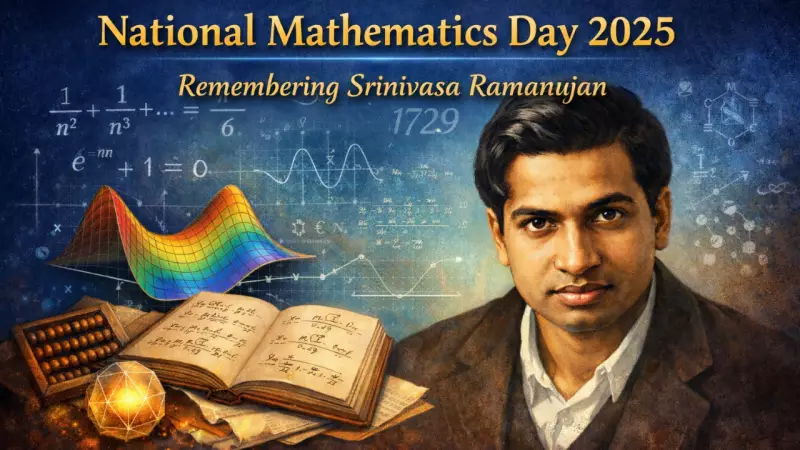
Every year on December 22, India observes National Mathematics Day, a formal tribute to the legendary mathematician Srinivasa Ramanujan. While schools host competitions and institutions put up posters, the day invites a deeper reflection. Ramanujan's extraordinary and turbulent life story poses a blunt, enduring question to any education system: What does it do with a mind that defies conventional 'good student' norms but has the power to transform the subject itself?
The Formal Recognition and the Uncomfortable Genius
National Mathematics Day was officially declared in 2011 by the then Prime Minister Dr. Manmohan Singh. The announcement came during the celebrations marking the 125th birth anniversary of Srinivasa Ramanujan in Chennai on December 26, 2011. Singh also proclaimed 2012 as the National Mathematics Year.
In his address, Prime Minister Singh hailed Ramanujan as "one of the greatest mathematicians the world has seen," whose "dazzling brilliance" lit up the early 20th-century mathematical world. He noted that the English mathematician G.H. Hardy had ranked Ramanujan's genius alongside giants like Euler, Gauss, Archimedes, and Newton. Singh emphasized that while India rightly claims him, Ramanujan's legacy belongs to all humanity.

The Education That Shaped and Almost Broke Him
Born on December 22, 1887, Ramanujan's early schooling unfolded in Tamil Nadu, with his family moving between Erode, Kumbakonam, and Madras (now Chennai). Contrary to the oversimplified narrative of having "no formal training," Ramanujan did undergo the ordinary school route. His distinction was his profound, self-driven depth in a system that prized breadth.
The pivotal moment arrived in his teens when he encountered G.S. Carr's Synopsis of Elementary Results in Pure and Applied Mathematics. This compendium of theorems, often presented without proofs, became his private laboratory. He verified, extended, and created mathematics with daily urgency.
His academic journey, however, was marked by a stark mismatch with the system. After finishing school with distinction in mathematics, he entered Government Arts College, Kumbakonam, on a scholarship. The pattern was set: brilliant in mathematics, indifferent to other subjects. He lost his scholarship. Later, at Pachaiyappa’s College in Madras, he again excelled only in his chosen field, failed the crucial "Fellow of Arts" examination, and left without a formal degree. His lack of a university education was not romantic minimalism but a structural clash between a curriculum demanding all-round performance and a mind demanding intense, singular depth.
From Madras Clerk to Cambridge Fellow: A Journey of Raw Brilliance
By his early twenties, Ramanujan was producing profound mathematics while living in near-poverty. After gaining some local recognition and publishing in the Journal of the Indian Mathematical Society, he secured a clerical position at the Madras Port Trust in 1912. By day, he handled accounts; by night, he delved into number theory.
The turning point came on January 16, 1913, when he wrote to the renowned Cambridge mathematician G.H. Hardy. Introducing himself as a clerk with "no University education," Ramanujan sent not a carefully argued essay but pages of startling mathematical results—identities, series, claims about primes—often without proofs.
Hardy's initial reaction, as noted by Britannica, was incredulity. Yet, the raw mathematics had an undeniable fingerprint of genius. Hardy later wrote that some formulas "defeated" him and he had "never seen anything in the least like them before." This professional recognition sparked a historic correspondence. Hardy became both mentor and translator, demanding rigorous proofs while Ramanujan delivered raw brilliance.
Hardy's advocacy enabled Ramanujan to travel to England and join Trinity College, Cambridge. The recognition followed: In 1918, he was elected a Fellow of the Royal Society and became the first Indian Fellow of Trinity College, Cambridge. His letter succeeded not as a plea but as irrefutable evidence of his gift.

The Enduring Legacy: More Than a List of Contributions
Ramanujan's contributions are often summarized as work in number theory, infinite series, and partitions. Their true impact, however, lies in how they became highways for modern research.
His collaborative work with Hardy on the partition function revolutionized how mathematicians estimate the growth of partitions, laying a foundation for analytic number theory. His discoveries in infinite series, continued fractions, and special functions provided powerful tools for later work in modular forms and q-series.
Perhaps most astonishing was his late discovery of "mock theta functions." These mysterious objects, described in his final letters, seemed incomplete. Decades later, mathematicians realized they were foundational, with profound applications in modern number theory, mathematical physics, and even string theory. Ramanujan often discovered first and justified later, a testament to his unique intuitive genius.
The Significance of National Mathematics Day Today
National Mathematics Day holds critical contemporary significance. It challenges India to move beyond treating mathematics as a fearful examination subject and to embrace it as an essential life skill and a field of creative inquiry.
The day serves as an annual nudge to schools, parents, and policymakers. It highlights that mathematical thinking is crucial not just for engineers but for navigating the modern world—from personal finance and app development to medical research and economic policy.
It also flags a pressing national concern: a decline in students pursuing advanced mathematics leads to shortages in research mathematicians, quality teachers, and innovators. This gap ultimately affects the country's capacity for scientific and technological innovation. At its best, National Mathematics Day is a call to nurture curiosity, reward logical reasoning, and make the pursuit of mathematical knowledge aspirational once again, inspired by the unforgettable legacy of Srinivasa Ramanujan.