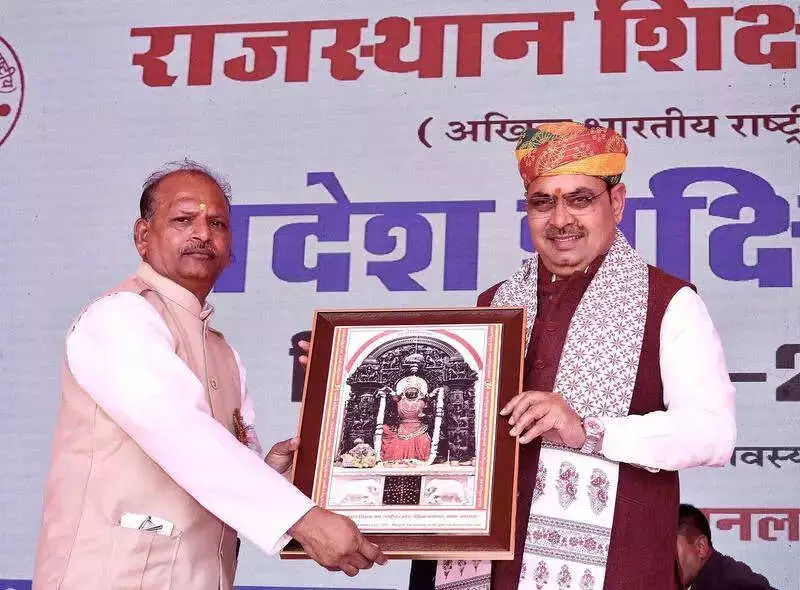
Rajasthan Chief Minister Bhajan Lal Sharma has placed the responsibility for realizing the ambitious goals of the National Education Policy (NEP) squarely on the shoulders of the state's educators. Addressing a major gathering of teachers, he stated that their commitment is the most critical factor in shaping a developed India and a developed Rajasthan.
Teachers as the Pillars of Educational Reform
Speaking at a state-level teachers' conclave held in Banswara on Saturday, Chief Minister Sharma outlined the transformative potential of the NEP. He asserted that while the policy provides a new direction for 21st-century India, its real-world impact hinges entirely on classroom execution. The vision of reforms like mother-tongue instruction, flexible curricula, vocational training, and fostering critical thinking must be delivered by dedicated teachers, moving from policy documents into student learning experiences.
Major Infrastructure and Access Boost in Education
The Chief Minister detailed significant strides in expanding and upgrading educational infrastructure across Rajasthan. In higher education, the state government has established 71 new government colleges and completed building construction for 177 colleges. Furthermore, 17 institutions have been upgraded from offering only undergraduate to postgraduate programs.

To enhance skill-based learning, professional courses have been widely introduced. BBA courses are now available in colleges at all 41 district headquarters, while BCA programs have started at seven divisional headquarters. Computer Science has also been launched in colleges across 41 districts.
School Modernization and Student Welfare Schemes
On the school education front, a massive digitalization drive is underway. The CM announced that over 8,000 smart classrooms have been operationalized in more than 4,000 schools. Simultaneously, repair and maintenance work is in progress for nearly 65,000 school buildings to improve the learning environment.
Highlighting direct support for students, Sharma said the state has distributed 39,586 scooters to meritorious students under the Kalibai Bheel and Devnarayan Scooty schemes. For broader welfare, a direct benefit transfer (DBT) of Rs 800 per student is provided for uniforms and school bags. This scheme covers students in classes 1 to 8 and all girls in classes 9 to 12.
So far, this DBT initiative has transferred more than Rs 330 crore directly into the bank accounts of over 41 lakh students, ensuring transparency and timely support.
Governance at the Doorstep
Later on Saturday, the Chief Minister visited a rural problem resolution camp at Tejpur gram panchayat in Banswara district. He interacted with local officials and residents who were beneficiaries of various government schemes. Sharma emphasized that such camps are crucial for taking governance to the people's doorstep and ensuring prompt resolution of their issues.