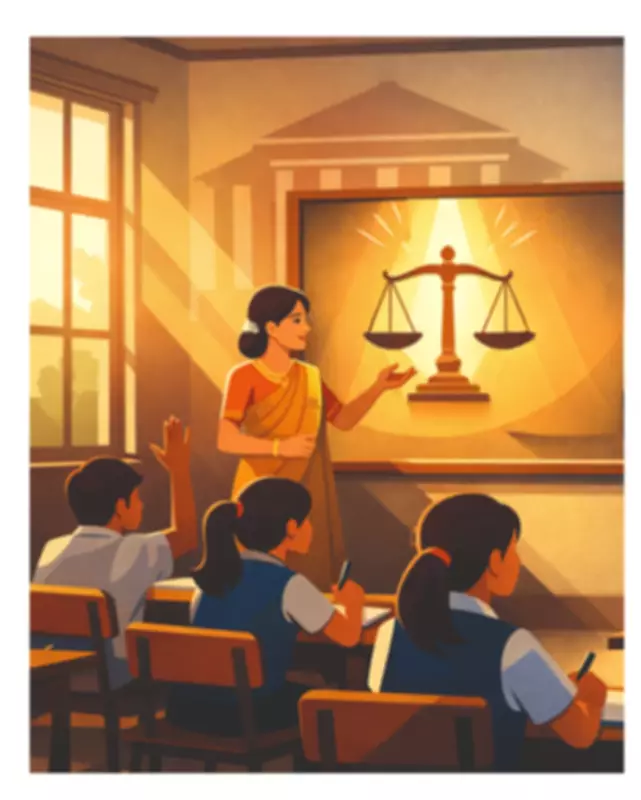
Supreme Court Intervenes in NCERT Textbook Controversy Over Judicial Corruption
Recently, a Class VIII National Council of Educational Research and Training (NCERT) social science textbook containing a section on "corruption in the judiciary" sparked widespread headlines and public debate. The Supreme Court of India took suo motu cognisance of this material, questioning whether such portrayals are appropriate for adolescents who are encountering constitutional institutions for the first time in their educational journey.
The Court directed an immediate halt to the circulation of the textbook and sought detailed explanations from those responsible for its preparation and approval. In response, the Union government indicated that the controversial portion would be removed, and the textbook would undergo a comprehensive revision to align with educational standards.
Pedagogical Tensions in Civic Education
This episode illuminates a deeper pedagogical tension in how civic education is structured in India. The core question is not whether institutional shortcomings exist—every constitutional democracy acknowledges fallibility and the need for continuous improvement. Rather, the debate centers on whether a child's first sustained introduction to the judiciary should begin with allegations of corruption. Civic education, much like constitutional design, depends critically on sequence. Foundations must precede fractures to ensure students develop a balanced understanding of democratic institutions.

In Tamil Nadu, civic education cannot be detached from the state's rich intellectual tradition. Figures like Subramania Bharati emphasized courage without contempt, while the Thirukkural placed virtue before authority yet insisted on social order. Periyar E V Ramasamy wielded scepticism as a precise tool for reform, not as a blunt instrument for destruction. None of these thinkers mistook early cynicism for enlightenment. Their shared lesson is subtle: question power, but understand its essential function in governance.
Case Study: The NEET Controversy in Tamil Nadu
Consider the prolonged controversy in Tamil Nadu over the National Eligibility-cum-Entrance Test (NEET). The state assembly passed legislation seeking exemption from NEET for medical admissions, citing federal autonomy and social justice concerns. This bill's journey involved multiple constitutional steps:
- Approval by the governor's office
- Seeking the President's assent
- Constitutional scrutiny and subsequent litigation in various forums, including proceedings before the Supreme Court
Within classrooms, educators faced a critical question: how should this controversy be taught? Options include presenting it as evidence of federal friction, as a case study in constitutional processes, or as proof that "the system is stacked." Rushing to the last formulation risks reducing complex constitutional dynamics to mere conspiracy theories. Instead, the NEET episode serves as an exemplary teaching tool because it illustrates constitutional procedure in motion—legislative initiative, executive discretion, judicial review, and federal negotiation. To frame it as institutional betrayal would be pedagogical malpractice; to present it as institutional dialogue is true civic education.
Broader Curricular Debates and Democratic Vitality
Tamil Nadu has witnessed numerous curricular controversies beyond the implementation of Samacheer Kalvi. Revisions in social science textbooks, particularly those relating to caste history, social reform movements, and political figures, have triggered intense debates about representation, omission, and emphasis. Questions have been raised about:
- How leaders such as Periyar are portrayed
- Whether national narratives overshadow regional struggles
- Whether rationalist thought receives adequate contextual framing
Such debates are not signs of democratic decay; they are symptoms of democratic vitality. However, sequence matters profoundly. Students must first understand that textbooks are curated attempts at shared memory—they are neither infallible scriptures nor partisan pamphlets. This foundational understanding prepares them to engage critically with content without losing faith in institutional frameworks.

Balancing Critique and Respect in Advanced Curricula
This does not mean shielding students from uncomfortable truths. Allegations of judicial corruption, whether in Tamil Nadu or elsewhere, are part of democratic reality. Discussions about transparency in judicial appointments, the collegium system, and in-house inquiry procedures deserve a dedicated space in advanced curricula. But such chapters must follow foundational instruction on due process, judicial independence, and the constitutional architecture of courts.
Otherwise, there is a risk of collapsing institutional criticism into institutional nihilism. A generation trained to believe that judges are merely politicians in robes will not defend judicial independence when it is genuinely threatened. Ironically, premature cynicism can weaken accountability mechanisms by eroding public trust in necessary institutions.
Constitutional Duties and Intellectual Lineage
The Constitution of India speaks of fundamental duties in Article 51A, including respect for the Constitution itself. Respect is not blind obedience; it is recognition of necessity. In Tamil Nadu's charged political culture, rich with rhetoric, satire, and sharp debate, there is a temptation to treat irreverence as sophistication. But irreverence without grounding is not rationalism; it is impatience.
To educate children to respect the law is not to deny them the tools of critique. It is to sequence those tools responsibly:
- First, teach them how a court functions
- Then, teach them how it may fail
- First, teach them why institutions exist
- Then, teach them how they may be reformed
Otherwise, we risk producing citizens adept at dismantling but uncertain about building. Democracies, unlike demolition sites, cannot afford perpetual reconstruction. If Tamil Nadu's intellectual lineage teaches us anything, it is that courage need not cancel respect, and scepticism need not erase structure. The classroom must reflect that delicate balance. Teach the law first; the chapter on corruption can wait.
Architectural Foundations of the Judiciary
To teach children first about corruption—judicial, executive, or legislative—is to invert the moral sequence of democracy. The judiciary, for instance, must be introduced not as a theatre of scandal but as a constitutional organ. Articles 124 to 147 of the Constitution establish the Supreme Court, while Articles 214 onwards establish the Madras High Court. This architectural framework matters because the rule of law is a lived practice sustained by courts, procedures, and precedent.
The Supreme Court is not infallible, nor are high courts beyond reproach. Allegations of judicial misconduct have surfaced across jurisdictions, prompting necessary debates about accountability mechanisms, in-house procedures, and the limitations of impeachment under Articles 124(4) and 217. However, a chapter on judicial corruption belongs in a mature civic curriculum, one that has already explained separation of powers, judicial review, and constitutional remedies. Otherwise, we risk producing students who believe the law is merely a mask for power, not a restraint upon it—a perspective that undermines the very foundations of democratic governance.