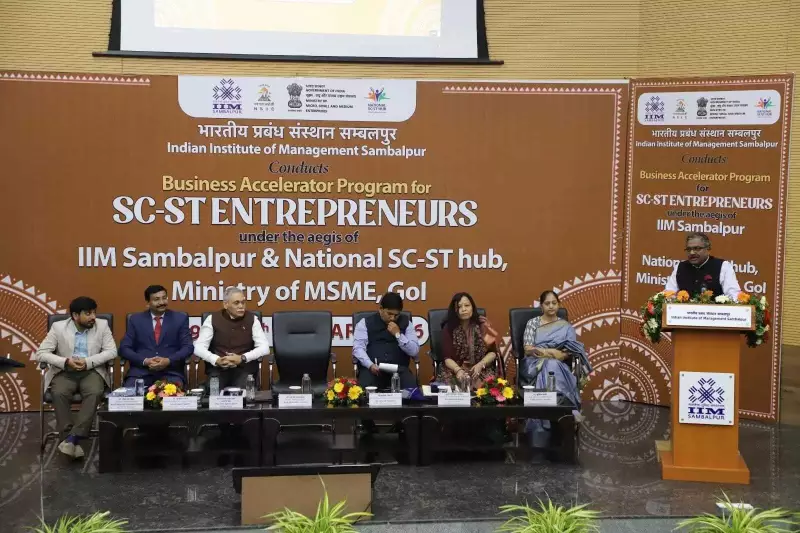
The Indian Institute of Management (IIM), Sambalpur, has taken a significant step towards fostering inclusive economic growth by hosting a comprehensive six-day business accelerator programme specifically designed for SC/ST entrepreneurs. This initiative was conducted in collaboration with the national SC/ST hub under the Ministry of Micro, Small and Medium Enterprises (MSME).
Empowering Entrepreneurs for Viksit Bharat 2047
The programme was strategically designed to strengthen the entrepreneurship ecosystem by building capacity and upskilling participants with essential business, financial, and digital skills. This aligns directly with the broader national vision of Viksit Bharat 2047 and supports the United Nations Sustainable Development Goals, emphasizing sustainable and equitable development.
The inaugural cohort saw enthusiastic participation from 25 aspiring entrepreneurs hailing from diverse states including Odisha, Andhra Pradesh, Telangana, and Maharashtra. This regional diversity highlights the programme's reach and relevance across different entrepreneurial landscapes in India.

Leadership and Vision for Societal Impact
Professor Mahadeo Jaiswal, Director of IIM Sambalpur, articulated the institute's profound vision during the programme. He emphasized that the core mission is to nurture responsible leaders who possess a strong entrepreneurial mindset. Professor Jaiswal further elaborated that true entrepreneurship transcends mere personal wealth creation; it is fundamentally about generating value for society, contributing to national progress, and fostering planetary well-being.
Building on the success of the first cohort, IIM Sambalpur has announced the commencement of the second cohort in February. This next phase will offer an intensive 72-hour hybrid learning experience. The format includes convenient virtual weekend sessions combined with a rigorous six-day on-campus module at the IIM Sambalpur campus, providing a blend of flexibility and immersive learning.
St. Xavier's High School Inaugurated in Cuttack
In a parallel development in the education sector, St. Xavier's High School was formally inaugurated on January 23rd on the premises of the historic Christ Collegiate School at Mission Road in Cuttack. The school marks a new chapter in educational offerings for the city.
The institution will follow the Central Board of Secondary Education (CBSE) curriculum. In its initial phase, it will offer classes ranging from Bal Vatika (pre-primary) up to Class VIII. The management has outlined plans for gradual expansion in the coming years, ensuring sustained growth and development. This venture is being developed under a long-term 50-year agreement with the Cuttack Christian Education Board, signifying a committed partnership.
A Focus on Values and Heritage
The inauguration ceremony was a notable event, featuring the unveiling of a 7-foot-tall statue of the iconic freedom fighter, Netaji Subhas Chandra Bose, symbolizing inspiration and patriotism. Renowned educationist Anand Kumar, famous for the Super 30 initiative, addressed the students, strongly emphasizing the critical importance of value-based education in shaping future citizens.
Strategically located at a historic and central site in Cuttack, the school aims to create a vibrant, nurturing, and conducive learning environment that honors its legacy while building a modern educational foundation.
National Seminar on Tribal Livelihoods at Fakir Mohan University
Adding to the week's significant events, the Postgraduate Department of Anthropology at Fakir Mohan University recently organized a pivotal two-day national seminar. The theme was 'Tradition, Transformation and Development'.
The seminar provided a crucial interdisciplinary platform, bringing together scholars from diverse fields including anthropology, sociology, political science, economics, psychology, environmental sciences, health, and nutrition. The primary focus was to deliberate on the emerging livelihood challenges faced by tribal and indigenous communities. These challenges are intensifying amid the rapid technological, socio-economic, and cultural changes characterizing the 21st century.

The collective discussions aimed at brainstorming and formulating sustainable and inclusive development pathways that respect traditional knowledge while integrating necessary transformations for progress and resilience.