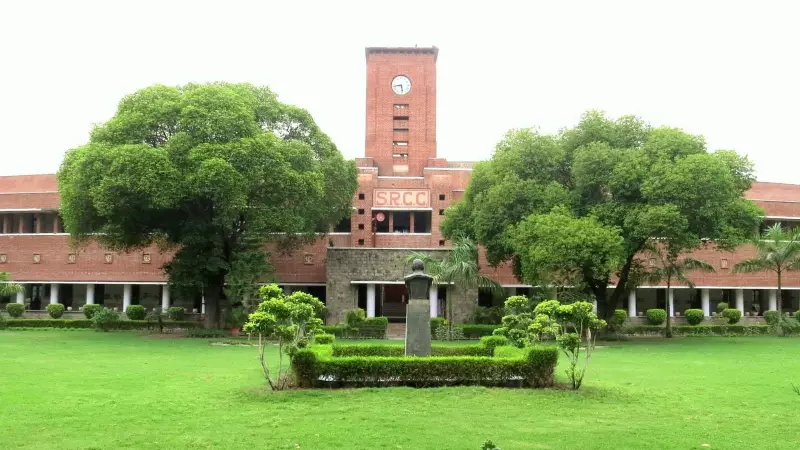
Delhi University's prestigious Shri Ram College of Commerce (SRCC) has officially launched its centenary celebrations, commemorating a remarkable 100-year journey of molding India's business minds, economists, and administrators. The curtain-raiser event on Friday at the college's North Campus marked the beginning of a year-long festivity, reflecting on an institution that began as a bold educational experiment.
Humble Beginnings in a Daryaganj Bungalow
The story of SRCC is one of visionary ambition. In the pre-Independence era, around a hundred years ago, 12 students gathered for commerce classes on the first floor of a rented bungalow at 8, Daryaganj in Old Delhi. At the time, commerce was a rare subject in Indian universities. This modest setup, with four faculty members under the supervision of R K Kumar, who later became the first principal, was the seed from which a giant would grow.
The foundation was laid even earlier, in 1920, on the day of Basant Panchami. Seven leading businessmen, spearheaded by the industrialist Sir Shri Ram, established the Commercial Education Trust. Their mission was clear: to nurture homegrown business talent in a country lacking formal commerce education. The Trust's first venture, the Commercial School in Charkhe Walan, offered a post-matriculation diploma.

A Century of Evolution and Expansion
The institution's pivotal moment came in 1926 when it affiliated with the University of Delhi, formally integrating commerce into the university system. This set the stage for decades of growth. It launched its annual magazine 'Yamuna' in 1928, upgraded to a degree college, and introduced honours and postgraduate programmes in economics well before India gained independence.
In 1951, marking its silver jubilee, the college specialized fully in commerce and economics and was renamed Shri Ram College of Commerce in honour of its founder. It moved to its current North Campus location in 1954. A landmark shift occurred in 1957 when SRCC became co-educational, welcoming women into a traditionally male-dominated field. The introduction of the BA (Honours) Economics programme in 1958 solidified its academic framework.
The subsequent decades saw rapid infrastructural development, including student centres and hostels. A student-led 'Shramdaan' initiative even built a swimming pool, making SRCC the first Delhi University college to have one. The college's strength now stands at over 3,000 students across various programmes, a far cry from the inaugural batch of 12.
Shaping India's Economic Architecture
Speaking at the centenary event, University of Delhi Vice-Chancellor Professor Yogesh Singh hailed SRCC as a "globally recognised academic brand." He emphasized that its contribution transcends rankings, noting, "Hundred years is long enough to build institutions, shape generations and influence the journey of a nation. SRCC has done all three." He credited the college for producing the economists, administrators, judges, and business leaders who drive India's growth.
Principal Simrit Kaur framed the centenary as a collective achievement. "For a hundred years, SRCC has stood for purpose over profit and ethics over expediency," she stated, reaffirming the college's commitment to developing socially responsible leaders grounded in ethical practices and sustainability.
The ceremony was graced by distinguished alumni, including Sminu Jindal, Managing Director of Jindal SAW Ltd, and former Supreme Court judge Justice A K Sikri. Sangeeta Jaitley, wife of late Finance Minister Arun Jaitley, spoke of the college's profound impact on his values. A commemorative coffee-table book, 'Timeless Frames', tracing SRCC's journey from Daryaganj to its present stature, was also released.
From its origins in a small bungalow to becoming an iconic institution, SRCC's century-long journey has indeed closely tracked the evolution of India's own economic and governance story, preparing generations of leaders for the challenges of a dynamic nation.