Three Plays That Bring Scientists to Life
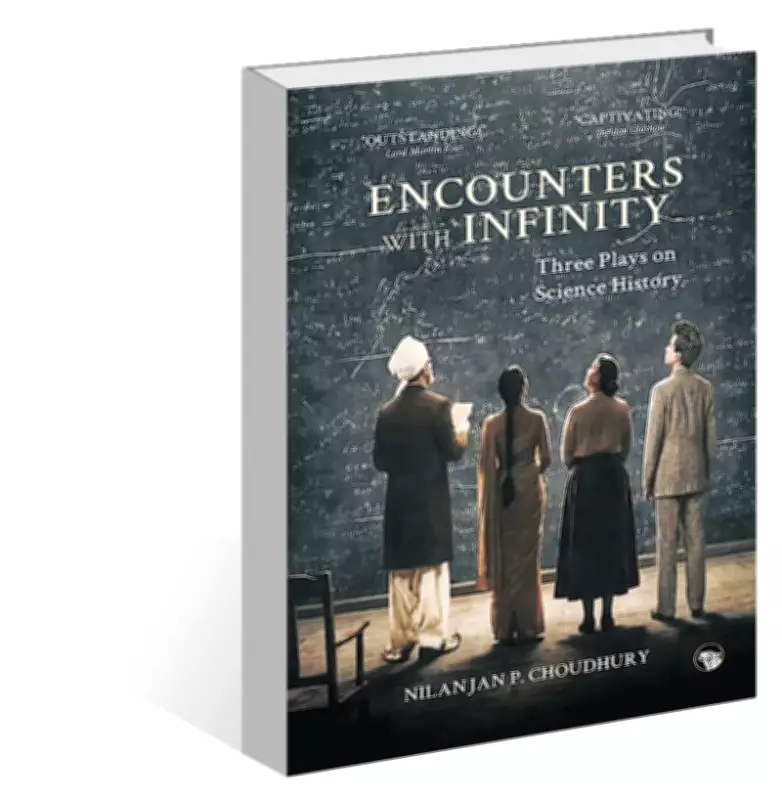
Nilanjan P Choudhury's Encounters with Infinity: Three Plays on Science History (Speaking Tiger, 221 pages, Rs 499) is a collection of three plays that dramatize the lives of key figures in modern science. Through 'The Square Root of a Sonnet', 'The Trial of Abdus Salam', and 'Invisible Particles', Choudhury explores the stories of Subrahmanyan Chandrasekhar, Abdus Salam, Bibha Chowdhuri, and Marietta Blau. Rather than straightforward biographies, these plays delve into the human dramas behind discovery: ambition, friendship, prejudice, exile, and the pursuit of truth.
Innovative Narrative Structures
Each play employs a distinct dramatic framework. 'The Square Root of a Sonnet' is a ghost play, where Chandrasekhar, his wife Lalitha, and Arthur Eddington revisit the past from an afterlife-like setting, with flashbacks. This structure is explicitly inspired by Michael Frayn's Copenhagen. 'The Trial of Abdus Salam' uses a courtroom-style interrogation, with a mysterious 'Voice' acting as prosecutor, judge, and fanatical nation. While Salam initially seems on trial, it becomes clear that the fanatical state of Pakistan and fundamentalist religious orthodoxy are the real subjects. 'Invisible Particles' reconstructs history and culminates in a ghostly reunion. Together, the trilogy examines how knowledge and power interact.
Dramatising Scientific Ideas
Choudhury skillfully dramatises scientific concepts rather than merely inserting facts. For instance, Eddington explains relativity using tablecloths, apples, and conversation. Salam's electroweak theory is linked to his philosophical and religious search for unity. Basic particle physics emerges through Bibha and Marietta's discussions of experiments and instruments. Humour prevents the scripts from becoming didactic: Lalitha teases Chandra for giving her Sommerfeld's Atomic Structure and Spectral Lines during courtship, calling him a 'nerd'. In 'The Trial of Abdus Salam', banter between Salam and the Voice includes Urdu-Hindustani repartee and self-deprecating jokes, making profound issues accessible.

Politics of Recognition and Marginalisation
The dominant theme across the three plays is the politics of recognition and historical grievances of marginalised groups. The protagonists are all 'outsiders': Chandrasekhar, a colonial Indian in Cambridge struggling with betrayal; Salam, an Ahmadi Muslim in Pakistan confronting scientific universalism versus political exclusion; Blau, a Jewish woman in Nazi Europe; and Bibha, an Indian woman in a male-dominated field facing erasure. The conflicts are not just between science and society, but between truth and recognition, conviction and compromise, ambition and justice. All three plays are haunted by the fear of being forgotten. Lalitha carries a 'box of memories' into the afterlife, Salam worries about how history will remember him, and Bibha and Marietta discuss the 'long list of women made invisible by history'. The book repeatedly asks: Who gets remembered? Who gets erased? Who writes scientific history?
A Nuanced Approach to Historical Figures
Choudhury resists simplistic binaries of villains and victims. In his author's note to 'The Square Root of a Sonnet', he explains his effort to move beyond portraying Eddington as a mere antagonist and Chandrasekhar as a wronged hero, exploring nuances instead of painting a black-and-white picture. This is a welcome deviation from many simplistic victim-villain narratives.
The Tradition of Science Theatre in India
The reviewer, TV Venkateswaran, a visiting professor at IISER Mohali, recalls the pioneering work of Kerala Sasthra Sahitya Parishad (KSSP) in using theatre for public engagement. During the Emergency (1975-77), KSSP turned to theatre as a vehicle for civic resistance. Their adaptation of Brecht's Galileo resonated with audiences, with the Inquisition representing authoritarian machinery. Plays like 'Ekalavyante Peruviral' and 'Visham' raised questions about exploitation, caste oppression, gender justice, and environmental degradation. These experiences taught that theatre can humanise abstract concepts and foster emotional engagement with science-society intersections.

Connecting to Classical Indian Drama
Venkateswaran draws parallels between Choudhury's plays and classical Indian farces like 'Mattavilāsa-Prahasana' (attributed to Pallava king Mahendravarman I, c. 7th century CE) and 'Bhagavadajjukam', which satirised dogmatic philosophers and ascetics. These works questioned who gets to claim authority over knowledge and how claims to truth should be judged. Similarly, Choudhury's scientists are closer to these truth-seekers than to Faustus or Copenhagen figures. The central tension lies not in the dangers of knowledge itself, but in the human and institutional forces that shape recognition and exclusion.
A Distinctive Voice in Indian Science Theatre
This collection revives memories of earlier science theatre experiments in India while carving out a distinctive contemporary voice. Choudhury moves beyond familiar questions of discovery and ethics to foreground scientific temper, exclusion, recognition, and social justice. He insists on a genuinely universal vision of science that acknowledges contributions across cultures, nations, religions, and genders. Encounters with Infinity presents science not merely as a body of knowledge, but as a profoundly human and collective enterprise shaped by both triumphs and silences.