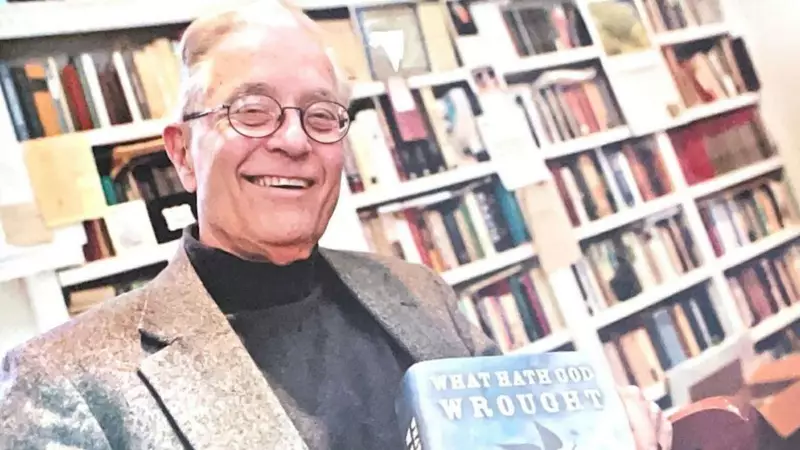
The world of historical scholarship has lost a towering figure. Daniel Walker Howe, the acclaimed historian who won the Pulitzer Prize for his masterful work on early 19th-century America, has passed away. He was 88 years old.
His death was confirmed by his wife, Susan Howe, to The New York Times. The cause was attributed to complications arising from a fall. Howe's passing marks the end of an era for students and scholars of American history, who revered his insightful and transformative narratives.
A Life Dedicated to Unraveling America's Past
Born on January 10, 1937, in Ogden, Utah, Daniel Walker Howe's academic journey was illustrious. He earned his undergraduate degree from Yale University before crossing the Atlantic to study at Magdalen College, Oxford, as a Rhodes Scholar. He later completed his PhD at the University of California, Berkeley.

Howe's career was spent at some of the most prestigious institutions. He taught at Yale University, the University of California, Los Angeles (UCLA), and finally at Oxford University, where he was a professor emeritus. His teaching influenced generations of historians, instilling in them a rigorous approach to understanding the forces that shaped a nation.
The Pulitzer Prize and a Seminal Work
While Howe authored several important books, his magnum opus was undoubtedly What Hath God Wrought: The Transformation of America, 1815-1848. Published in 2007, this volume became part of the renowned Oxford History of the United States series.
The book was met with widespread critical acclaim for its sweeping yet detailed analysis of a pivotal period. In 2008, it was awarded the Pulitzer Prize for History, cementing Howe's reputation as a preeminent scholar. The Pulitzer committee praised the work as a "penetrating analysis of the transformative period between 1815 and 1848."
In this book, Howe argued that the era was defined not just by political expansion like Jacksonian democracy, but crucially by a communications revolution—the rise of the telegraph, railroads, and a vibrant print culture. He masterfully wove together technological innovation, religious fervor, and political conflict to explain how modern America began to take shape.
Legacy of a Distinguished Scholar
Daniel Walker Howe's contributions extend beyond his Pulitzer Prize. His earlier work, The Political Culture of the American Whigs, is still considered a foundational text on the subject. He was known for his clear prose, meticulous research, and ability to challenge conventional historical wisdom.
His passing is deeply felt across academic circles. Colleagues and former students remember him not only for his intellectual brilliance but also for his kindness and dedication as a mentor. He leaves behind a rich body of work that will continue to inform and inspire future explorations of American history.
Howe is survived by his wife, Susan Howe, a distinguished poet and professor. His first marriage to Lynn Wisham ended in divorce. His family, friends, and the global community of historians mourn the loss of a true giant in the field, whose books will remain essential reading for anyone seeking to understand the complex tapestry of the United States.