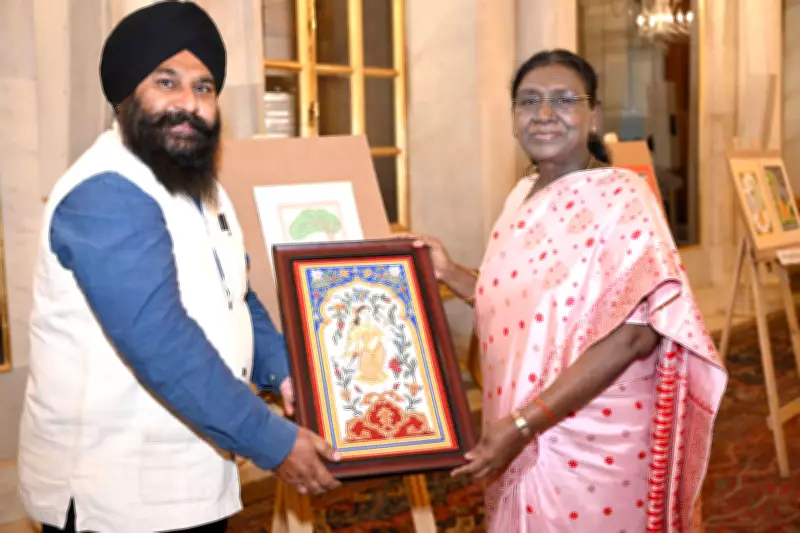
Gurprit Singh Mankoo, a 50-year-old former commercial portrait painter from Ludhiana, has been honoured at Rashtrapati Bhawan for his decade-long mission to preserve Punjab's vanishing Sikh miniature art form, known as Mohra Kashi. He was one of only 11 traditional artists selected nationwide for the Artists-in-Residence programme, where President Droupadi Murmu presented him with a ceremonial shawl and memento.
Presidential Recognition for Traditional Art
During the 10-day residency in Delhi, Mankoo exhibited his highly detailed pieces to President Murmu. A statement from the President of India's official X account praised the residency as a vital cultural safeguard: "President Droupadi Murmu met a group of artists of traditional miniature art forms of India and witnessed their work at Rashtrapati Bhavan. The Artists-in-Residence programme is a celebration of the spirit of India’s artistic traditions, reaffirming the important role of living art traditions in preserving cultural identity and inspiring future generations."
Mankoo expressed profound honor at presenting his work to the President and collaborating with fellow traditional masters. His invitation followed a recommendation from Padma Shri laureate Jai Prakash Sharma.

Journey into Mohra Kashi
Mankoo's artistic journey began in childhood under the mentorship of noted Ludhiana realist painter Dilbagh Singh. He spent his early career painting conventional landscapes and portraits for local collectors. However, a 2014 restoration project at Sri Harmandar Sahib (the Golden Temple) in Amritsar transformed his focus. There, he discovered the beauty of traditional fresco and miniature detailing, inspiring him to rescue the fading art form from obscurity.
He pivoted to studying ancient lime-plaster techniques, organic mineral pigments, and holy geometric motifs. Working from a family-run home studio with guidance from Bengaluru-based mentor M V Kambar, Mankoo now dedicates his practice to preserving the spiritual essence of Punjabi heritage.
"In an era obsessed with speed and convenience, this art demands slow, deliberate craftsmanship," Mankoo said. "My goal is to inspire younger generations to learn these roots so the legacy survives."
What is Mohra Kashi?
Mohra Kashi is an ancient fresco technique indigenous to Punjab, reaching its zenith in the 19th century under Maharaja Ranjit Singh's royal patronage. Often called the bedrock of the historic Sikh School of Art, it is a highly specialized "buon fresco" method where natural, hand-ground mineral and stone pigments are painted onto layers of wet, slaked lime plaster. The artwork must be completed while the plaster remains damp, allowing the pigments to chemically fuse with the curing lime. As the wall dries, the paint becomes a structurally permanent part of the building, rendering vibrant floral and geometric motifs durable for centuries. Historically, this craft adorned havelis, temples, and gurudwaras, including the interior walls of Sri Harmandir Sahib.
Mankoo's recognition underscores the importance of preserving such traditional art forms in an age of rapid modernization.