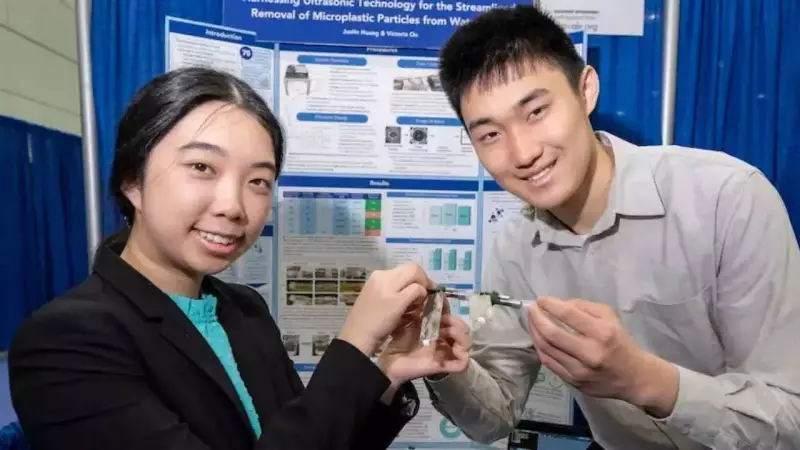
At first glance, the device appears unremarkable. It is slim and cylindrical, small enough to fit comfortably in your palm. You will find no filters to replace, no chemicals to add, and no moving parts to monitor. Water simply enters one end, and cleaner water flows out the other. This elegant simplicity is entirely deliberate.
High School Innovators Tackle a Global Problem
Victoria Ou and Justin Huang, two high school students from Texas, started this project after discovering how incredibly difficult it is to remove microplastics from water once they reach treatment systems. Instead of trying to improve existing filters, they asked a different and more creative question. Could they use sound to separate tiny plastic particles without ever trapping them?
Their innovative answer took the shape of a pen-sized ultrasonic device. This tool relies on the principles of physics rather than traditional filtration. For their groundbreaking work, they received the prestigious $50,000 Gordon E. Moore Award. This is the highest honor at the 2024 Regeneron International Science and Engineering Fair, placing their project among the most celebrated student research efforts this year.

How the Tiny Device Works
The prototype may look modest, but its operation is remarkably precise. Water flows through a narrow chamber. Inside, piezoelectric transducers generate powerful ultrasonic acoustic waves. These waves create specific pressure zones that gently push microplastic particles out of suspension. The particles move into concentrated regions, allowing them to be separated cleanly from the flowing water.
Because the system depends on physical forces instead of membranes or chemicals, it avoids common pitfalls. There is no filter clogging and no risk of secondary contamination. In controlled laboratory tests presented at the ISEF competition, the device successfully removed between 84 and 94 percent of microplastics in a single pass. It achieved flow rates of about 40 milliliters per minute. The students have been careful to describe these results as coming from a research prototype, not a finished consumer product ready for the market.
The Persistent Challenge of Microplastics
Microplastics are notoriously hard to eliminate from water systems. Their extremely small size and irregular shapes allow countless particles to slip right past the standard filtration methods used in most treatment plants today.
A landmark 2018 investigation by Orb Media brought this issue into sharp public focus. The study detected microplastics in the majority of tap water samples tested across seven different countries. Since that report, numerous studies have identified microplastics not just in rivers and oceans, but also in our food, the air we breathe, and even human blood.
The United Nations Environment Programme estimates that millions of tonnes of plastic waste enter the environment every single year. This waste gradually breaks down into microplastics, which become nearly impossible to recover once they are widely dispersed.
Miniaturizing a Scientific Concept
Researchers have explored ultrasonic separation in academic labs for years. However, these systems usually required large, specialized, and expensive equipment. The judges at ISEF highlighted a key reason Ou and Huang's project stood out among thousands of entries. The students successfully miniaturized the complex concept into a compact, fully functional system.
Experts view the students' approach as a highly promising supplementary technology. It could be particularly useful for specialized applications or in pre-treatment stages. It is not seen as a direct replacement for our existing large-scale water infrastructure, but as a valuable tool that could enhance it.
Viral Attention and Real-World Limits
Images and videos of the pen-sized device have spread widely across the internet, drawing massive public attention to the project. Amid this viral interest, Ou and Huang have remained clear and realistic about the device's current limits.

Scaling this technology for wider use would require significant improvements. Engineers would need to boost its durability, enhance its energy efficiency, and ensure strong performance across a much broader range of real-world water conditions. These challenges are typical for experimental water purification systems and would likely demand several more years of dedicated research and development.
For Victoria Ou and Justin Huang, winning this major award marks just the beginning of a longer scientific journey. For everyone else watching their progress, their work delivers a powerful message. It shows how careful experimentation and clear, innovative thinking—even at the high school level—can make a meaningful contribution to solving one of the most complex environmental problems of our modern era.