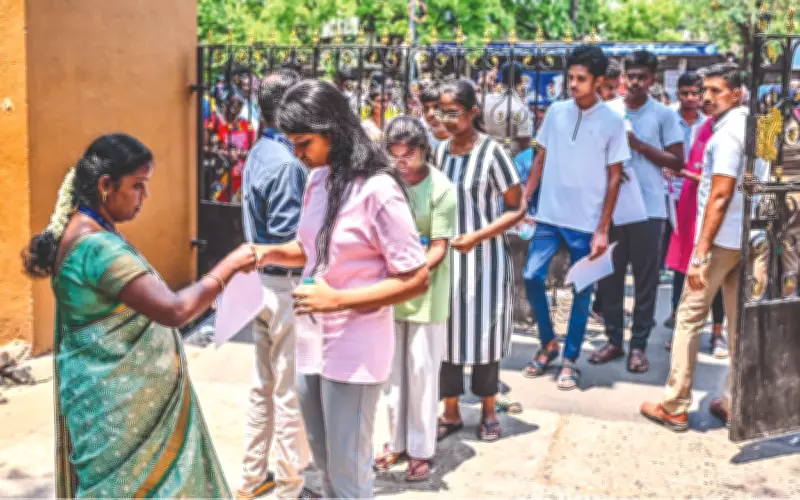
India has cancelled its national medical entrance examination, NEET-2026, following yet another question paper leak. The decision has plunged more than 23 lakh students and their families into uncertainty, reigniting a debate about systemic dysfunction at the National Testing Agency (NTA), which administers the exam.
Outrage Over Repeated Failures
Student counsellor Manickavel Arumugam expressed frustration, stating, “Heads should have rolled in 2024, when there was information about a paper leak. The allegations were brushed under the carpet. Had we dealt with it in 2024, it would not have happened again. NTA should at least have introduced reforms and considered shifting to a phased computer-based test such as JEE instead of conducting a pen-and-paper exam for so many students.”
Over the years, NEET has been plagued by impersonation scams, question paper leaks, errors, and correction goof-ups. Its systems and processes have been debated in state assemblies, Parliament, courts, and the media. Yet little has changed. Several agencies, including the Central Board of Secondary Education (CBSE), have been placed in charge of the test at different points. However, unlike CLAT, CUET, or JEE, NEET — which has the largest student base of any entrance exam — has remained the most persistently controversial.

Impact on Students and Families
The consequences of cancellation extend beyond a postponed exam date. Coaching centres have begun rescheduling crash courses ahead of the re-examination, expected in July or August. S Sanjay, who completed Class XII in 2025, said, “I took a year-long course. After writing the NEET exam, I thought it was over. I will probably have to do another refresher just to write the exam again. My parents may have to pay for crash courses and mock tests again.”
The disruption cascades through the medical education system. The National Medical Commission mandates that the academic year begin by August 1, with a month-long foundation course before core coursework starts on September 1. Delays in exams, results, and admissions force colleges to compress the academic calendar. K Karthikeyan, an MBBS student beginning his internship, noted, “Teachers rush through portions. Co-curricular activities are cut down, and there are no holidays for at least the first two years of the course.”
Broader Consequences for Healthcare
Hospitals also feel the impact. Final-year medical students serve as interns for a year, forming a critical layer of the workforce in government hospitals. When batches start late, gaps open between outgoing and incoming interns. A senior professor at a government medical college said, “The next batch ends up coming in about four months after the previous batch leaves. It affects service.”
The career toll compounds with each passing year. Students who begin late finish late — and often miss postgraduate exam cut-off deadlines, forcing a year-long wait before they can begin PG preparation. Dr V N Alagavenkatesan, parent of NEET aspirant Vimela Venkatesan, urged, “Before students appear for the next exam, government must initiate action against those responsible.”
Loss of Faith in the System
For students such as M S Srinivasan, the systemic failure has shaken their faith entirely. “I’ve started looking at alternatives to study medicine abroad,” he says. Yet most know they have little choice but to try again — in India, the white coat, for now, comes only one way.