Sarnath Banerjee's Drifting Narrative: From Rich Loneliness to Cross-Border Love
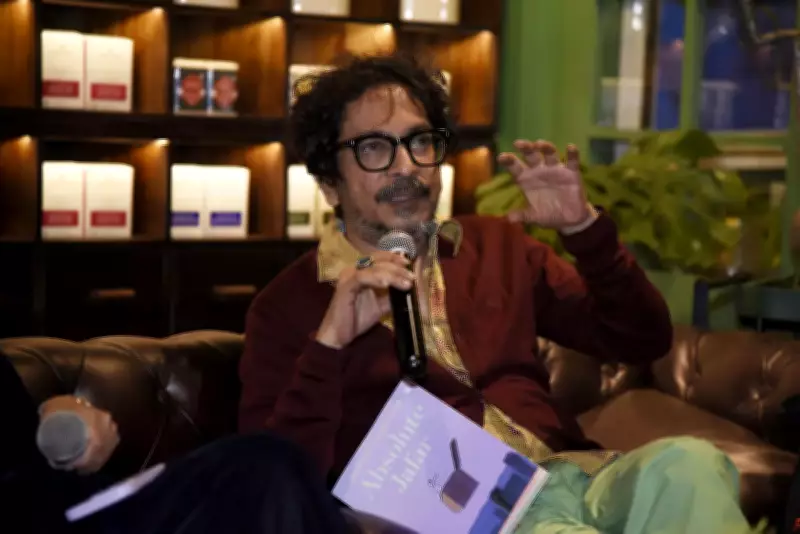
In a captivating evening conversation with Malavika Banerjee, graphic novelist Sarnath Banerjee demonstrated his signature non-linear storytelling style. He doesn't speak in straight lines but rather drifts, loops back, and detours through diverse territories—cricket metaphors, Japanese art, Berlin loneliness, and Karachi folklore—often within the same breath.
The Beauty of "Rich Loneliness"
One of the evening's most lingering ideas was loneliness as a landscape. Banerjee spoke poetically about "a silence that you would find in College Street after the last office-goer has gone to the Chinese restaurant and had his drink and the pavements are still warm with footsteps of office-goers and sellers of books and vendors." He described walking into a drama hall and "seeing this amazing, very pregnant, very articulate, very beautiful loneliness carved out of a place that was full of hubbub."
This "rich loneliness" is particularly significant for Bengali men, he noted, often bound up with dhoopur—those afternoons "when you do your schooling, your thinking, your literature." Yet Banerjee was quick to clarify: "I don't have any interest in nostalgia, I've lived through that world and I've done, and should." He warned that attempts to recreate old College Street risk becoming "a cheap simulacra," adding that "my son is not going to be like me, it is his hormonal duty to rebel against his father."

"An Indo-Pak Marriage is Like a Lifelong Problem"
At the heart of Banerjee's work lies his own cross-border love story, which moderator Malavika Banerjee jokingly called "a popular new disease, a lifelong problem." Banerjee embraced this characterization as he confessed: "I had zero chance in Delhi. My reputation was ruined. Then I found an unsuspecting Pakistani woman who in a moment of affection said, 'You look like my sister.' That was my moment."
He added dryly that his mother "did not take that very kindly." The marriage brought a whirl of cities, cultures, relatives, and contradictions, eventually leading to a son whose tales entered Banerjee's work. "The boy's stories are so good," Banerjee laughed, recalling how "he wants a salary. He was nine years old. First he said 60 cents. Then 50. Then 30. Finally we agreed."
Even as he joked about doing "TED Talks on how to prevent Indians and Pakistanis from getting married," he admitted the journey pushed him through layers of stereotype into everyday discovery: "You find the jokes, the food, the eccentric relatives, and all of that comes through the stories the father tells his son, the jinn stories."
"I Don't Draw What I See, I Draw from Memory"
Despite his archival approach to storytelling, Banerjee clarified that he isn't nostalgic in the conventional sense. He collects fragments of life—cassettes, paper punches, everyday objects—but these serve as tools for "historicizing emotion, how we felt at a particular time."
Comics, he believes, are uniquely suited to this task because they allow the second imagination to flourish, capturing both the seen and the unseen. Even his mother's critiques became part of this archive: "She would say, 'He can't even draw like he should.' But that friction shaped my work," he laughed.
The interplay between text and image in comics, he argued, mirrors life itself: "Two people may interact, disagree, or act independently, yet the landscape and story continue to evolve on their own logic." He shared that "my mother was convinced I couldn't do either words or pictures properly. She thought I was just doing some clever sleight of hand—decorating things instead of really drawing. It took years to explain to her that comics work in silences as much as in lines."
The evening unfolded as a journey across time zones and emotional landscapes, where stories weren't just told but collected, archived, and gently teased into existence. Rounds of Darjeeling tea steamed on the tables while a savory-to-dessert spread of small bites quietly made its way through the room, grounding the drifting ideas in warmth, aroma, and taste.