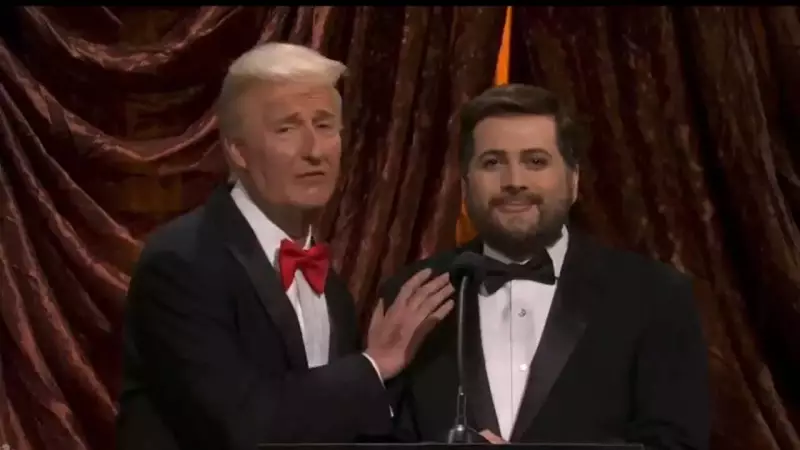
This week's episode of Saturday Night Live began not with a traditional cold open, but with a surreal, self-congratulatory fever dream centered on former US President Donald Trump. The sketch presented a bizarre alternate reality where Trump hosted his own media awards ceremony, aptly named "The Trumps."
A Self-Referential Awards Extravaganza
In this satirical segment, Trump was not only the host but also the sole nominee and winner across every category. This mirrored real-world events, where Trump recently presided over the Kennedy Center honors at the prestigious arts institution he had renamed after himself. The sketch served as a twisted parody of the actual awards circuit, highlighting the former president's penchant for self-aggrandizement.
Viral Clip and Controversial Dialogue
A clip from the sketch quickly went viral, featuring James Austin Johnson's portrayal of Donald Trump and Jeremy Culhane as Vice President JD Vance. The duo appeared on stage to announce nominations for "best picture of Trump." Their exchange took a contentious turn:

- Vance: "Did you know that if I win in 2028, I'll be the first president in 100 years to have a beard?"
- Trump: "Wow! And speaking of your beard, how's your wife Usha?"
- Vance: "Very good, sir."
- Trump: "I'm insinuating you're gay."
Social Media Backlash Erupts
This particular joke ignited immediate backlash across social media platforms. Viewers expressed their displeasure, accusing the show of crossing a line with homophobic humor.
One user commented pointedly, "So leftists are allowed to be homophobic and racists now?" This remark underscored the perceived hypocrisy in the sketch's approach.
Another critic noted, "Saturday Night Live really dusted off a joke from the Beard Discourse Vault and said, 'Yep, still runs'." This observation suggested the humor felt outdated and recycled, lacking in contemporary sensitivity.
Broader Implications for Satirical Comedy
The controversy raises important questions about the boundaries of political satire. While SNL has a long history of lampooning public figures, this instance highlights the fine line between clever parody and offensive commentary. The show's attempt to critique Trump's persona inadvertently ventured into territory that many found discriminatory, sparking a broader conversation about responsible humor in today's culturally aware landscape.
As the clip continues to circulate online, it remains a testament to the powerful, and sometimes polarizing, impact of late-night comedy on public discourse.