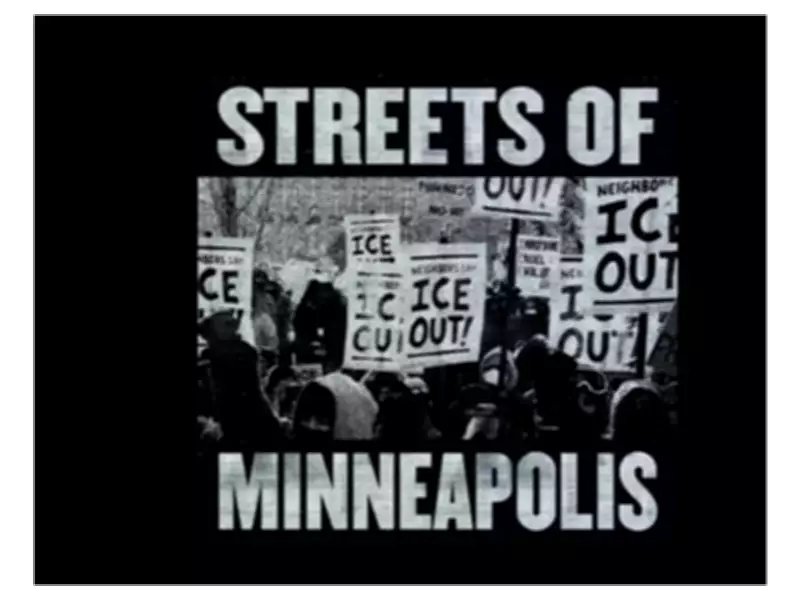
Bruce Springsteen Unleashes Powerful Protest Anthem 'Streets of Minneapolis'
In a bold artistic statement that marks one of his most politically charged releases in decades, legendary singer-songwriter and guitarist Bruce Springsteen has unexpectedly dropped a new protest song titled 'Streets of Minneapolis'. The track serves as a direct musical response to recent immigration enforcement operations and alleged state actions in Minneapolis that have sparked national controversy.
A Swift Musical Response to Current Events
Taking to his official Instagram account, Springsteen shared the inspiration behind his urgent creative process, revealing he wrote the song on Saturday, recorded it the following day, and released it immediately to his global audience. The rock icon explained his intention to address what he described as "state terror" occurring in Minneapolis while honoring two American citizens who lost their lives during recent operations.
"I wrote this song on Saturday, recorded it yesterday and released it to you today in response to the state terror being visited on the city of Minneapolis," Springsteen wrote in his social media post. "It's dedicated to the people of Minneapolis, our innocent immigrant neighbors and in memory of Alex Pretti and Renee Good. Stay free, Bruce Springsteen."

Lyrical Content and Musical Arrangement
The powerful track opens with a full-band arrangement that builds into stirring sing-along moments, featuring Springsteen's signature storytelling through vivid imagery. The lyrics paint a dramatic picture of urban conflict, referencing specific locations like Nicollet Avenue while criticizing federal enforcement actions.
Key verses include: "Through the winter's ice and cold/ Down Nicollet Avenue/ A city aflame fought fire and ice/ 'Neath an occupier's boots/ King Trump's private army from the DHS/ Guns belted to their coats/ Came to Minneapolis to enforce the law/ Or so their story goes."
In a tribute section honoring Minneapolis citizens, Springsteen continues: "Against smoke and rubber bullets/ By the dawn's early light/ Citizens stood for justice/ Their voices ringing through the night. And there were bloody footprints/ Where mercy should have stood/ And two dead left to die on snow-filled streets/ Alex Pretti and Renee Good."
Context and Celebrity Reactions
Bruce Springsteen now joins a growing list of prominent celebrities who have publicly criticized Immigration and Customs Enforcement (ICE) actions in Minneapolis. Other notable figures who have voiced concerns include:
- Billie Eilish
- Jimmy Kimmel
- Dave Matthews
- Olivia Rodrigo
- Stephen Colbert
The song's release follows the tragic deaths of two U.S. citizens during recent immigration enforcement operations. Renee Good, a 37-year-old mother of three, was reportedly shot on January 7 during protests against what demonstrators called militarized raids. Alex Pretti was killed at point-blank range on January 24 after being restrained by federal officers, according to reports.
Springsteen's History of Social Commentary
This is not the first time Bruce Springsteen, affectionately known as "the Boss," has used his musical platform to address pressing social and political issues. His extensive catalog of protest songs and socially conscious music includes:
- 'American Skin (41 Shots)' from 2001, responding to the 1999 NYPD killing of unarmed immigrant Amadou Diallo
- The widely misunderstood but fundamentally critical 'Born in the USA', which serves as an anti-Vietnam War anthem
- 'Streets of Philadelphia', addressing the AIDS crisis and earning him an Academy Award
According to Billboard magazine, Springsteen has consistently demonstrated a willingness to engage with difficult national conversations through his art, establishing himself as one of America's most important musical commentators on social justice issues.

The release of 'Streets of Minneapolis' represents Springsteen's latest contribution to this tradition, arriving at a moment of heightened tension around immigration enforcement and urban policing practices in the United States.