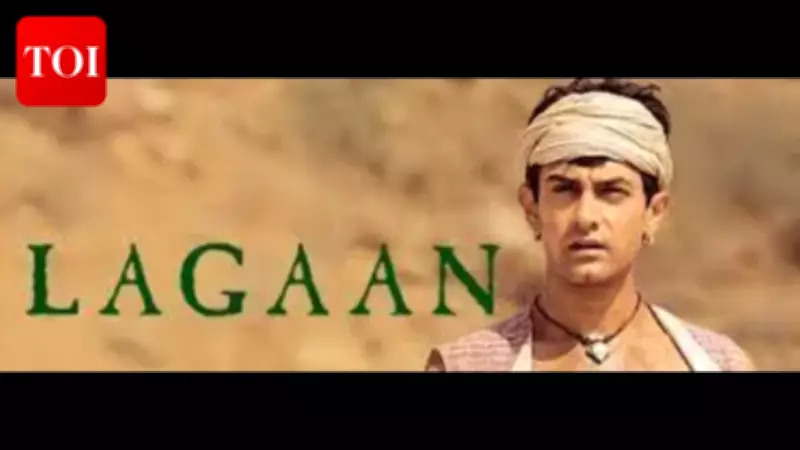
A quarter of a century ago, the film industry passed on a four-hour period musical about villagers playing cricket against the British Raj. This weekend, from June 12 to 14, that same film returns to Indian cinemas for a special three-day run, marking 25 years since its original release on June 15, 2001. The gap between those two facts tells the whole story of Lagaan, a film almost nobody wanted to fund and that nobody has since been able to forget. When Lagaan: Once Upon a Time in India returns to cinema screens this weekend, it will do something a 224-minute period musical about cricket and colonial taxation has no business doing in the streaming age: it will fill halls. A generation not born when the film first released will sit through nearly four hours of a story it already knows by heart and will still hold its breath at the final over. That, more than any award, is the measure of what Ashutosh Gowariker created. Here are 25 things that made Lagaan unforgettable.
Production and Scale
1. The film that built a studio
Lagaan was the maiden production of Aamir Khan Productions. The banner did not pre-exist the film; it came into being because no established producer was willing to bankroll so unconventional an idea, and Aamir Khan finally decided to put his own money where his belief was. This reflects Aamir Khan's vast body of work: the one-movie-per-year idea, shying away from bulk when that was the norm, and the guts to trust his instinct when everyone was a skeptic.
2. A first-timer at the helm of production
Aamir's then-wife, Reena Dutta, served as executive producer, taking charge of one of the most logistically daunting shoots in Hindi cinema with no prior film experience. She ran a self-contained unit in the middle of nowhere and brought it home.

3. A first cut that ran seven and a half hours
By Aamir's own recollection, the earliest assembly of the film stretched to roughly seven and a half hours, with close to four of those hours covering everything before the cricket match began. Gowariker remembers it as closer to five. Either way, it was eventually disciplined down to the theatrical runtime of three hours and forty-four minutes. Even in the pre-social media era, when audiences had patience for long movies, this was a huge risk. To today's generation, accustomed to shorter runtimes, Lagaan was the pathbreaker that set the rule: if an idea, story, script, and editing are good, people will sit for almost four hours in a cinema hall.
4. A village raised from the dust
The entire village of Champaner was built from scratch on the barren flats of Kutch in Gujarat. There was no existing location to dress. The mud walls, lanes, and temple were all constructed, lived in for the length of the schedule, and left behind. Champaner is a UNESCO World Heritage Site, renowned for being an exceptionally preserved pre-Mughal Islamic city and a major Hindu pilgrimage center, located about 50 km from Vadodara at the foothills of the Pavagadh volcanic hill.
5. Air-conditioning in a drought
For all that the film depicts a parched, famine-struck 19th-century village, the quarters built for the cast and crew in that desert were said to come fitted with modern comforts, including air-conditioning and toilets. The contrast between the suffering on screen and the practical needs of a long shoot off it became part of the film's lore.
The Script and Casting
6. Bhuvan, before Aamir
The role that defined Aamir Khan was, by several accounts, offered around first. Shah Rukh Khan was reportedly approached and declined, after which Hrithik Roshan and Abhishek Bachchan were also in the frame before the part came to Aamir. He too hesitated, famously calling it "a strange idea," before committing not only as the lead but as the producer.
7. An Englishman learning Hindi by ear
Paul Blackthorne, who played the cold, contemptuous Captain Andrew Russell, did not speak Hindi. He learned every one of his Hindi lines phonetically, syllable by syllable, which makes the menace he carries on screen all the more remarkable.

8. The largest British contingent in an Indian film
Along with Kulbhushan Kharbanda as Raja Puran Singh, Lagaan assembled what was then the biggest ensemble of British actors ever cast in a Hindi film. The region's erstwhile royals are also said to have helped the production with vintage cars and location support.
9. A heroine's first film
Gracy Singh made her feature debut as Gauri, holding her own in an ensemble dominated by veterans. The casting churn ran deep across the unit; the role of Bhura that Raghubir Yadav eventually played had first been offered to the late Ravi Baswani.
10. The voice that framed it all
Amitabh Bachchan lent his unmistakable baritone to the opening and closing narration, setting the legend in motion and gently laying it to rest at the end. It is the voice you hear before you see a single villager on screen.
Music and Sound
11. Recorded live, against the odds
Lagaan was among the first major Hindi films in decades to be shot in sync sound, capturing dialogue on location rather than dubbing it later in a studio. For a film of this scale, shot outdoors with a vast cast, it was an enormous technical gamble that paid off in texture and realism.
12. The tyranny of silence
Sync sound meant the desert had to be genuinely silent for every take. A single hand pump or a tractor working a couple of kilometres away could ruin an entire shot, so the unit had to hunt down and shut off every stray source of noise across a wide radius before the cameras could roll.
13. A score that carried the story
"Ghanan Ghanan" turns the longing for rain into communal euphoria, "Mitwa" swells with resolve, and "Radha Kaise Na Jale" sets the love triangle to a folk pulse.
14. The anthem of the making
"Chale Chalo," the rousing call to keep marching, became more than a song in the film. It turned into the unofficial rallying cry of the production itself and later gave its name to the feature-length documentary that chronicled the shoot.
15. A prayer for everyone
The film's devotional heart is "O Paalanhaare," a bhajan written so that it belongs to no single faith, addressing a protector that a believer of any religion can claim as their own. It anchors the film's quietly principled spine: the idea of defeating the coloniser by his own rules and without raising a weapon, which gives Lagaan its undefeated moral core.
Behind the Scenes
16. A cricketing boot camp
The actors playing the villagers were put through months of cricket coaching before filming so that they could play convincingly, with period-appropriate bats and equipment rather than modern gear. The clumsiness of men learning the game had to be earned, then unlearned.
17. A shoot that ran on sheer will
The making demanded a kind of endurance that has passed into legend. Gowariker, struck by a debilitating back ailment, is said to have directed portions of the film lying down, while the ailing veteran AK Hangal kept turning up to shoot so the production would not stall.
18. Ten thousand villagers in the stands
The grand cricket sequences called for crowds on a scale rarely attempted, and the production drew on roughly ten thousand local people from in and around Bhuj as extras to fill the match with genuine, roaring life.
19. Real heat, real drought
None of the desolation was faked. Daytime temperatures on the outdoor shoots regularly climbed past 45 degrees Celsius, and because the region was suffering an actual prolonged drought, the scenes that needed rain had to be created with water tankers—the irony of which was lost on no one.
20. The earthquake that came after
The land that gave the film its parched beauty turned tragic soon after. Bhuj was devastated by the catastrophic earthquake of January 26, 2001, only months after the unit had wrapped its work there—a sombre footnote to a place that had hosted such a joyful effort.
Global Impact and Legacy
21. Only the third to reach the Oscars
Lagaan earned a nomination for Best Foreign Language Film at the 2002 Academy Awards, becoming only the third Indian film ever shortlisted in the category, after Mother India in 1957 and Salaam Bombay! in 1988. The statuette went to the Bosnian war drama No Man's Land, but the nomination alone carried the film to the world.
22. A box office it had no business winning
Made on a budget of around Rs 25 crore, Lagaan collected roughly 65 crore worldwide and stood among the highest earners of 2001, all while sharing its release date with the blockbuster Gadar: Ek Prem Katha. Two very different visions of the freedom struggle opened together, and both found their audiences.
23. A clean sweep of the awards
The film dominated the year's award circuit, winning eight National Film Awards—the most of any film that season—and matching that with eight Filmfare Awards including Best Film, Best Director, and Best Actor. The trophy cabinet groaned louder than the villagers ever did.
24. A soundtrack for the ages
AR Rahman's work on Lagaan is routinely ranked among the finest in the history of Indian cinema, blending folk textures, Western orchestration, and classical Indian vocals into something that has refused to date. A quarter of a century on, the songs are still alive on playlists, long after many of the year's bigger hits have faded from memory.
25. The big screen, again
To mark the milestone, Lagaan is set to play on the United Kingdom's largest IMAX screen at the BFI IMAX in London on July 12, 2026, as part of the London Indian Film Festival, with Aamir Khan appearing in a rare in-conversation session a few days later to revisit how it was all made. The film that the industry once would not fund is now an honoured guest on the world's grandest screens.
The afterlife of this blockbuster tells us the most about its legend. Lagaan set a template—the underdog rising through sport against impossible odds—that Hindi cinema has been reworking ever since, in films like Chak De! India and Dangal. It made a director the industry had written off into a name to reckon with, and it turned an actor into a producer who would go on to shape the films that followed. Twenty-five years later, audiences who were not even born when Lagaan was released will sit through three hours and forty-four minutes and still hold their breath at the final ball. That is why this movie is coming back, and that is why people will go to the cinema hall. It is a fitting tribute, because Lagaan was always a film built for the big screen and the collective gasp of a packed auditorium rather than the solitary glow of a phone. To understand why it endures, it always helps to remember just how unlikely its existence was in the first place.