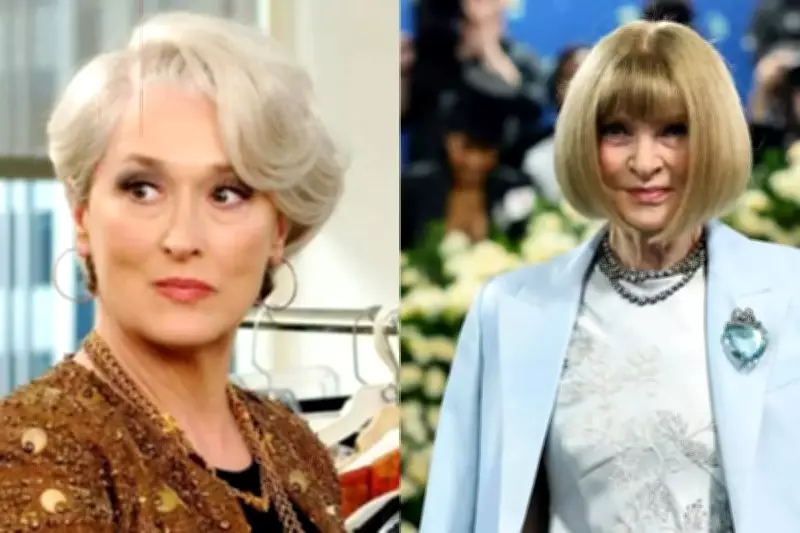
In the glittering prelude to The Devil Wears Prada 2, set to hit Indian screens today, one image lingers with particular resonance: Anna Wintour, Vogue editor from 1988 to 2025, and actress Meryl Streep, captured together for Vogue's May cover by the legendary Annie Leibovitz. On the cover, they stand clad in Prada, the real-life force and her cinematic echo, trading glances that speak volumes about power, performance, and the art of never apologizing for ambition.
The Shared Journey of Ambition
This thread is common to both Wintour and Streep's career journeys. Streep was told early in life she wasn't "beautiful enough" for Hollywood leading lady roles. She now holds the record for the most Oscar nominations for acting among women in Hollywood, with 21 nominations and three wins. She is one short of crossing Katharine Hepburn, who won four Oscars. Knowing Streep's trajectory, it is a matter of time before she surpasses this record. Wintour's story, however, is one that most are not familiar with. It started as a story about fashion and became a story of vision and a legend, a cultural reset that changed fashion's lexicon forever.
Streep's portrayal of Miranda Priestly in The Devil Wears Prada (2006) as the glacial, exacting, and unforgettable "boss from hell" has long been whispered to draw from Wintour's own legend. Yet as the sequel arrives, it is Wintour herself who emerges as the true auteur of the fashion narrative, the woman whose existence has unfolded with a cinematic sweep far grander, more ruthless, and infinitely more fabulous than any Hollywood confection could hope to capture.

The real story, the one Hollywood borrowed but could never fully capture, is not about a difficult boss. It is about a woman who dismantled an entire cultural system and rebuilt it in her own image. Wintour's most radical act was not cruelty, but clarity and great ambition. Her greatest revolution began not in a boardroom, but on a New York street in 1988, with a couture jacket and a pair of jeans.
The Novel and Its Impact
Lauren Weisberger's 2003 roman à clef, The Devil Wears Prada, and its blockbuster 2006 cinematic adaptation cleverly rode the coattails of Wintour's aura, distilling the high-stakes ballet of Runway magazine into a millennial parable of demanding bosses, beleaguered assistants, and the seductive terror of impossible errands. The character Andy Sachs, played by Anne Hathaway, captured the zeitgeist: the boss Priestly-Wintour as ice queen, the intern Weisberger-Hathaway as the wide-eyed Everywoman navigating a world where a cerulean sweater could trace its lineage back to Oscar de la Renta.
When the movie came out in 2006, designers reportedly quivered at the prospect of association, fearing blackballing. Yet Wintour, ever the strategist, met the phenomenon with characteristic poise. She called the original film "entertainment" laced with "a lot of humour and wit." She even attended a screening, and for the sequel, offered pointed notes on set. The former Vogue editor, now global chief content officer and artistic director at Condé Nast, insisted, for instance, that a Dior office scene feature only white flowers, as the house would decree. A cameo was floated but ultimately deemed "too meta." In the end, the movies borrowed her lightning, but she still remains the storm.
The Revolutionary Cover
To understand the woman behind the bob and the perpetual sunglasses, one must return to November 1988, a single cover that detonated decades of convention and rewired the global fashion lexicon. Freshly installed as editor-in-chief of American Vogue, Wintour inherited a publication steeped in the "beige years" of the Marie Grace Mirabella era. Mirabella's tenure from 1971 to 1988 had served professional women with utility and aspiration delivered through touch-me-not studio portraits: tightly cropped headshots, heavy makeup, immovable jewellery, and neutral backdrops. Fashion existed in a vacuum of perfection, preserved by distance from the street. Wintour gathered that modern women in the 1980s did not even want the Vogue-fashion ideal; they just did not know what they wanted. And Wintour did.

She sensed a different wind blowing, wanting pace, sharpness, and sexiness, imagery that reflected not just what women might wear, but how they lived. Enter Peter Lindbergh's lens and Carlyne Cerf de Dudzeele's styling on the streets of New York. The intended look was a Christian Lacroix opulent haute couture jacket with a matching skirt. But fate intervened. Nineteen-year-old Israeli model Michaela Bercu had gained a touch of weight, and the skirt refused to cooperate. Wintour, decisive as ever, discarded the offending piece and reached for the model's own stonewashed Guess jeans, retailing at a mere $50.
The result was an outtake elevated to cover glory: Bercu laughs, hair wind-tossed across her face, eyes half-closed in spontaneous delight, midriff teasingly exposed beneath the $10,000 baroque fantasy of the Lacroix jacket. The printers, accustomed to the Mirabella paradigm, rang the office in alarm, thinking it a mistake. But it was no polished sanctuary; it was raw realness, a movement, a cultural reset.
Wintour is the daughter of journalist Charles Wintour, editor-in-chief of the London Evening Standard. She grew up learning the basic tenets of journalism: relativity, far-sightedness, and chutzpah. This cover had it all. Thus began the journey of a true fashion journalist. Weisberger's chick-lit novel may have been appealing to pop culture, but it completely edited out what serious fashion journalism is all about. Remember Andy Sachs's flippant attitude towards fashion, quietly dismantled by Miranda Priestly as she explained the cultural journey of a cerulean sweater? That was that scene multiplied by a Vogue reset in 1985 that no one saw coming.
The Shift from Studio to Street
Under Mirabella, Vogue had become a carefully controlled universe, often called the "beige years," favouring studio perfection, tightly cropped headshots, heavy makeup, neutral backdrops, and a sense of polished remove. Fashion was aspirational precisely because it was unattainable. The distance between the reader and the image was the point. Mirabella's Vogue was not without intelligence, engaging with working women, politics, and the Equal Rights Amendment, but visually, it preserved fashion as a sanctuary untouched by the messiness of real life. Women who had entered the workforce en masse did not want the fashion sensibilities of the Stepford wives or to see themselves wrapped in beige.
Wintour ended that sanctuary. Her editorial philosophy was "pacy, sharp, and sexy," but more importantly, it was participatory. She understood that a new generation of women did not want to be instructed by fashion; they wanted to see themselves in it. In essence, she understood in 1985 what Kareena Kapoor's character would say in the 2005 movie Jab We Met: "Main apni khud ki favourite hoon" (I am my own favourite person).
Thus, the Vogue cover shift was architectural: from studio to street, from stillness to movement, from perfection to personality, from total looks to high-low mixes. Fashion was no longer a museum; it became a conversation. The timing felt almost prophetic. Just months earlier, Black Monday in 1987 had shaken the financial world when the Dow Jones plunged 22.6% in a single day, wiping out nearly half a trillion dollars. That moment cracked the era of excess, power suits, bold shoulders, and unapologetic luxury. Into this shift came Wintour's high-low vision, mixing couture with everyday wear. It reflected a broader cultural reset. Fashion was no longer trickling down from elite circles of conspicuous consumption; it became more fluid, more personal, open to interpretation. Clear hierarchies gave way to ambiguity. A woman could pair a Lacroix jacket with jeans and project both status and effortless cool.
This was the birth of the "mix-master" approach and what we now call high street fashion. That decision to pair denim for the first time on a Vogue cover was seismic. It marked Wintour's arrival as a true creative force. She turned Vogue from a traditional fashion magazine into a cultural authority where style met identity, politics, celebrity, and business. She had a sharp eye for talent, championing designers like John Galliano, Alexander McQueen, and Marc Jacobs early on. She also brought actors, musicians, athletes, and politicians into fashion's spotlight, expanding its influence.
It made perfect business sense and fashion sense. By bringing in celebrities and crossing into culture, Wintour widened Vogue's audience, attracting new readers, advertisers, and global attention. At the same time, she kept fashion relevant and dynamic, reflecting how people actually dress and think.
Then there was the Met Gala. What began in 1948 as a small fundraiser became, under her leadership from 1995, the biggest night in fashion, often compared to the Oscars. It turned into a global spectacle, raising hundreds of millions for the Metropolitan Museum of Art. Each year, its theme shapes conversations, and the red carpet becomes a stage where creativity and commerce meet.
Not everyone welcomed Wintour's changes. Designers like Yves Saint Laurent and Karl Lagerfeld valued couture's exclusivity and worried that mixing high fashion with everyday wear would weaken its appeal. There were concerns that Vogue might lose its traditional audience or dilute luxury's mystique. But Wintour was not a woman to back down. "I haven't met a woman yet who wants to look old," she said, rejecting outdated ideas. Over time, even skeptics adapted. Lagerfeld became a close ally, and the resistance faded. High-low fashion became the norm, strict red lines blurred and went away, street style gained influence, and a more natural, imperfect aesthetic found its place in fashion.
The Personal Journey
Behind the glamour, Wintour's story has all the reversals of a biopic. Born in London in 1949, she left school at 15 or 16, pulled toward fashion. Her rise was far from smooth. In 1975, as a junior editor at Harper's Bazaar in New York, she was fired after just nine months. Editor Tony Mazzola found her "too European," too stubborn, unwilling to follow direction. Some shoots were seen as too radical; other stories say she struggled with basics. Wintour later admitted she lacked polish early on. But the setback became formative. "Everyone should get sacked at least once," she said, as it forces self-reflection. Rejection became her drive.
That early failure helped shape the intensely focused leader she became. The so-called "Nuclear Wintour" was defined by clarity and control, sunglasses on, decisions firm, standards uncompromising. The late André Leon Talley, longtime colleague and editor-at-large, later offered a more critical view in his memoir, describing her as emotionally distant and unsentimental when people no longer fit her vision. Staff stories reinforce this: exacting feedback, quick exits for those who fell short, and a team carefully built in her image. Yet there were lighter moments too, a dry joke, a brief smile, reminders of a more human side beneath the discipline.
Her personal life carried its own share of scrutiny. She married child psychiatrist David Shaffer in 1984 and had two children before their marriage ended in 1999, reportedly under the strain of her demanding career. She later married telecom investor Shelby Bryan in 2004; their long relationship ended quietly around 2020. Through it all, Wintour maintained a controlled, almost regal privacy, her image consistent, her boundaries firm. Today, as a grandmother, she speaks more openly about balance. In a 2026 Vogue conversation with Meryl Streep, she reflected that work could wait, but family could not, a shift in tone from her earlier, all-consuming focus. Her leadership philosophy remains direct: people respond to certainty, she believes, even if that certainty is at times performed. She values strong voices who disagree rather than simply comply. And her core belief has stayed constant: fashion, like life, must move forward.
By 2025, after 37 years as editor-in-chief, she stepped into broader roles at Condé Nast while retaining control of the Met Gala. What once seemed disruptive, mixing high fashion with everyday wear, has become standard. She did not dilute fashion; she expanded it, making it more participatory and culturally connected.
In an industry that devours trends and discards yesterday's icons, Anna Wintour has endured by authoring her own mythology. Fired young, doubted by the establishment, tested by personal tempests, she held the line. Her life is the ultimate high-low masterpiece: the granddaughter of Fleet Street privilege who dropped out of school, the perfectionist who could not pin a dress yet pinned an entire industry to a new era, the private woman whose public persona launches sequels.
As The Devil Wears Prada 2 celebrates its glossy fiction, the real story, Wintour's, remains the one worth wearing. More dramatic than any script, more fabulous than any fantasy, and infinitely more consequential. It lands, always, like that Lacroix jacket on faded jeans: unexpected, unforgettable, and utterly of the moment.
About the Author
Haimanti Mukherjee, while not jumping with joy seeing every dog that comes her way, fantasizes about fantasy books or classics to read and re-read. That could be the gist of it all, except for the aroma of biryani that beckons, or that story idea stuck in the head that refuses to go until it is penned down.