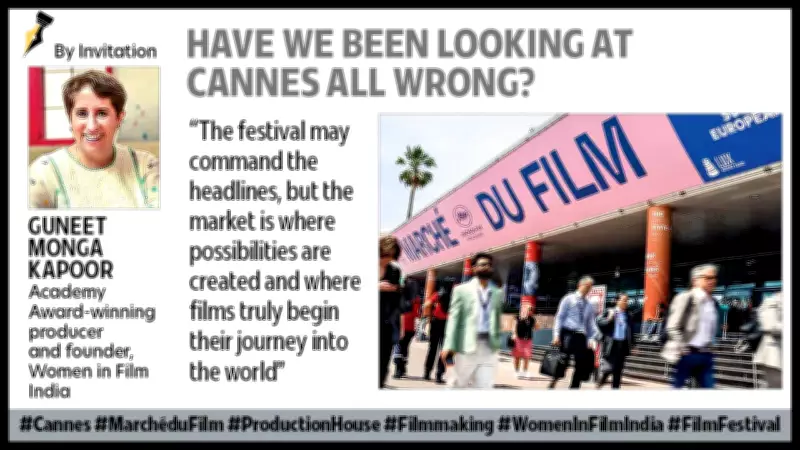
For those who have never been to Cannes, imagine a road by the beach in Juhu or Versova, Mumbai, a long stretch buzzing with activity. Now imagine that same road transformed into the epicentre of the global film industry for ten days. At Cannes, you walk constantly, between screenings, meetings, markets, and events. It is a fitting metaphor for the journey itself: you walk for years, building relationships and credibility, so that one day your films can run. That is Cannes.
It is a place where filmmakers, producers, distributors, sales agents, festival programmers, financiers, and industry stalwarts from across the world converge in one compact space. You are not just there to pitch your project; you are there to shape its future, finding collaborators, planning its festival journey, discovering opportunities, and building connections that can last a lifetime. Few places bring together so much cinematic ambition, talent, and possibility under one roof, or rather, along one strip of land.
This year marked my 15th year attending Cannes. As I walked through the city, I found myself revisiting the places that have defined my journey there: the cafes where deals were first discussed, the meeting spots that led to lasting collaborations, and the theatres that hosted premieres of films that went on to become milestones in Indian cinema, including The Lunchbox, Gangs of Wasseypur, and Masaan. For almost two decades in the film industry, I have lived by instinct, courage, and a lot of hustle. Finding my way through spaces I had once only dreamed of entering, and slowly realising that sometimes the most powerful thing you can do is stop waiting for a seat at the table and build your own. That idea stayed with me for years. I have learned that talent was never the problem for women in cinema. Access was. Networks were. Exposure was.

Perhaps the most meaningful shift has been moving from navigating these rooms myself to helping others enter them. Through Women in Film India, we have been building bridges between Indian women filmmakers and the global film ecosystem, supporting three women at Cannes last year and four this year, creating opportunities for the kind of access and networks that can change the trajectory of a career. This year, for the first time, two Indian women, out of just ten participants selected globally, were chosen to attend the impACT Lab at the Marché du Film in Cannes. Through a nationwide search conducted by Women in Film India, we were proud to support their journey to Cannes. In addition, two more Indian women producers were selected to participate in the prestigious Producers Network programme, further strengthening the presence of Indian women filmmakers and producers on one of the world's most influential film industry platforms. Not as guests, and definitely not as plus-ones. They walked in as scholars, selected through a national open call, evaluated by an industry jury, and sent there with the specific purpose of learning how the global film market actually works. They sat in rooms alongside filmmakers from across the world, participating in conversations that most Indian filmmakers never get access to at all.
That is the Cannes I come to every year. The one in the photographs is a different place entirely. Over the years, I have realised that Cannes is often misunderstood as a place of screenings, red carpets, and parties. While all of that exists, the real value of Cannes lies elsewhere. It lies in the possibility of a conversation. It is one of the few places in the world where every stakeholder in the film ecosystem comes together in one concentrated space. What matters is having the courage to walk up to someone, introduce yourself, share an idea, and begin a conversation. A single meeting can lead to a co-production partner, a festival strategy, financing support, international distribution, or a creative collaborator who stays with your project for years. For independent filmmakers, especially, Cannes opens doors that may otherwise remain inaccessible. It is a place where films find advocates, where international partnerships are formed, and where entire futures can be shaped through a chance introduction. The connections you make there often outlast the festival itself and continue to influence your work for years to come.

The festival may command the headlines, but the market is where possibilities are created and where films truly begin their journey into the world. India makes more films than almost any other country on earth, and yet our presence in these rooms remains disproportionately small. The reason is structural. Cannes operates on relationships built over years, on institutional backing, and on a deep understanding of how the global film ecosystem functions. Think about what it takes to build that kind of presence. France has spent decades negotiating bilateral co-production treaties, funding international distribution, and maintaining a permanent infrastructure at Cannes that works on behalf of its filmmakers every single year.
If India is serious about strengthening its place in these global conversations, there is much to learn from countries that have approached international markets strategically. South Korea offers the clearest example. At this year's Cannes, the Korean Film Council's KO-PICK programme placed Korean producers directly within the Producers Network, backed by government funding, structured market access, and long-term international relationships. This is the result of decades of strategic investment, not just in producing films, but in ensuring those films have pathways to travel, find partners, and compete globally. The lesson is not that India should replicate Korea's model exactly, but that global success is rarely accidental. It is built through sustained participation, institutional support, and a commitment to creating opportunities for filmmakers beyond national borders. India's support for independent cinema on the international stage is still evolving, but if we want our stories to travel further, we must invest not only in making films but also in building the networks, partnerships, and market presence that allow them to thrive internationally.
Co-productions fundamentally expand what is possible for a film. They unlock access to international financing, public funds, distribution networks, and long-term partnerships that are often unavailable to purely domestic productions. For a country with extraordinary stories and filmmaking talent, India's next challenge is building the infrastructure around that talent: the market relationships, institutional support, and global presence that enable films to travel. Every producer who enters spaces like the impACT Lab or the Producers Network contributes to building that ecosystem, one conversation, partnership, and opportunity at a time. The future of Indian cinema on the global stage will require filmmakers and producers to view Cannes not as a destination, but as an ongoing investment in their work. It means saving up to be there year after year, preparing months in advance, setting up meetings before boarding a flight, attending networking events with purpose, following up relentlessly, and understanding what international partners, programmers, and financiers are looking for rather than simply asking them to look at our projects. The opportunity is already there. The stories are certainly there. The talent has never been in question. What remains is our willingness as an industry to engage with the global ecosystem strategically, patiently, and collectively. If we do that consistently, the next decade of Indian cinema will not just be about taking films to the world; it will be about helping shape the future of world cinema itself.
And then there is the magic of Cannes that no schedule can account for. One of our scholars casually ran into Pedro Almodóvar. I found myself crossing paths with Pan Nalin, whom I had interned with nearly twenty years ago. That is the thing about Cannes: every step of the way, you run into people you have admired for years, and people who may become part of your journey in the years ahead. The distance between a chance encounter and a life-changing opportunity can sometimes be just a few steps. At Cannes, you never really know what might happen next, and that is precisely what keeps people coming back.