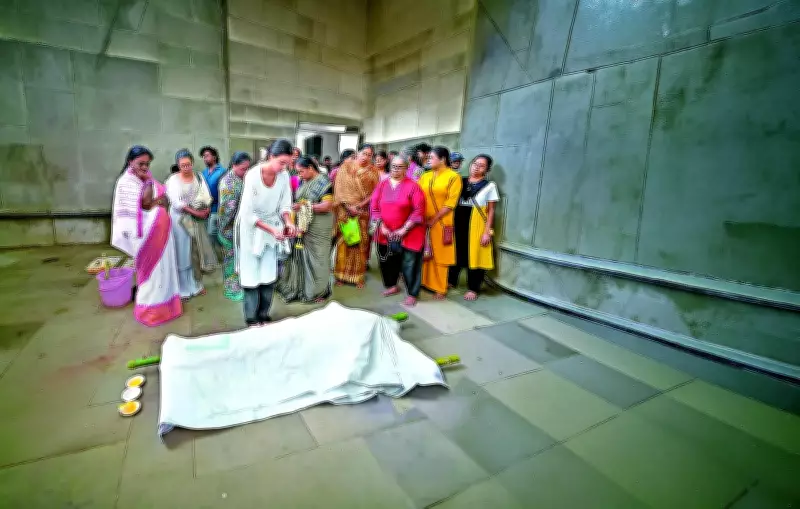
In death, as in life, some families continue to make a statement. When Esha Lankesh performed the final rites of her grandmother, Indira Lankesh, at Bengaluru's Banashankari Crematorium on Tuesday, the act included no speeches, slogans or declarations. Yet it spoke volumes. In a society where funeral rituals are still overwhelmingly viewed as a male responsibility, Esha's presence at the centre of the ceremony challenged a convention that many continue to accept without question.
A Conscious Choice, Not Necessity
The significance of the moment lies not merely in the fact that a granddaughter performed the last rites. It lies in the fact that she did so despite the presence of male heirs in the family. The decision was not born out of necessity. It was a choice.
For generations across communities in India, the right and responsibility to perform funeral rites have largely been passed down through men. Sons light the pyre. Grandsons carry forward the lineage. Women mourn, participate and grieve, but are often relegated to the margins of the final ritual. While these practices have evolved in many urban and progressive households, they continue to carry considerable social weight.

The Lankesh Family Legacy
The Lankesh family, however, has rarely been one to follow a script written by others. Indira was married to the late writer, journalist and filmmaker P Lankesh, whose work challenged political and social orthodoxies. Their daughter, Gauri Lankesh, became a powerful voice against communalism and injustice, paying the ultimate price for her convictions when she was assassinated outside her Bengaluru home in 2017. Daughter Kavitha Lankesh and son Indrajit Lankesh have each, in their own ways, embraced lives that reflect independence of thought and expression.
Seen in that context, Esha's role in her grandmother's final rites does not appear as an isolated act. It feels like the continuation of a family tradition — one that places personal conviction above inherited expectations.
Irony and Reform
There is also a deeper irony worth reflecting on. The family belongs to a community, whose origins lie in the teachings of the 12th-century social reformer Basavanna. His philosophy rejected rigid hierarchies and championed equality, dignity and social reform. Yet, like many communities, traditional practices around death and inheritance often remained shaped by patriarchal norms.
By choosing Esha to lead the rituals, the family appears to have embraced the reformist spirit rather than the restrictive custom. Importantly, this was not a symbolic gesture performed for public approval. It was a deeply personal act of love and responsibility. A granddaughter saying goodbye to a grandmother. A family honouring someone in a manner that reflected her values rather than society's expectations.
A Resonant Moment
That is what makes the moment resonate beyond the boundaries of one family. At a time when conversations around gender equality often become polarised, Esha's act offered a simple but powerful reminder: equality is not always restricted to public debates and protests. Sometimes it is reflected in the choices families make in their most intimate moments.
Read the latest Entertainment News and Celebrity updates. Download the TOI App.