Every year, as the world celebrates the anniversary of literary giant Rabindranath Tagore, it becomes essential to revisit the origins of his writings. What triggered the poetic genius in him? Who first encouraged him to hone his writing skills? The answer lies in a special woman who became his confidante and muse: his sister-in-law Kadambari, married to his elder brother but closer to him in age and temperament.
A hauntingly beautiful Kathak dance drama explores their deeply layered relationship, marked by fragile intersections of companionship, creativity, loneliness, and eternal remembrance. Through evocative abhinaya, poetry, music, and movement, the performance journeys into the emotional world of Kadambari, whose presence left an indelible imprint on Tagore’s life and literature.
What is often viewed as a controversial relationship, Kathak guru Shovana Narayan has tried to sift through the surrounding noise to understand its core essence. She assembled a team of researchers, writers, and artists to create the dance drama titled “Kadambari – The Poet’s Muse”. It pays tribute to a friendship that catalyzed the birth of a poet, for which the world should be grateful.

For Guru Shovana Narayan, the production emerges from a lifelong engagement with Tagore’s literary and philosophical universe. “I have been deeply influenced by Rabindra Sangeet and Indian classical traditions, and my artistic journey has consistently revisited Tagore’s works. This evoked a natural interest in his life. The mysterious Kadambari fascinated me immensely and culminated in this dance enactment,” she said.
Dhiraj Singh, who plays the main role of Rabindranath Tagore, shares his experience: “Playing the young ‘Rabi’ (Rabindranath Tagore) was a remarkable experience because Tagore for me is a limitless artist—he was a poet, composer, painter, thinker all rolled into one. Shovana ji too is like that, and it’s to her credit how she made me—a non-dancer—part of this beautiful dance drama.” Singh, himself an artist, writer, filmmaker, and educator, feels elated with the honor.
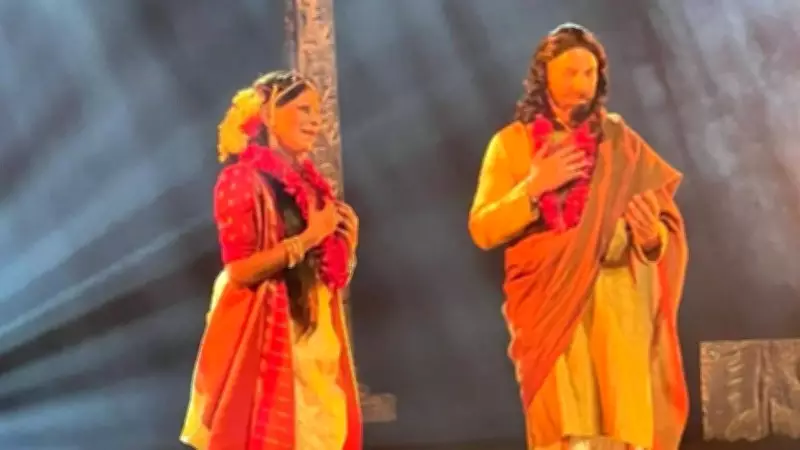
The stage imagery moves between memory and melancholy: Kadambari draped in luminous red, suspended between devotion and despair; Robi (Tagore) portrayed as the restless poet whose words initially struggled to fully articulate his feelings. The performances reflect on how Kadambari’s silent suffering and emotional companionship shaped the young Robi’s imagination, leaving behind echoes that would later permeate his poetry, songs, and writings.
At her passing away, in Tagore’s words, the dance drama underscores the depth of his loss: “She, my Queen, has died and my world has shut against the door of its inner apartment of beauty which gives the real taste of freedom.”