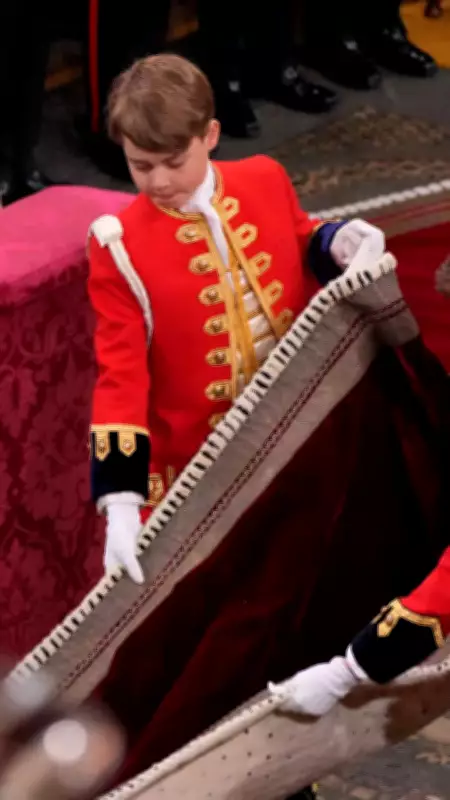
The Coronation of King Charles III drew global attention to the Crown Jewels, ancient rites, and the weight of history. However, one of the most intriguing stories unfolding within Westminster Abbey involved a young nine-year-old prince actively participating in the ceremony itself. Prince George was not merely a spectator at his grandfather's crowning; he was a participant.
In the weeks leading up to the Coronation, it was announced that George would serve as one of his grandfather's Pages of Honour. This ceremonial role required him to walk in the procession and assist with ceremonial duties during parts of the service, granting him one of his most prominent public roles to date. Reportedly, George's inclusion was considered a significant honour and marked a milestone in his public life. He was not just a grandchild but an active part of one of the United Kingdom's most important constitutional ceremonies.
Far More Than a Ceremonial Appearance
The role was seemingly more than just an ornamental appearance in the ceremony. It had a specific purpose, after all. According to ABC News, the Pages of Honour accompanied the King through parts of the service and helped carry his ceremonial robes during the Coronation. While the task itself was straightforward, it formed part of a carefully choreographed ceremony where timing and precision mattered. This difference in approach altered the context of Prince George's appearance. He was not a peripheral observer nor briefly paraded before cameras before retreating from the proceedings. Instead, he was entrusted with a duty within a centuries-old ceremony, a vital part of the Coronation event. For royal watchers, that alone made the moment notable.

The Detail Many Focused On
It was not an extraordinary act or a dramatic expression; rather, it was that George treated the task as a duty rather than a photo opportunity. Throughout the service, he continued in the formal procession and carried out the duties required by his position with no visible attempt to draw attention to himself or to breach the solemn tone of the proceedings. Such a feat cannot be overstated in the context in which it occurred. Coronations are events viewed by millions around the world, and every tiny movement is meticulously captured and scrutinised by cameras and commentators alike. It is difficult to conceive of the pressure even for a child. George's quiet effect stemmed from his ability to blend in with the proceedings while simultaneously undertaking a duty of public importance, a clear sign of composure during a highly scrutinised public event.
A Glimpse Into the Future
The Coronation was also a landmark moment for visualising the future of the Monarchy. Inside Westminster Abbey were three generations linked by succession: King Charles III, the reigning monarch; Prince William, the heir to the throne; and Prince George, who stands second in line. George, performing as one of his grandfather's Pages of Honour, forged another tangible link in this chain of succession. His presence allowed him to observe the ceremony from the inside at close quarters and to learn about its traditions firsthand. The monarchy places significant emphasis on tradition and continuity. The ceremonies that surround royal life serve to emphasise not only the figurehead of the present day but the continuity and permanence of the institution. George's participation was significant for this reason beyond the mere carrying out of his ceremonial duties.

Growing Up in Public
Unlike most children, Prince George's development and early milestones are largely witnessed by a global audience. From his first day of school to public visits and royal events, he has barely known a moment of his life without media scrutiny. Coronations can be different, though; rather than being solely an observer, George was a participant, and it was a milestone from which he grew and learned. Reportedly, eyes were keenly fixed upon George in the run-up to the Coronation due to his role as future King. That attention was understandable, as many tuned in to watch the King crowned and many followed the young prince in particular. What we watched was not some dramatic display of childlike emotion but something quite different: a young child following instructions and completing the task assigned with precision and calm. It is ultimately this that made the duty so memorable. The robes he carried may have belonged to an ancient tradition; the ceremony drew on traditions that stretch back more than a thousand years, yet it is the relatively simple sight of a young prince, still years away from his majority, walking through Westminster Abbey with something he needed to do that has captured imagination. Ultimately, in the case of royal affairs, the smallest roles can often highlight more about the one to come.