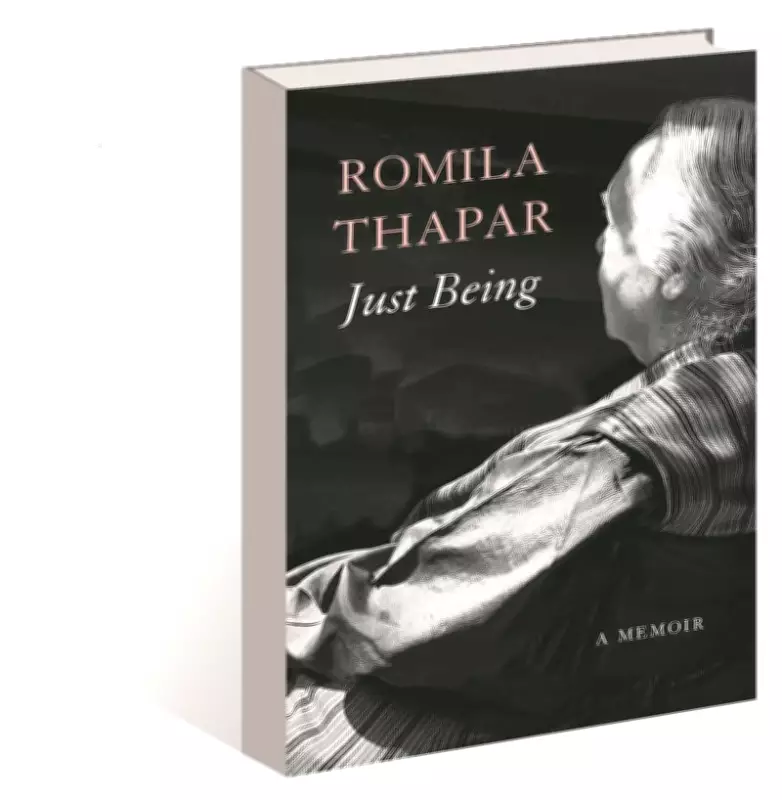
Romila Thapar, India's most distinguished historian and public intellectual, has published her memoir 'Just Being' at the age of 94. The book, published by Seagull Books, spans 710 pages and offers an extremely rich account of an extremely rich life.
A Life of Scholarship and Independence
Thapar has spent six decades researching ancient Indian history, training generations of students, and subjecting Indian society to rigorous rational scrutiny. She has consciously shunned official rewards, turning down the Padma Bhushan twice to maintain her independence as a scholar. Her work has earned her both a large community of admirers and a group of visceral haters, including ire from governments and right-wing organizations.
According to the review by Salil Misra, visiting faculty at BML Munjal University, Thapar is a nationalist who dreams of an affluent, democratic, secular, and egalitarian India. Her memoir, 'Just Being', is the culmination of a life dedicated to making India's past and present intelligible to Indians and outsiders.

Early Life and Influences
Thapar grew up in cosmopolitan military enclaves in Lahore and Pune, where she encountered Muslims, Parsis, Christians, and Anglo-Indians from upper-middle-class backgrounds. Her father, a doctor in the army, sparked her interest in ancient Indian history after a trip to South India. He shared his readings with his 14-year-old daughter, prompting her to learn Sanskrit during a six-month break from school.
On August 15, 1947, Thapar was asked to unfurl the national flag and give a speech. She raised two questions: 'What are the roots of our basic identity as Indians?' and 'In which direction are we likely to go?' These questions set the agenda for her intellectual life, forming the axis around which her research revolves.
Nationalism and Universalism
Thapar became a nationalist and universalist during her trips to England, where she observed that Indian history was a prisoner to European knowledge. Colonial representations claimed Indians lacked a sense of history, which Thapar disproved by demonstrating that ancient Indian texts, both Brahmanical and Buddhist, contained a clear sense of history embedded in ways not intelligible to colonial scholarship.
She devoted much of her research to rescuing Indian history from colonial knowledge and Eurocentric blinkers. When she joined Jawaharlal Nehru University (JNU) in 1970, she helped create a new curriculum for the proper study of Indian history.
Crusader Against Politicized History
Thapar's second mission has been to rescue Indian history from prejudiced and politically motivated accounts. With the rise of identity politics, different stakeholders have vested interests in how the past is perceived. Leaders of political Hinduism have loaded history with prejudices and motives to suit their politics.
Thapar has been an active crusader for scientific history based on data and valid interpretation. She has produced historical knowledge on themes such as the homeland of the Aryans, their diet, the role of internal dissent in Hinduism, and the destruction of the Somnath temple, putting it in the public domain. This has antagonized many, but she remains undeterred.
A Reflection of the Nation
Thapar's lived life mirrors the life of the nation. As she moved from adolescence to youth, India transitioned from a colony to a sovereign republic. She made promises to herself just as the young nation made promises to itself. The reviewer notes that the Indian nation has failed to live up to those promises.
'Just Being' offers glimpses of how Thapar looks upon the nation and her own life. She has lived with grace and dignity, and the same grace characterizes her memoir. It is an extremely rich account of an extremely rich life.